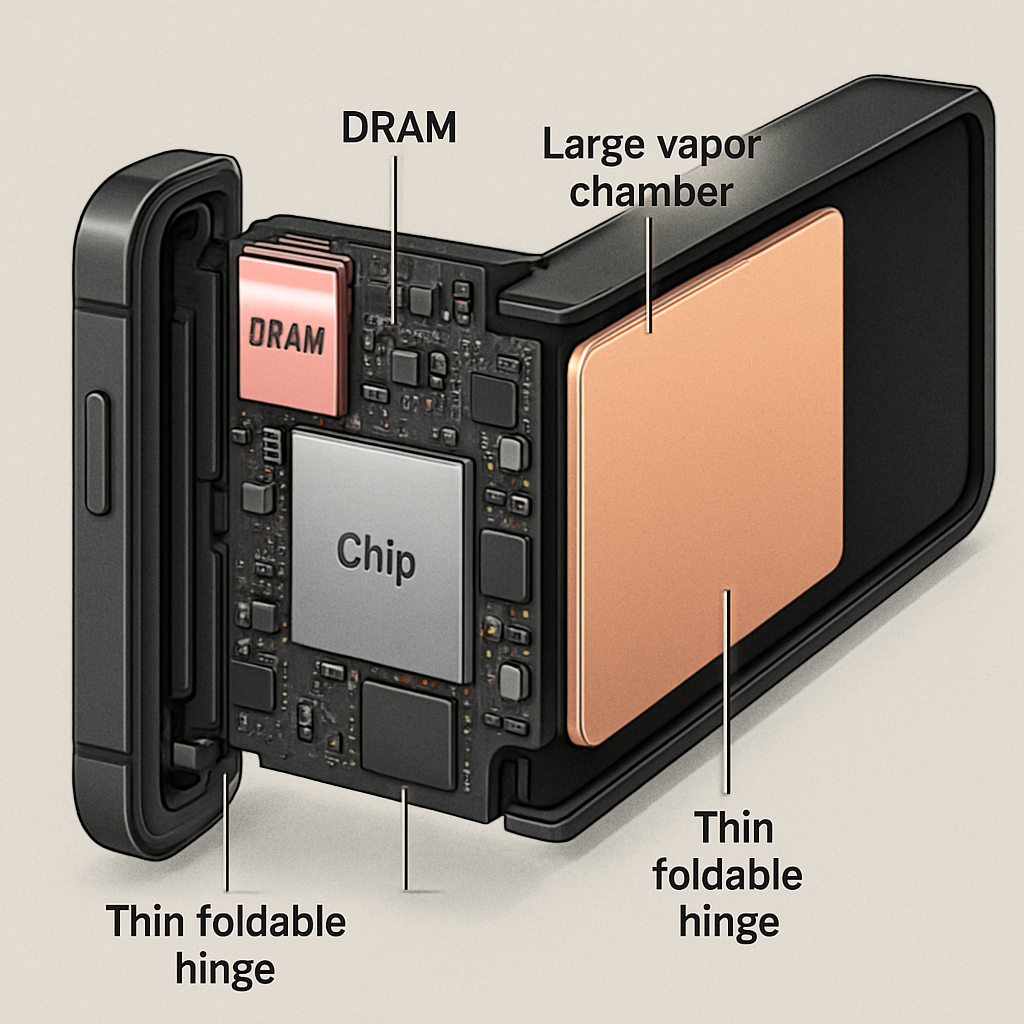
Apple’s new iPhone Duo packs the A20 Pro chip, bringing what Apple claims is desktop-class performance to its first-ever foldable phone. Hitting that level of sustained power required more than just a build on a 2nm process—Apple had to rethink nearly every element of the Duo’s internal cooling. Here’s how those engineering innovations work together to push the limits of mobile performance.
Shifting Memory to the Side: Less Heat, More Efficiency
Traditional phones used “package-on-package” (PoP) construction, where the chip and DRAM stack vertically—placing the memory directly on top of the processor. While this saves motherboard space, it traps heat and makes it harder to cool the chip. To solve that, Apple adopted a layout inspired by its M-series chips and moved the DRAM beside the chip instead of above it—what analysts refer to as a wafer-level multi-chip module (WMCM) design. This change lets heat escape more directly into the cooling system, reducing thermal bottlenecks.
Redesigned Cooling Path: Four Pillars Keeping Things Cool
To handle the extra heat generated by higher sustained performance, Apple introduced several thermal upgrades—each built to address a specific heat path issue. The first is direct silicon access to the cooling hardware, meaning the processor is connected straight to the vapor chamber without DRAM blocking the path. The second is what Apple describes as a “metal over foam” layer—a thermally compliant interface between the vapor chamber and the chip that helps bridge gaps and improve heat transfer.
Third, Apple’s vapor chamber itself has been beefed up. It now has three times the surface area of earlier designs, and carries more de-ionized water to allow vapor to move and redistribute heat more efficiently. Fourth, a new back-of-display thermal layer—a nanotube copper display metal plate—has been added. It doubles as a structural reinforcement for the display and also shuttles heat away faster.
Putting It All Together: A20 Pro and Duo’s Performance Gains
The A20 Pro, shipping in both iPhone 18 Pro and iPhone Duo, includes these design changes. It’s built with 6 CPU cores (two “super” cores and four efficiency cores), a 7-core GPU, and dual 16-core Neural Engines—supporting higher AI workloads while packing more sustained power than previous generations. Apple claims around 40% better sustained performance over the A19 Pro and significantly more over older chips.
For the Duo specifically, these thermal upgrades help offset what’s lost in the design: folding phones have hinges and layered screens that tend to trap heat. The upgraded vapor chamber, improved packaging design (moving the memory off the processor’s heat path), and the supporting layers behind the display all converge to give the Duo performance closer to a laptop than typical smartphones.
Apple’s balancing act here matters: pushing performance without letting the phone overheat or throttle too early. It’s not just about top speeds in benchmark tests—it’s the kind of performance you can sustain while playing graphics-intensive games, editing video, or using local AI models over longer periods. These design choices also set a foundation for how foldables might evolve—thinner, more capable, and more durable.