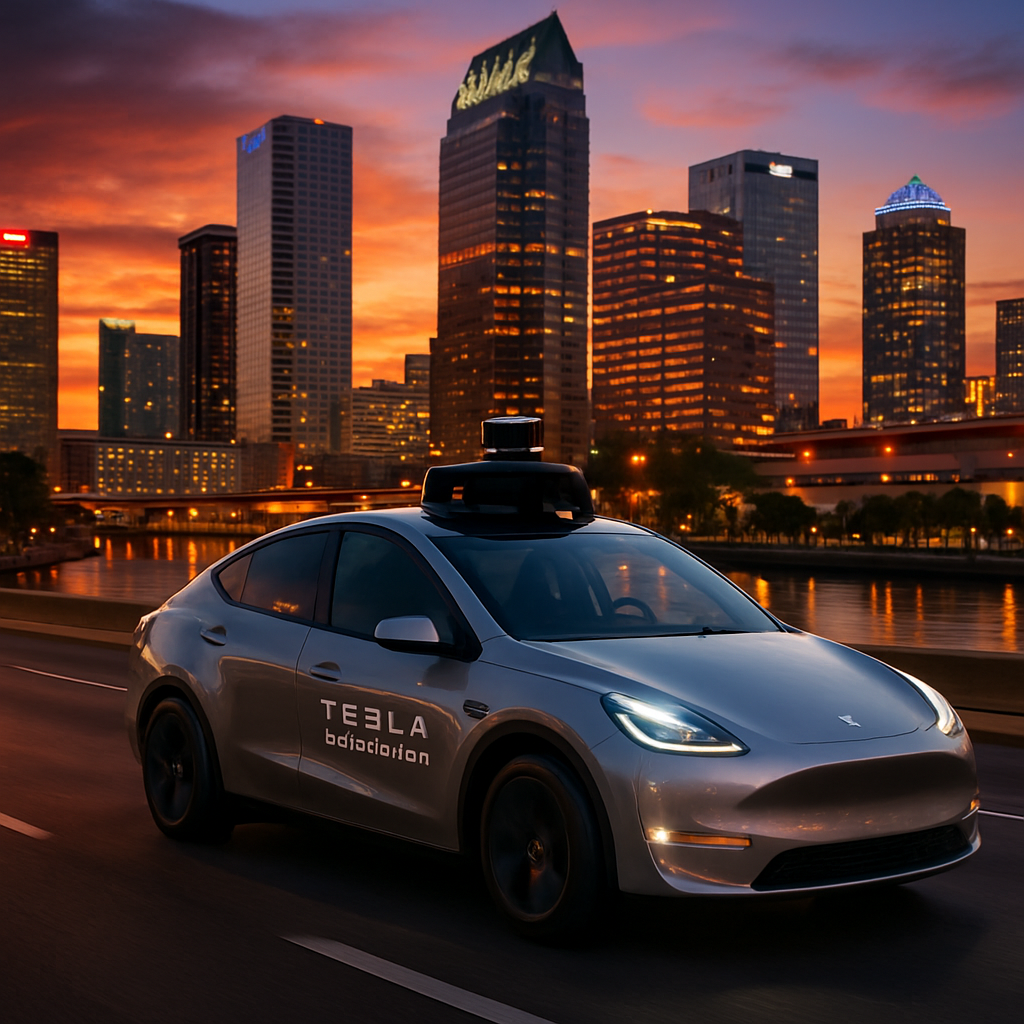
Tesla has expanded its autonomous ride-hailing service, Robotaxi, to include Orlando and Tampa, Florida. This development follows the company’s recent launch in Miami, marking a rapid expansion within the state. The announcement was made via Tesla’s official Robotaxi account on X, stating, “Robotaxi now in Tampa & Orlando!”
The initial service areas in both cities are limited. In Tampa, the Robotaxi operates primarily in the downtown region, extending into neighborhoods such as Ybor City, Tampa Heights, West Tampa, and parts of East Tampa. Notably, the service does not yet cover Tampa International Airport, South Tampa, or most suburban areas. Similarly, the Orlando service area encompasses a small section of southwestern Orlando. Tesla has not disclosed the number of vehicles deployed in these cities or provided a timeline for future expansion.
This expansion comes just ahead of Tesla’s second-quarter earnings report, scheduled for July 22. The company’s autonomous ride-hailing service is a significant component of its valuation, as CEO Elon Musk shifts focus toward artificial intelligence, autonomous driving, and humanoid robots. Investors are closely monitoring the progress of the Robotaxi service, especially given Tesla’s cautious approach to its rollout. Musk has emphasized that rigorous safety testing is the primary constraint to faster deployment.
Unlike competitors such as Alphabet-owned Waymo, which utilizes lidar sensors, Tesla’s Robotaxi system relies on cameras and AI-based software for navigation. The company plans to eventually introduce its purpose-built Cybercab vehicle, designed without pedals or a steering wheel, to the Robotaxi fleet.
In the broader context, Tesla’s rapid expansion of its Robotaxi service in Florida underscores the company’s commitment to scaling its autonomous ride-hailing operations. However, the limited initial service areas and the absence of the Cybercab highlight the challenges inherent in deploying such technology. As Tesla continues to navigate regulatory and safety hurdles, the success of these pilot programs will be crucial in determining the viability and future growth of its autonomous services.