Ron Johnson’s new book, co-written with Zander Nethercutt, provides an inside look at the early days of Apple retail, revealing how and why the iconic Apple Store model was born. “Shop Different: How Retail Revealed Apple’s Genius” retraces Johnson’s journey from an experienced retailer to the visionary behind Apple’s physical stores—under the watchful eye of Steve Jobs. With Apple now wrapping up a five-year plan to open or remodel about 50 stores world-wide—roughly 10% of its global retail footprint—this narrative comes at a timely moment. The company’s retail arm remains one of its most successful ventures, nearly 25 years in.
What Led to Apple Stores
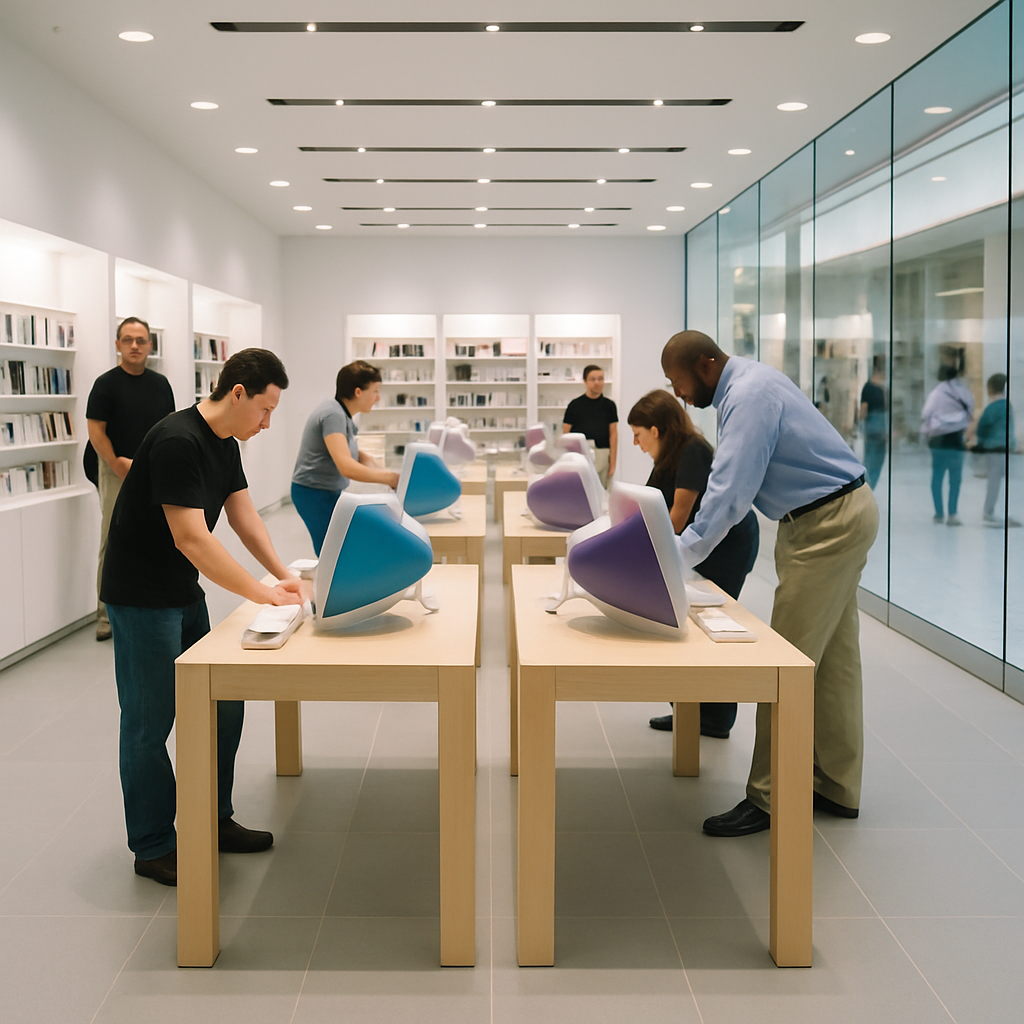
At the time, Apple’s challenge was visibility and control. Though the iMac was a big hit, the company’s products had to compete for attention in Best Buy and other third-party retailers, where shelf space was limited and shelf-placement motivated more by price than by quality or brand. The story goes that Jobs personally approached Johnson to help solve the problem. Their solution went far beyond simply selling products—Apple Stores were designed to let people try Macs firsthand, transforming the retail environment from transactional displays to interactive showrooms. The goal wasn’t to out-discount competitors but to create immersive, destination-style spaces where product use, not persuasion, took center stage.
The design of Apple Stores also featured customer-focused service, notably the Genius Bar, which provided free support—an improvisation compared to paid Apple Specialist services in third-party stores. This, along with the layout, aesthetic, and overall customer experience, emphasized connection, discovery, and education over hard-selling.
Where ‘Shop Different’ Falls Short
Despite its strengths in telling the origin story, the book has its limitations. Johnson takes on the vanguard role decisively but doesn’t cover the competitive fallout comprehensively. There’s almost no exploration of how Microsoft attempted its own retail model, how Gateway’s stores failed, or why Apple’s mid-2000s imitators didn’t succeed. Key successors in Apple retail leadership—such as John Browett or Angela Ahrendts—receive little more than passing mention, even though their tenures shaped the stores’ evolution after Johnson’s departure in 2011. The book also diverges toward more general business reflections in its epilogue, which some readers may find feeling disconnected from the core narrative.
Overall, “Shop Different” is rich with the details of that formative era—Johnson’s retail instincts, the gamble on aesthetic and experiential design, and Jobs’ insistence on perfection. But it leaves gaps in examining what came next and how competitors tried—yet ultimately failed—to replicate Apple’s retail magic.
Rating: 3.5 stars
Pros:
- Unparalleled insider perspective on a pivotal moment in Apple history
- View from a retailer’s mindset, not just a technologist’s
- Explains the rationale behind the bold investment in physical stores
Cons:
- Lacks coverage of Apple’s retail leadership post-Johnson
- No detailed account of rival retail experiments
- Epilogue shifts into general business territory, away from Apple history
The book is available in hardback at $45, with online retailers listing it closer to $32 as of its release date, September 22, 2026.
Why It Matters
Apple’s decision to invest heavily in owning retail space—both physical stores and the brand experience they offer—helped redefine customer expectations for tech retail. The design choices made then influenced a generation of store architecture and brand behavior. “Shop Different” shows how those early risks were not merely about sales but identity. Apple wasn’t just selling computers; it was selling confidence, quality, immersion. In a time when digital sales dominate, the book reminds us that physical presence still holds power if designed with intention.
For those interested in Apple’s origin myths, retail strategy, or how innovation extends beyond product lines, this is a must-read. But readers seeking a complete chain from Apple’s early 2000s rise through the present era may feel the narrative stops just as things get really interesting.