Google has officially unveiled a new platform that lets developers integrate their apps much more directly into its AI-powered services, notably Gemini and Search. The so-called Connected Apps Platform—now in public preview in the U.S.—allows third-party businesses to build and submit apps that users can access and use without leaving Google’s own tools. The move signals Google’s bet on the “agentic web” model, where your favorite services live inside AI assistants rather than as standalone apps.
What’s the Connected Apps Platform?
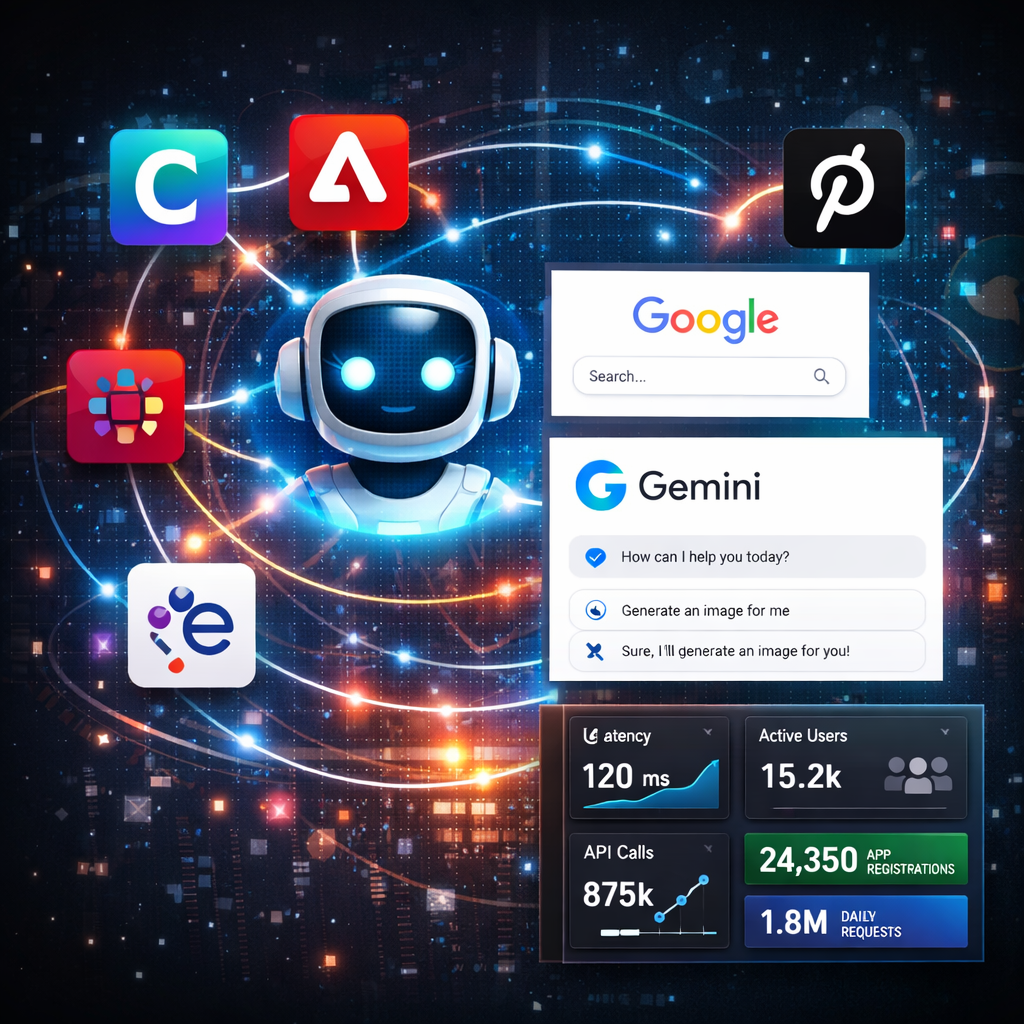
The Connected Apps Platform makes it possible for developers to link their apps to Google’s AI features, enabling actions like designing with Canva, creating playlists via YouTube Music, or ordering groceries—all inside Gemini or Search. Apps communicate with Google’s systems using the Model Context Protocol (MCP) server or via Android MCP (AppFunctions APIs), depending on whether they’re being used on client devices or across platforms. Developers also get access to tools for managing and monitoring their integrations—things like traffic, latency, error rates, and preserving their branding via verified logos and accounts.
The preview is currently limited to U.S.-based developers who can sign up for a waitlist. Google hasn’t yet revealed when its broader rollout to other regions will begin.
Current & Upcoming Integrations
Already, more than 50 apps are connected to Gemini, ranging from Adobe and Peloton to Experian and Localiza. Over the next few weeks, many of those apps will also become available in Google Search. Search currently supports fewer connected integrations, but partners include Instacart, Canva, YouTube Music, Yahoo Fantasy Football, and others. Additionally, the meditation app Calm has been confirmed as a new participant in the Connected Apps effort—set to launch across both Gemini and Search.
The range of connected apps spans several categories: productivity and creativity (e.g., Adobe, Squarespace, Webflow), lifestyle and events (SeatGeek, Localiza), health and fitness, and more. Users can often invoke these tools inside Gemini by using “@
Why It Matters
This development could reshape how people interact with AI and apps. As tools like Gemini become hubs for doing things directly—rather than sending users out to separate apps—it changes the balance of power toward integrated AI services. In effect, Google is offering a new layer of visibility for developers—not unlike SEO once did for websites—where being integrated with Gemini/Search can drive engagement directly inside Google’s AI environments.
At the same time, this raises questions about privacy, control, and regional availability. Users (and developers) will need to keep track of which features are supported in which locations, and what data access each app requires.
As AI agents increasingly reshape how we engage with digital services, Google’s Connected Apps Platform is a major step in making that future feel more seamless. What to watch next: how quickly apps roll out globally, how deeply these integrations compete with standalone apps, and how Google balances convenience with transparency and user control.
Analytical takeaway: Google’s move reflects a deeper shift toward AI becoming the operating layer of the web. By opening up integrations to more developers, Google not only accelerates adoption of its agent-centric architecture but also stakes a claim in where users spend their time—inside AI agents rather than discrete apps. The success of this effort will depend on breadth of apps, transparency on data usage, and how intuitively users can manage permissions and multi-app workflows. This is a critical moment that may define how agencies trade off control for convenience in the AI era.