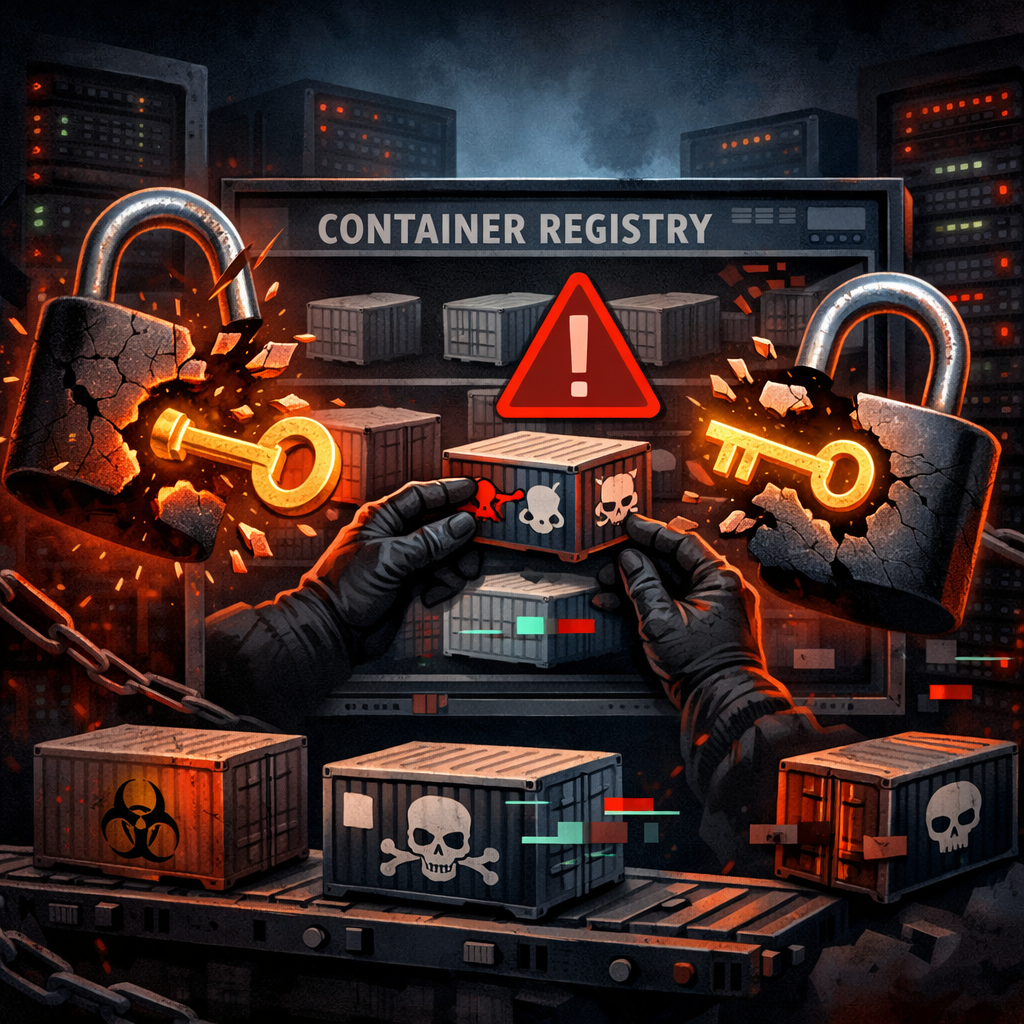
Red Hat has disclosed a critical vulnerability in its Quay enterprise container registry product that lets unauthenticated attackers completely take over registry images. Tracked as CVE-2026-123710, the flaw carries a 9.8 CVSS rating and was officially published on November 11, 2026. It affects both Quay 3 and Quay 5 deployments. In short, an attacker who can reach a registry’s key server can hijack its token signing mechanism.
What the Vulnerability Enables
The issue lies in the way Quay’s service key server handles key rotation requests. Under certain configurations—namely when FEATURE_ANONYMOUS_ACCESS is enabled—a token issued via the /v2/auth endpoint bypasses critical validation. The server checks for correct issuer and audience via a JWT signed with an approved key, but it does not verify whether the token was intended to authorize key rotation. Because the audience parameter is controllable by the client, an anonymous user can effectively use this gap to rotate any service key.
Once the attacker provides their own public key via the /keys endpoint, the system grants it the same privileges as the legitimate key—without expiring it. Red Hat Quay will then regard this malicious key as trusted immediately. From there, the attacker gains full read and write access: stealing private containers, replacing image tags, and injecting poisoned images. Any build process relying on image pulls could be compromised.
Scope & Mitigation
Only installations where /keys can be accessed by untrusted clients are vulnerable. Most notably, those with anonymous access enabled. The vulnerability has been present since Quay’s earliest public code.
Red Hat recommends immediate interim fixes while waiting for a patched release: restrict access to the /keys endpoint using proxies or load balancers so only trusted services can reach it; audit service_key_rotate and service_key_delete events with null expiry dates; and remove any unfamiliar service keys. Deleting malicious keys alone won’t fully solve the problem unless access restrictions are enforced—that endpoint must not remain exposed.
Even so, a fully patched version was not available at the time of disclosure. Red Hat advises all users deploying Quay versions 3 or 5 to monitor security advisories closely and apply the fix once released.
Why This Matters
Container registries like Red Hat Quay are at the heart of modern software delivery pipelines. They store images used for production systems, often containing sensitive data or secrets. If an attacker hijacks signing keys, the risk isn’t just leaking images—it’s poisoning trusted containers, enabling supply chain attacks, and undermining confidence in build integrity.
No evidence of exploitation in the wild or public exploit code has emerged yet. But the exploit path is straightforward and severe enough that defenders need to treat this as urgent.
Analytical view:This flaw illustrates how allowing anonymous access—even intended for benign use—can introduce systemic risk. It underscores the need for defense-in-depth: not just patching, but isolating endpoints, enforcing least privilege, and monitoring operations. As Quay’s case shows, a single misconfigured endpoint can unleash compromise of the whole registry—and by extension, the entire software ecosystem dependent on it. The broader lesson for organizations: treat registry security as foundational, not optional.