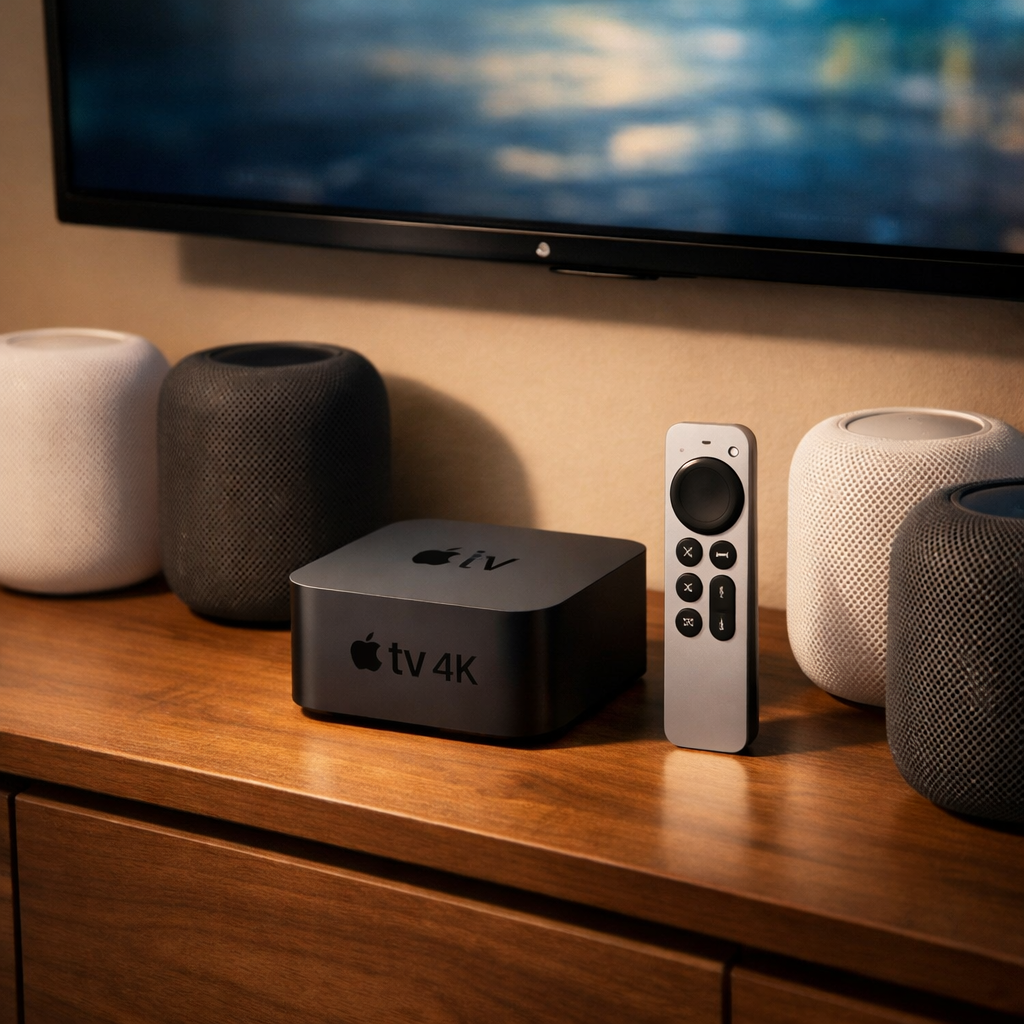
Apple’s refreshed Apple TV 4K arrives four years after its predecessor, boasting a slate of powerful upgrades—A19 chip, Wi-Fi 7, native AV1 decoding, and built-in microphones. But its steep price tag of $299 puts it far ahead of most competitors in the streaming box world in terms of cost. Do the features justify the cost? That’s what we explored.
Hardware and Performance Upgrades
The 2026 Apple TV 4K is visually unchanged—a glossy-edged matte puck in black survives from past generations. But under the hood, there’s a lot different. It comes with the A19 chip, which delivers up to 50% faster system speed, and its GPU offers twice the graphics performance of the previous model. For the first time, it can decode AV1 video natively—a big win for streaming services using the newer, more efficient codec.
Storage has also doubled: there’s now one configuration offering 128 GB of space and 8 GB of RAM. All units include gigabit Ethernet and support for Thread 1.4. Wireless connectivity jumps forward with Wi-Fi 7 and Bluetooth 6. The remote gets some wanted upgrades too—Precision Finding via Bluetooth 6’s Channel Sounding (not Ultra Wideband), and an audible chirp when the remote is misplaced, all without adding speaker holes.
Siri AI, Audio & Smart-Home Enhancements
One of the biggest additions is Siri AI: a version of Apple’s assistant that draws on personal information stored on your phone as well as broader world knowledge. With a supported iPhone on the same or recently connected Wi-Fi, Apple TV 4K can respond to questions that reference your messages, shows you watch, or even past interactions. For example, after watching a teaser on Apple TV+, Siri AI can pull up that trailer, identify actors, or update your watchlist. At launch the integration is limited to Apple’s own TV content, due to DRM constraints, but developer support could expand its reach.
On the audio front, the unit now supports surround sound using four HomePods (full-size or mini combinations). This delivers stronger spatial audio and true rear-speaker support. There’s also a Whole-Room Audio mode that broadcasts the same sound from every speaker—a helpful tweak for large or open spaces, or for times when you want uniform coverage across a room.
In its smart home role, the Apple TV 4K continues to serve as a hub for Apple Home and Thread networking. Performance gains with home-automation felt negligible during testing, but all core functionality remains solid, and its role as a Thread Border Router is intact.
Usability, Apps & Limitations
Apple’s remote gains refinements, but its design is mostly familiar. The touch-sensitive click wheel survives, along with standard playback, mute, and volume controls. Thanks to the new microphones, Siri can hear commands even when the TV is off—though finding the remote via voice still requires waking up the box first.
Gaming potential remains an area of disappointment. While Apple Arcade is available, there are still few major AAA titles on Apple TV. The new A19 chip should open doors for larger games, but none beyond indies have appeared yet. App support is also spotty. Profile integration across streaming services, alongside discovery features of the Apple TV app, are still limited. Netflix, for instance, does not yet support automatic profile selection or queue syncing with the Apple TV app.
Price, Value & Competition
The full price is $299. That’s much more than many competitors: the Google TV Streamer (with 4 GB RAM and 32 GB storage) sells for around $149, while high-end Fire tv devices go for about $199, but with weaker specs in storage, Wi-Fi, and networking. The price difference is partially explained by the upgraded components—storage costs have surged, the A19 is custom silicon, and Apple’s craftsmanship and regulatory compliance add cost.
When you use the device, experience is excellent. App launches, video startup, and all interactions feel significantly quicker. For viewers heavily invested in the Apple ecosystem—Home, TV+, HomePods—this amps up both utility and convenience. But for casual streamers or those using non-Apple service stacks, the premium may seem unjustified.
This Apple TV 4K is packed with high-end upgrades: modern codecs, improved audio, smarter Siri, and stronger networking. For power users in Apple’s world, it pulls ahead by a wide margin. But that $299 price point limits how many will find its value compelling—and gaps in third-party support, gaming, and recommendations still leave room for improvement. Whether it’s worth it depends heavily on how deeply you live inside Apple’s ecosystem, and whether the new features align with what you actually use. Regular streamer users will want to weigh what upgrades really matter—and whether competing devices might cover enough of their needs at far lower cost.