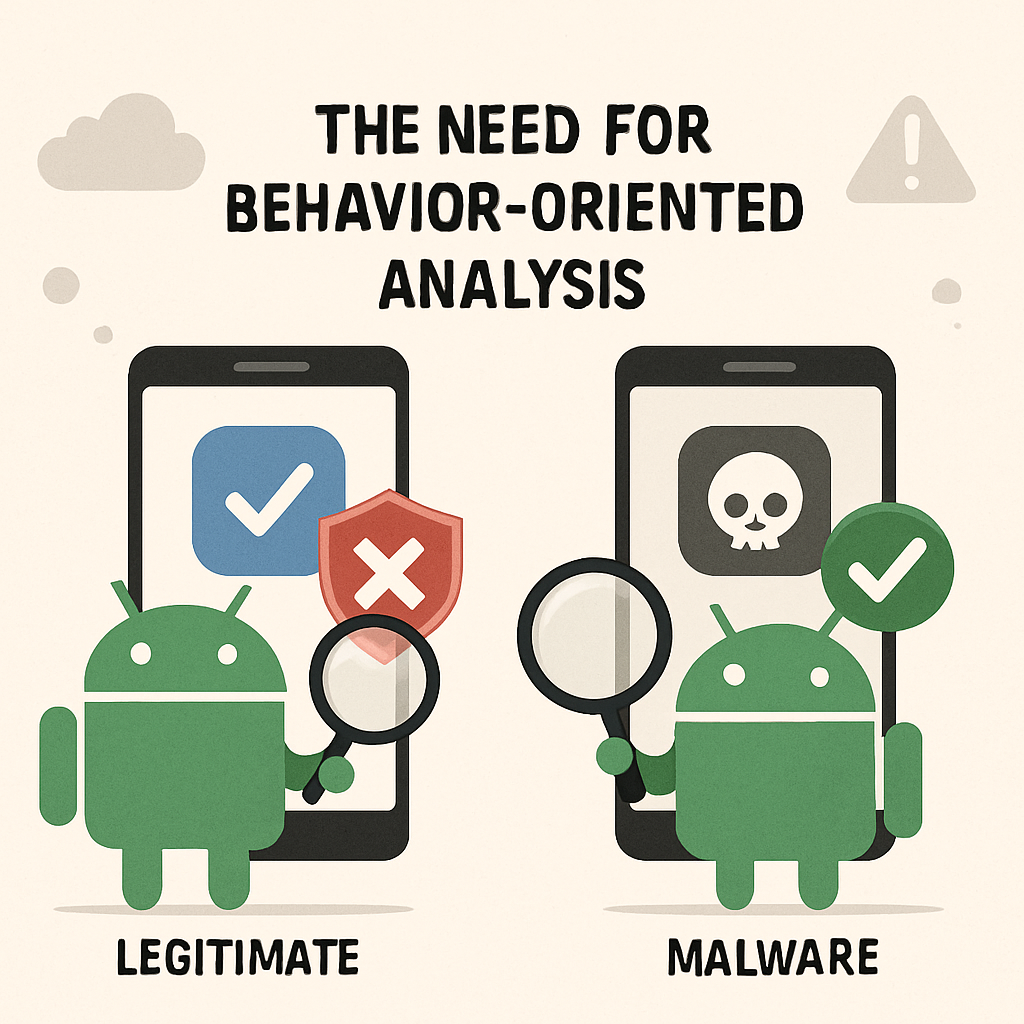
Android malware scanners are increasingly misaligning with real-world risks by over-flagging legitimate applications while missing sophisticated threats that disguise themselves behind ordinary code patterns. This growing detection gap stems from a heavy reliance on static signals rather than analyzing behavior and execution context, leading to noisy detections that erode trust among users and security analysts alike.
Traditional Android malware detectors assess applications based on static indicators such as requested permissions, sensitive API calls, and call-graph features. However, these signals only approximate an app’s actual behavior. Feature-rich benign software, like backup managers or parental control systems, often request broad permissions and are flagged simply because their feature profile appears statistically unusual compared to training data. Conversely, evolving malware families re-implement logic around unmonitored APIs or reduce conspicuous permissions to blend into the benign majority.
Learning-based detectors amplify this problem when concept drift sets in: models trained on historical malware distributions fail to generalize as new families evolve. Even newer Large Language Model (LLM) tools that analyze sensitive APIs still inspect isolated call chains rather than complete attack lifecycles, missing how seemingly benign actions combine into actual abuse.
Contextual Analysis: A New Approach
The fundamental issue is that maliciousness is not an inherent property of raw signals but of actions evaluated in context: what an app does, when it acts, and whether those actions align with user expectations. For instance, an SMS-sending operation is legitimate when triggered by a user inside a messaging application but becomes malicious when a banking impersonator silently intercepts one-time passwords (OTPs) and forwards them to an external server. Similarly, background file uploads are standard for cloud storage tools yet become spyware when performed by an app whose advertised role does not involve file synchronization.
Existing scanning engines rarely account for this operational nuance. They seldom distinguish between user-triggered UI flows and background broadcast receivers, nor do they map code execution back to an app’s advertised functionality. As a result, privileged-but-legitimate software is penalized for its capabilities, while multi-stage malware that distributes malicious logic across services and native libraries slips under heuristic thresholds.
Introducing PRAXIS: A Behavior-Oriented Framework
To address this detection dilemma, researchers have introduced PRAXIS, a behavior-oriented and context-aware analysis framework designed to eliminate false positives while capturing stealthy threats. The framework structures detection into a three-stage pipeline rather than relying on raw signal classification:
- Hypothesize: Extracts heterogeneous static signals (manifest permissions, components, intent actions, API call sites, and native function names) and uses an LLM to generate high-level attack-intent hypotheses from an adversary’s perspective.
- Confirm: Searches the application for concrete entry → source → effect execution chains (trigger → data access → impact), grounding behaviors via program analysis and discarding unverified hypotheses.
- Judge: Evaluates each confirmed behavior across two contextual axes: user awareness of the trigger and alignment with the app’s advertised functional role, reasoning about how individual actions compose into a coherent attack.
By evaluating behaviors against the app’s visible user interface, PRAXIS reliably detects deceptive actions, such as hidden data exfiltration masked by fake login prompts, while reducing false positives from legitimate applications with broad permissions.
In an era where malware is becoming increasingly sophisticated, the limitations of traditional static analysis are evident. The introduction of behavior-oriented frameworks like PRAXIS represents a significant advancement in malware detection, emphasizing the importance of context and user interaction in identifying malicious activities. As the threat landscape evolves, adopting such nuanced approaches will be crucial in maintaining robust mobile security.