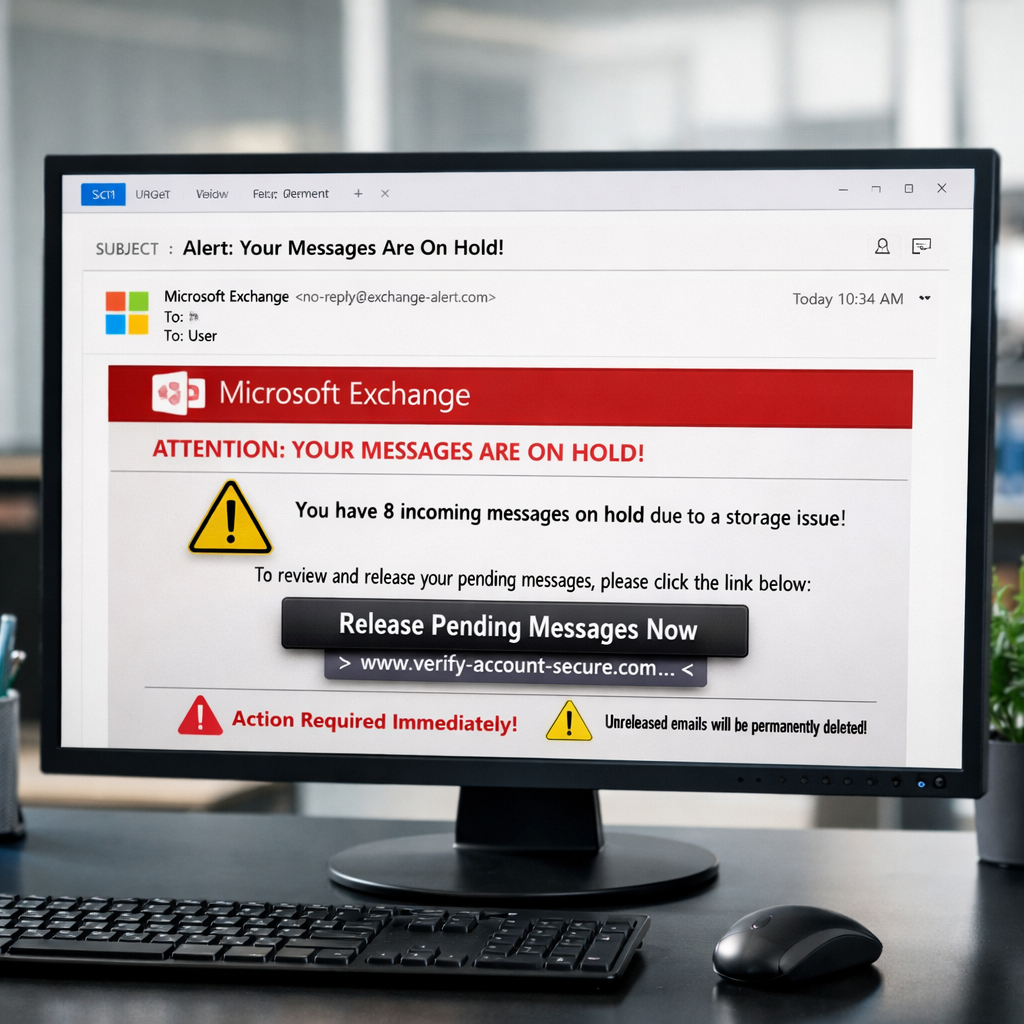
During a Microsoft 365 outage starting November 12–13, 2026, attackers seized the moment to send convincing phishing emails impersonating Microsoft Exchange Online. These emails falsely claimed that emails were held and would be permanently deleted unless recipients restored them immediately. While the outage was genuine and impacted multiple Microsoft services, the recovery demand in the emails was entirely fraudulent.
Campaign Details & Tactics
The attack emails began landing on November 13, just after service disruptions were first reported. Outages weren’t limited to email alone—they also affected Outlook, Teams, SharePoint, and other cloud apps. Microsoft attributed the outage to an infrastructure failure.
Security researchers identified the phishing campaign via Trellix’s SecondSight service. In roughly three and a half hours, about 252 phishing emails reached over 30 organizations across the U.S., Europe, the Middle East, and Asia-Pacific. Unlike malware-based incidents, this was a web-based credential theft operation.
How the Phishing Worked
Attackers mimicked Microsoft branding closely, using legitimate service notice templates, official logos, sender names like “Service Health,” and the real incident number (EX1550543). Some messages claimed users had 24 hours to recover their held emails—adding urgency during an outage where delays were already expected.
The phishing unfolded in timed waves between 17:04 and 20:38 UTC, with email subjects pairing “Outage” and codes, or using phrases like “Restore — 4 messages” or “security checkup.” Messages came from three domains, all sent via SendGrid. Tracking pixels were hidden in many emails to log opens.
The “Recovery” link redirected users through a custom tracking URL. Automated scanners saw benign content, while the users were pushed toward a login page. That final page pre-filled the email address, lending an appearance of normalcy—even though the URL didn’t belong to Microsoft. The site used an adversary-in-the-middle method to collect credentials and session tokens, including ones issued after multifactor authentication.
Indicators & Recommended Response
Researchers listed specific Indicators of Compromise (IoCs): sender domains like newbooker[.]com, planetmaison[.]com, moments-notice[.]com; tracking and phishing domain patterns; and click URLs using SendGrid and redirects. An IP used for open tracking was also identified.
Organizations are advised to treat outage alerts with suspicion unless verified. Better to confirm through internal help desks or IT departments instead of directly interacting with email buttons. Key signs to look for include subject lines referencing “Outage,” “messages held after the outage,” or unusual security requests. If credentials have been entered into a dodgy page, security teams should reset passwords, revoke active sessions, and audit login logs.
This incident highlights how threat actors rapidly leverage real disruptions—especially in cloud services—to execute phishing schemes. As multifactor authentication becomes more common, attackers aim for session hijacking to bypass MFA gaps. What to watch: improved monitoring of service health communications, better user education during outages, and more robust mechanisms to invalidate suspect login sessions. It’s a wake-up call that even legitimate-seeming alerts can hide serious risk—verification remains the best defense.