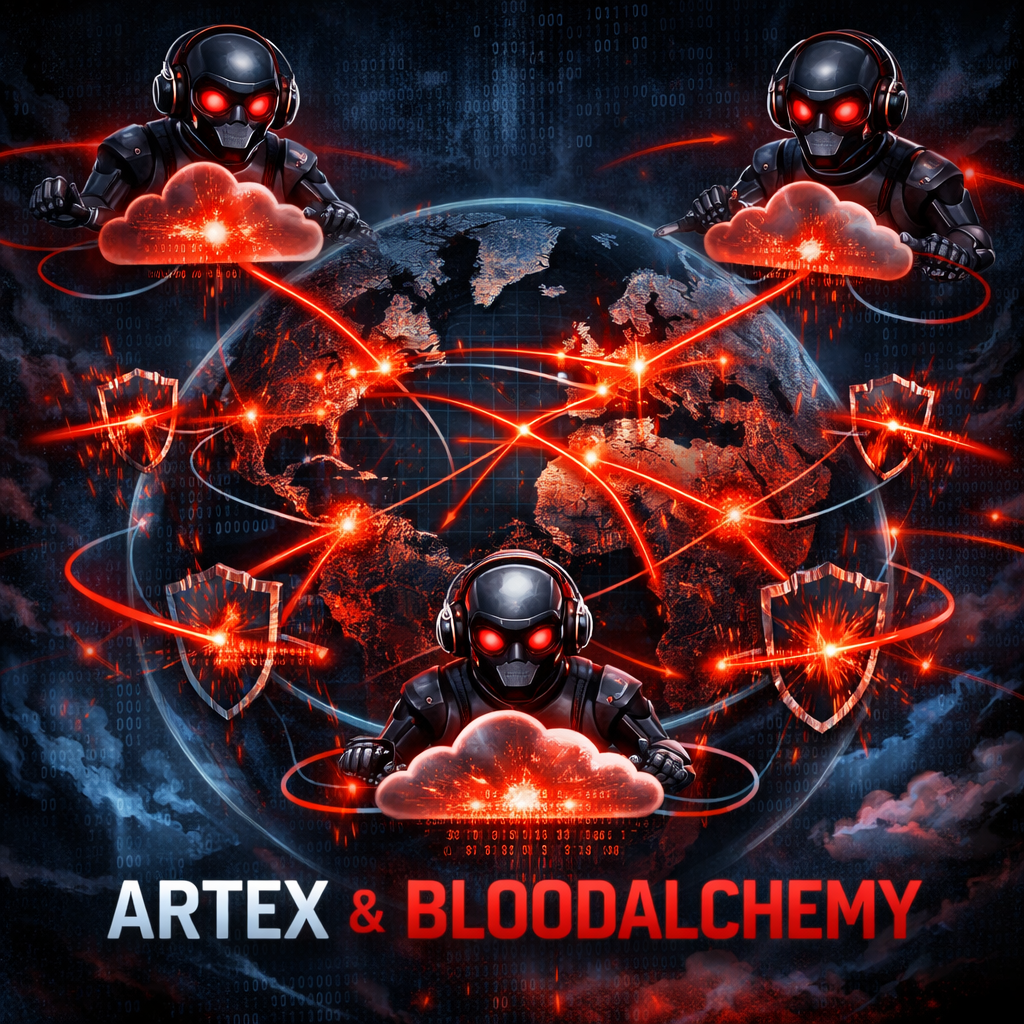
Starting October 17, 2026, a China-linked hacking group known as Vapor Panda unleashed a sweeping cyber espionage campaign targeting over 200 organizations globally, security researchers have confirmed. The group used ARTEX, an agent-based penetration testing framework, powered in large part by DeepSeek, a Chinese large language model, along with an unnamed commercial LLM, to scale attacks across multiple sectors. Teams in Latin America, Europe, the Middle East and Asia have been hit while U.S.-based targets included high-value telecom, semiconductor, defense, think tank, and government entities. Post-compromise activity has been verified in nine organizations. Data was collected from network scanning, reconnaissance, credential spraying, and the deployment of BLOODALCHEMY backdoors to maintain stealthy footholds.
What Is ARTEX—and How It’s Used
ARTEX is an AI-driven agentic framework built using Go, designed to automate stages of cyber intrusion. It orchestrates multiple subagents (“planners” and “workers”) under a shared task graph to progress through typical attack steps: initial access, reconnaissance, privilege escalation, and lateral movement. Humans remain in command, issuing directives like writing web shells or extracting domain administrator credentials, especially when AI agents hit critical forks.
In this campaign, planners working under ARTEX consumed roughly 1.4 billion input tokens in a single intrusion—an indicator of both scale and automation intensity. While the DeepSeek LLM provided primary brainpower, another commercial large language model supplemented it, though its identity remains unknown. The human operator—orchestrating from the wings in Chinese—guided agents through selecting targets, rotating strategies when certain attack paths failed, and ensuring sensor coverage on endpoints.
Targets, Tactics, and Tooling
The campaign’s targets spanned foreign affairs bodies in Latin America, Europe, Asia and the Middle East; defense, intelligence, finance, justice, and presidential offices in an unnamed European country; pharmaceutical, semiconductor, defense, nuclear, and financial firms in the U.S.; and telecom firms in the U.S., Belgium, and the Philippines. Post-exploitation was confirmed in nine cases where BLOODALCHEMY—a variant of ShadowPad—was installed, allowing persistence and data exfiltration. In at least 12 more organizations, credential theft and password spraying were underway.
Attackers chained together multiple attack vectors: exploiting unsigned SAML assertions, leveraging XML external entity (XXE) vulnerabilities, abusing orchestration services to get root inside containers, stealing LAPS passwords, forging admin tokens via stale authentication keys, and using leaked VPN configurations from prior email breaches. These paths show parallelized techniques, switching tactics when one route to internal resources was blocked, foreshadowing how adversaries are automating escalation.
ARTEX’s Origin & Rising Risk
ARTEX was developed by Li Puhua (aka “Autumn-27” or “Autumn”), a Chinese engineer. Initially open-source, it allowed users to plug in LLMs like DeepSeek, GLM, and Grok to perform intrusions. Amid mounting misuse—and after developers acknowledged abuse—ARTEX’s repository was taken offline and made private. Nevertheless, its footprint in recent campaigns makes it a standard in state-linked threat tooling.
Experts warn that frameworks like ARTEX significantly lower the barrier for complex attacks and enable small teams to mount widespread operations. Its proliferation suggests intelligence-gathering and intellectual-property theft operations worldwide may increasingly rely on AI orchestration.
This campaign underscores a turning point in cyberespionage. Adversaries are shifting from isolated intrusions to synchronized, automated campaigns. Security teams should prioritize robust key rotation, enforce strong identity proofing (especially in cloud infrastructure), closely monitor cloud roles and agents with ARTEX signatures, and ensure endpoint defenses catch what AI agents try to hide. Detecting these campaigns earlier may depend on knowing the telltale markers: ARTEX folder paths, command patterns, BLOODALCHEMY variants and even linguistic cues in transcripts.