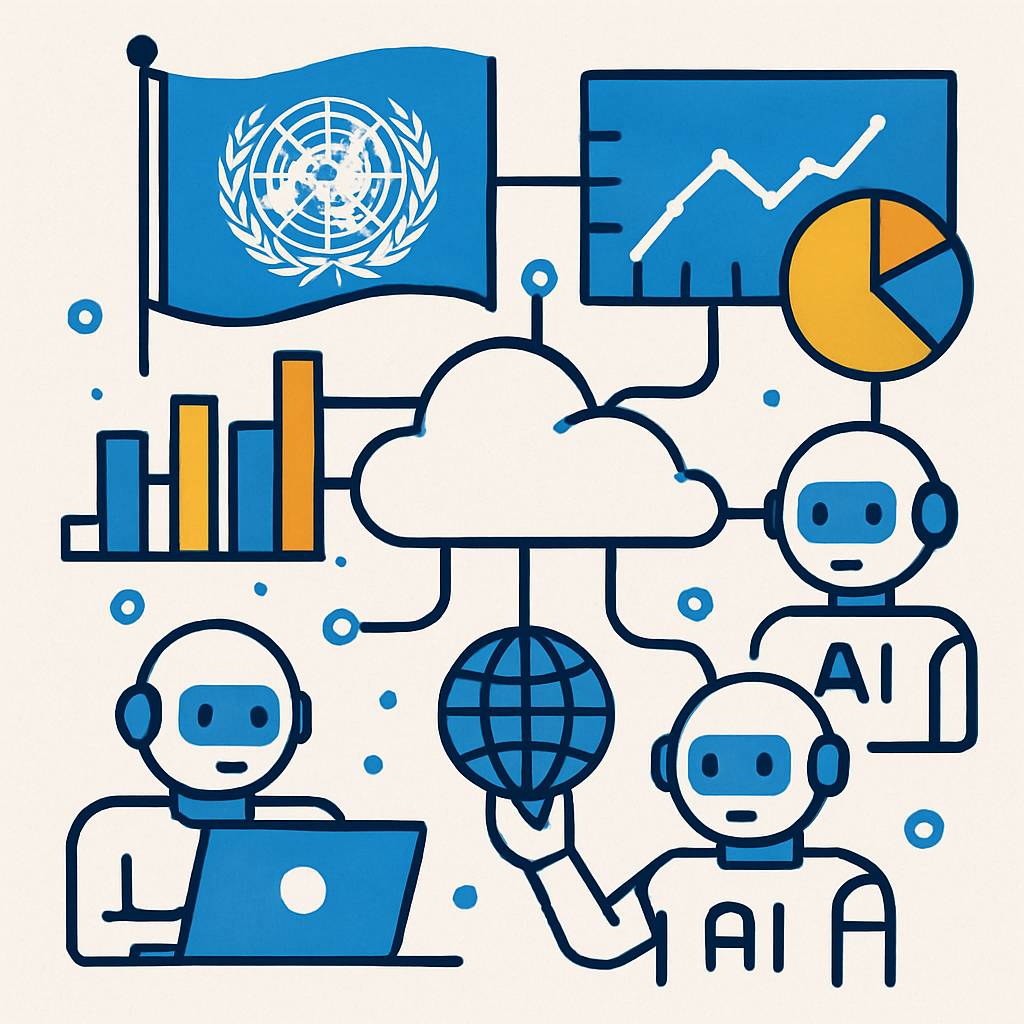
The United Nations has unveiled a new initiative aimed at transforming how global statistics are accessed and utilized by artificial intelligence agents. Using Google’s open-source Data Commons platform, the UN is launching the UN System Data Commons. This new system allows natural-language queries over statistics gathered from across UN agencies, replacing the older UNData portal, which had a more traditional database-style search. The new platform also incorporates the Model Context Protocol (MCP), enabling AI systems to pull data directly from external sources.
Measuring AI Models’ Performance Against Global Development Data
A recent benchmark conducted by UNICEF evaluated six large language models—including versions of GPT-4o, Claude Sonnet, Haiku, and Google’s Gemini—on over 133,000 queries related to global development indicators. The result: an average accuracy of just 21.2%. Many responses lacked any usable numeric data, and for those that did, subsequent tests often produced different numbers from the same model. This underscores a major challenge: current AI tools struggle to reliably surface precise, authoritative statistics.
Scaling Up to Make Data Widely Accessible
At launch, the UN System Data Commons includes contributions from nearly 20 UN entities and aims to integrate statistical datasets from 80% of UN agencies by 2027. Google.org has committed $2 million in funding and technical support to build the platform’s core infrastructure. While the platform is hosted on UN governance, the UN will eventually maintain and operate it independently.
The platform retains clear links to original data sources, allowing AI systems—or users—to trace information back to its UN origin. Demonstrations have shown how AI agents, using MCP, can automatically pull together relevant statistics—like infection rates, mortality, and life expectancy—to generate dashboards, infographics, and written summaries without requiring manual gathering of data.
Despite these advances, making data AI-accessible doesn’t guarantee infallibility. There remains risk of AI misinterpreting nuance, so review by human experts before citing or publishing outputs is critical. The UN and Google emphasize that authoritative data must be combined with careful validation.
This shift arrives amid rising usage of generative AI tools as gateways to public data. The UN’s system data website, which already receives over six million monthly visits, is seeing increasing traffic from AI-generated answers. Referrals from click-throughs in ChatGPT answers alone have surged year over year, and AI assistants now account for roughly one in ten total sessions.
As the UN gears up to make the majority of its global datasets AI-ready by 2027, supported by established protocols like MCP and built-in transparency, it’s clear the world is entering a new phase of data accessibility. But the success of this project will depend not just on technology, but on ensuring that AI-driven insights remain anchored in human oversight and precision.