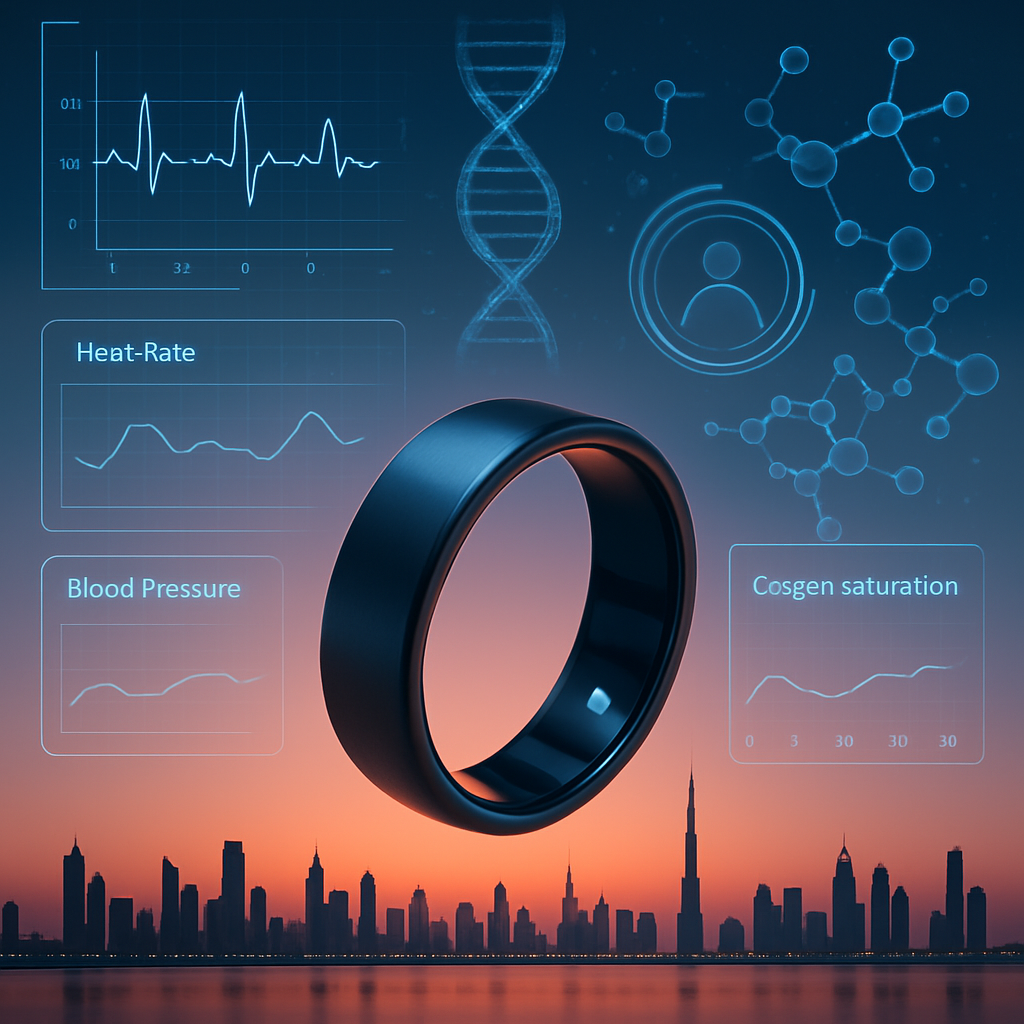
Ultrahuman, the smart ring maker from Bengaluru, has struck a deal with Abu Dhabi health officials to launch a model that gauges people’s biological age using both wearable sensor data and clinical tests. The agreement with the Abu Dhabi Public Health Center (ADPHC) spans two years and seeks to validate the model before making it available across the UAE. It will assess factors like sleep, exertion, cardiovascular health, and metabolism to measure how rapidly someone is aging.
From Wearable Hardware to Nation-Scale Health Algorithms
While Ultrahuman is widely recognized for its biometric smart rings—800,000 units sold globally so far—the company is shifting its emphasis toward becoming a health-data platform. Its ring is just one sensor in a toolkit meant to assemble broader insights into longevity and wellness.
The biological-age model is being engineered to accept inputs not only from rings but from wrist devices, patches, and chest straps, complemented by lab-based clinical biomarkers. This flexibility aims to make the model wearable-agnostic, broadening its potential reach. Eventually, users in the UAE will be able to access their ‘‘health age’’ via government health platforms such as TAMM and Sahatna.
Why UAE? Why Now?
The UAE is already one of Ultrahuman’s strongest markets, generating 4–5% of the company’s total revenue. It’s a place where Ultrahuman has operated for nearly five years—something that has allowed the startup to observe about 25% higher retention among users there compared to many other regions.
Ultrahuman’s current users tend to be aged 25 to 43, but deploying this model across UAE with health authority involvement exposes the algorithm to demographics well beyond that narrow range. Such real-world validation could surface age-related patterns the company hasn’t yet seen.
Though developed using Ultrahuman’s existing user data—including chronological age, wearable signals, and blood tests—the model won’t be trained on personal data from UAE residents. Ultrahuman won’t have access to personally identifiable information through this program.
This effort joins other preventive-health partnerships in Abu Dhabi: in May, for instance, the Department of Health in the emirate teamed up with wearable-maker Oura to integrate wearable data with long-term health data, initially focusing on cardiometabolic and women’s health.
Ultrahuman also revealed it is working on a new smart ring model capable of running on-device software—potentially powering AI applications or even games directly on the wearable.
The two-year UAE partnership is structured in phases and includes clinical validation stages. While Ultrahuman didn’t give a detailed timetable for rollout beyond that, it’s clear the plan is for health age estimation to be accessible nationally via government platforms eventually.
Why this matters:The move represents a broader shift in wearables—from tracking data to interpreting it with health predictions. If successful, the biological-age model could reshape preventive healthcare in the UAE and serve as a test case for similar programs elsewhere. What to watch: how well the model performs across diverse populations; how privacy and data governance are handled; and whether other countries follow with similar public-private health AI models.