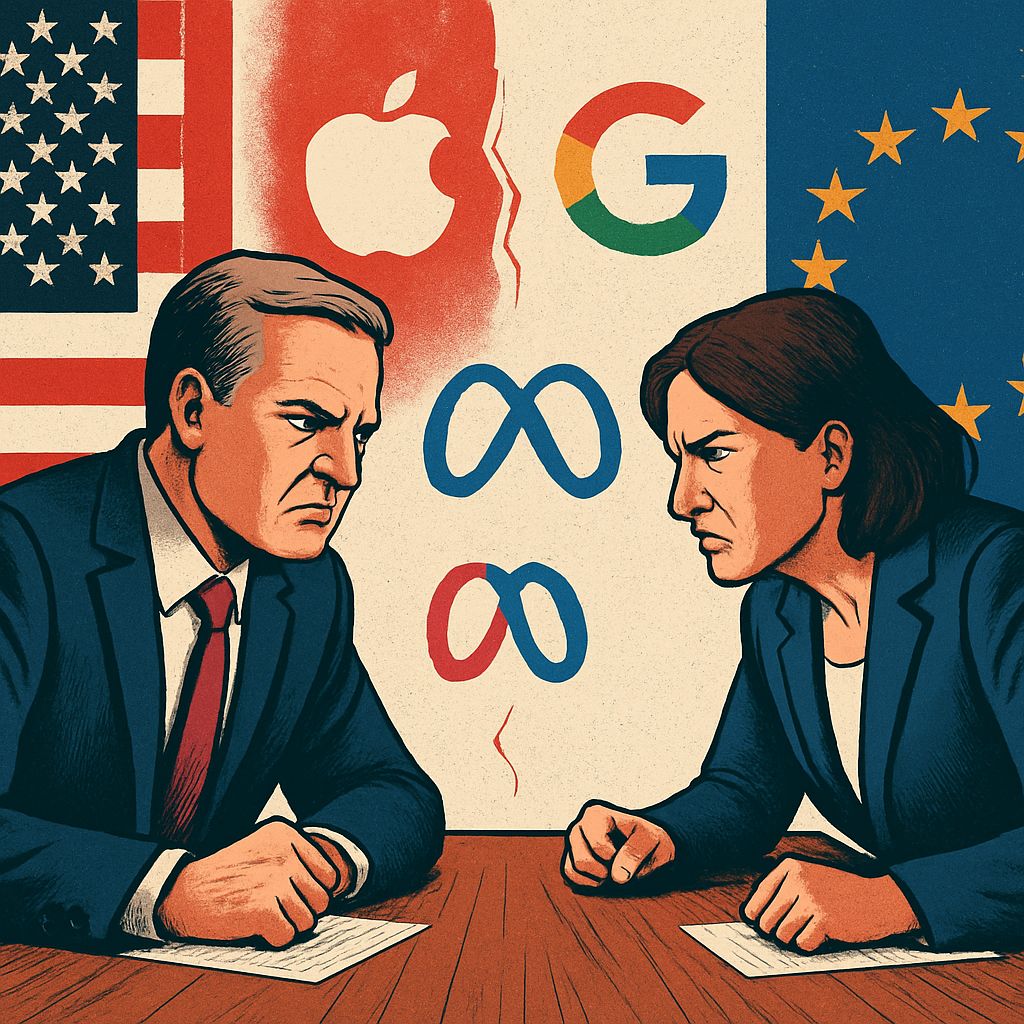
President Donald Trump has announced plans to investigate and counteract the European Union’s substantial fines imposed on major U.S. technology companies, including Apple, Google, and Meta. He described the EU’s actions as “illegal and highly unethical,” vowing to reverse these penalties and implement significant tariffs in response.
In a statement on Truth Social, Trump criticized the EU for targeting American firms, highlighting fines such as Apple’s $15 billion, Meta’s $3 billion, Amazon’s $2.5 billion, and Google’s recent $1 billion penalty. He emphasized that the U.S. would not serve as a “piggybank” for Europe and announced the initiation of a Section 301 investigation into the EU’s practices, with plans to impose substantial tariffs.
These fines stem from the EU’s enforcement of the Digital Markets Act (DMA) and other antitrust regulations. For instance, in 2025, Apple was fined $570 million for restricting developers from informing users about alternative payment options outside the App Store. Similarly, Meta faced fines totaling $1.04 billion in 2024 and 2025 for violations related to user data and advertising practices. Google’s recent $1 billion fine adds to its previous $4.5 billion penalty upheld earlier this month.
The Trump administration has previously expressed strong opposition to the EU’s regulatory actions against U.S. tech companies. In December 2025, the Office of the United States Trade Representative threatened retaliatory measures, including fees and restrictions on European services and companies, in response to what it described as discriminatory practices against American firms.
Trump’s focus on tariffs has been a hallmark of his second term, affecting both U.S. companies and consumers. A 10 percent blanket tariff enacted earlier this year expired recently, only to be replaced by new tariffs targeting countries accused of failing to prohibit the importation of goods produced with forced labor. These measures impact goods from the UK, China, and other nations.
As tensions escalate between the U.S. and the EU over tech regulations and trade policies, the global technology industry faces increased uncertainty. The potential for retaliatory tariffs and ongoing disputes could disrupt international markets and supply chains, emphasizing the need for diplomatic resolutions to these complex issues.