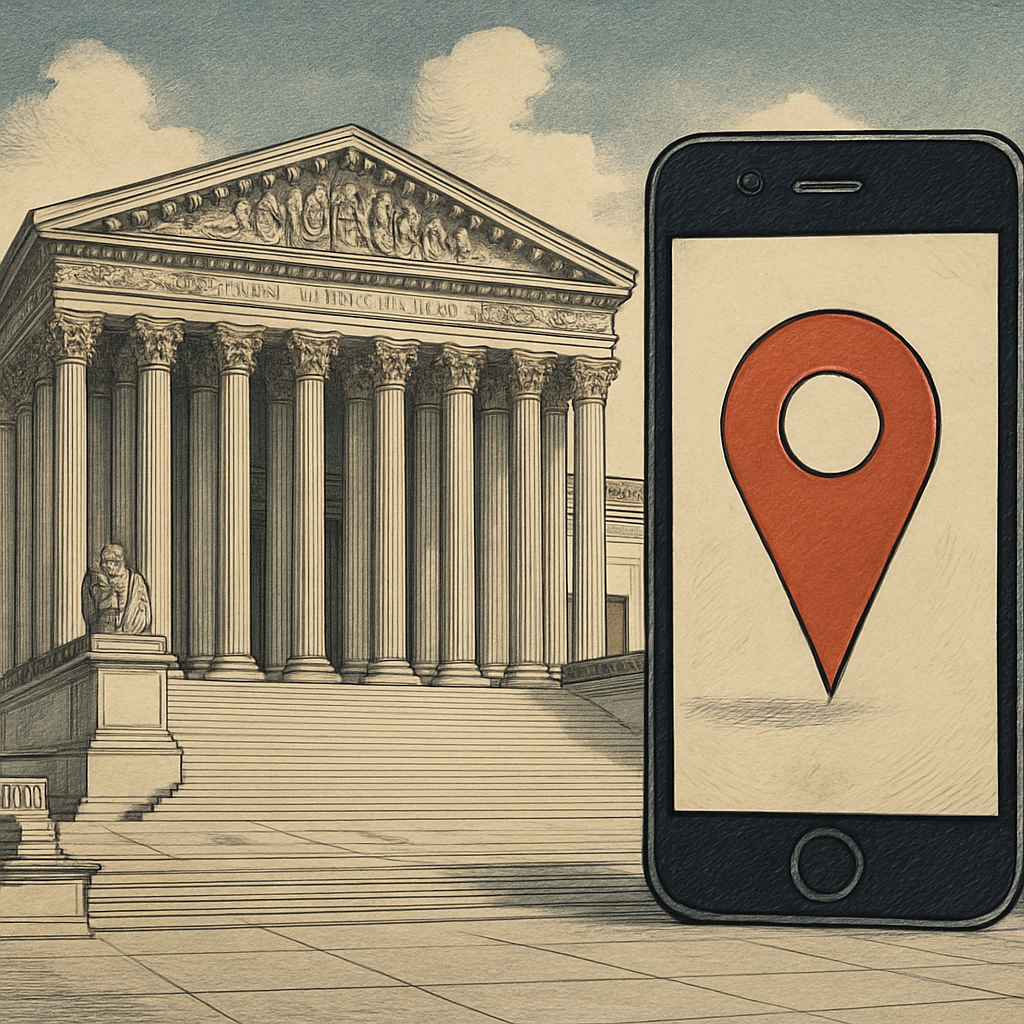
In a landmark decision, the U.S. Supreme Court has ruled that the Fourth Amendment’s privacy protections extend to cellphone users’ location history. This 6-3 ruling emphasizes that individuals maintain a reasonable expectation of privacy regarding their location data, even when they opt into services like Google’s location tracking.
The case originated from the 2019 bank robbery involving Okello Chatrie in Virginia. Law enforcement utilized a “geofence warrant” to identify cellphones near the crime scene, leading to Chatrie’s arrest and the recovery of stolen funds. Chatrie’s defense contended that the geofence warrant was overly broad, infringing on the privacy rights of individuals not suspected of any crime. While a lower court deemed the warrant unconstitutional, it admitted the evidence based on the officer’s good faith. The Supreme Court has now remanded the case for further review without deciding on the warrant’s validity.
Justice Elena Kagan, writing for the majority, stated that individuals do not forfeit their privacy expectations by opting into location services. She emphasized that a cellphone user should not be viewed as sharing private information with third parties, which can then be freely passed on to the government, merely by engaging in ordinary cellphone activities.
This ruling builds upon the Court’s 2018 decision in Carpenter v. United States, which held that accessing historical cell-site location information constitutes a Fourth Amendment search. The current decision extends this protection to more precise location data collected by services like Google’s Location History, which can pinpoint a user’s location within approximately twenty meters and record movements every two minutes.
While the Court did not declare geofence warrants unconstitutional, it underscored that obtaining such detailed location data is a search under the Fourth Amendment, necessitating a warrant supported by probable cause. This decision signals a significant shift in how digital privacy is perceived and protected under the Constitution.
As technology continues to evolve, this ruling highlights the judiciary’s role in adapting constitutional protections to modern digital realities. It sets a precedent for future cases involving digital data and privacy, reinforcing the necessity for law enforcement to adhere to constitutional safeguards when accessing personal information.