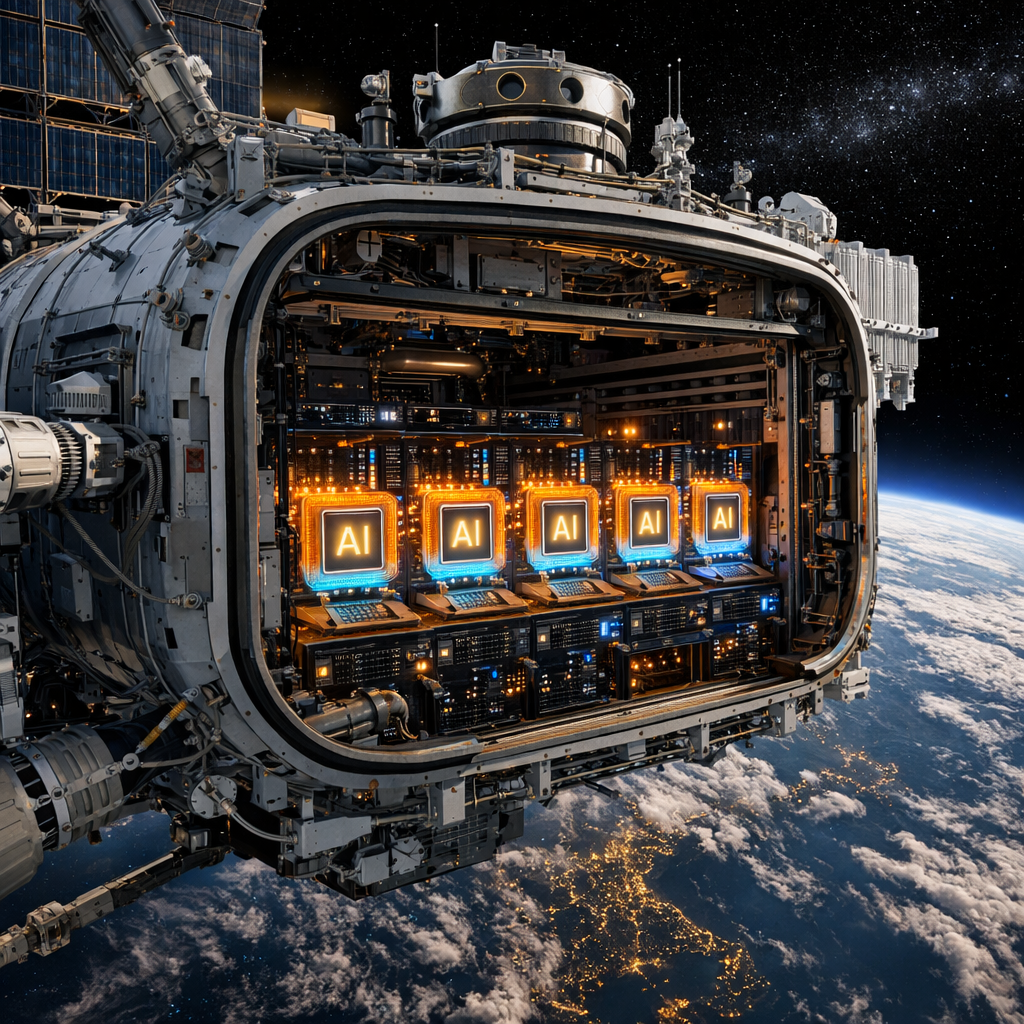
Companies pushing to build data centers in space are hitting a wall—not from vacuum, radiation, or weight, but from how they pay for the chips that make it all possible. The same financial models that work for terrestrial data centers don’t translate to orbit.
Collateral and Credit: Key to Terrestrial Data Centers
On Earth, data center operators frequently rely on debt financing: they borrow money, buy hardware (including chips), and then repay the loans over time using the revenue generated by the center. Lenders often require the chips themselves as collateral, since they retain resale value even after use. For example, chips such as Nvidia’s H100s and H200s still fetch prices close to their original cost years after their release—serving as insurance for lenders. This collateral model helps reduce the cost of borrowing. But orbit changes everything.
Why Space Data Center Financing Is Different—and Harder
When chips are launched into orbit—300 miles above Earth, racing at roughly 17,500 miles per hour—they can’t be repoed. Once in space, hardware is out of reach for lenders in the event of default. As a result, lenders involved in SpaceX’s recent $40 billion chip financing deal specifically requested that chips intended for orbital data center use be excluded from any collateral requirement. It’s unclear whether SpaceX agreed to this stipulation.
SpaceX is currently seeing more immediate profit by deploying compute hardware at ground stations. The company is accelerating its terrestrial data center buildout, including working to minimize supply chain constraints by rapidly developing infrastructure—such as casting turbine blades in‐house—to reduce reliance on outside vendors.
Starship, Reusability, and the Long Road Ahead
Elon Musk has suggested that space may become the cheapest place to operate data centers within two to three years. But that hinges on several breakthroughs—chief among them, reusability in heavy lift rockets. SpaceX’s Starship program is central to that vision. In its most recent test, the rocket’s booster stage failed to return, though the orbital (second) stage successfully landed back at their Texas facility. It’s still uncertain when the second stage will fly again or how much refurbishment will add to operational costs.
Existing and emerging space data center players—names like StarCloud, Cowboy Space Company, Sophia Space, and Orbital—will need to acquire chips, which under space constraints likely cost more than analogous terrestrial components. Google’s Project Suncatcher is exploring using its own TPU chips for orbital deployment. SpaceX and Tesla’s planned domestic chip foundry, Terrafab, has yet to break ground and faces a timeline of years and billions of dollars before producing semiconductors at scale.
Even if hardware cost and brush‐with physics weren’t enough, those building ground and space data centers must still deal with more mundane but critical challenges: securing sites for facilities, obtaining reliable power, navigating local opposition, and proving that demand will translate into sustainable revenue.
These financial frictions—especially around collateral for chips in orbit—could limit how quickly space data centers scale. Without a way for investors to feel protected, the sector risks undercapitalization just as it attempts to reach the stars.
Why It Matters & What’s Next
The mismatch between how current chip financing works and what orbital data centers need may force new financial instruments, insurance structures, or even stricter legal frameworks. What kinds of contracts do lenders need if collateral doesn’t exist in a traditional sense? How do you underwrite a piece of hardware hurtling through orbit?
This tension is already shaping the industry. Until rocket reusability improves, the cost barriers are likely to keep space data centers at a niche stage. But for companies that can redesign financing rather than just hardware, there’s potential for space to redefine infrastructure. The coming years will tell if the money side of the equation can catch up with the ambition.