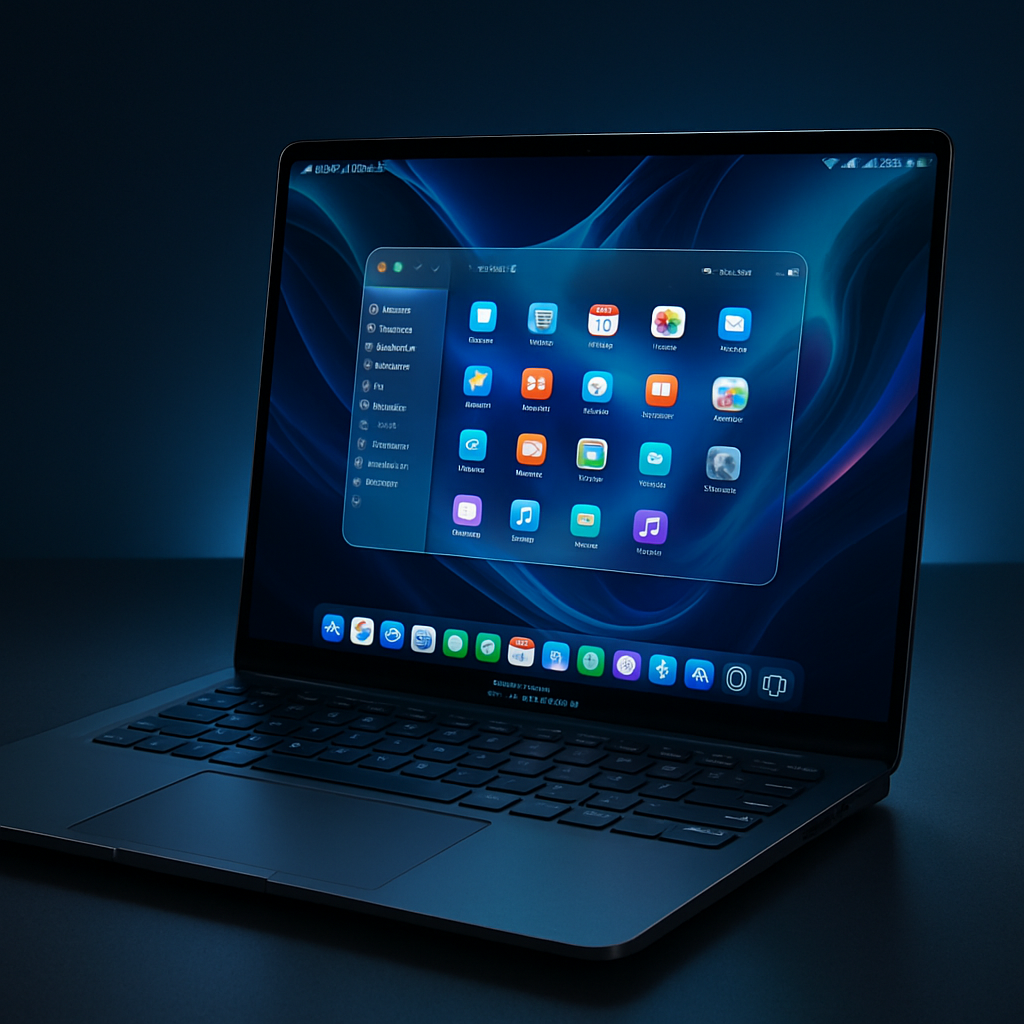
A recently launched open-source effort named “Snapintosh” has made it possible to boot macOS 27 (code-named *Golden Gate*) on the ASUS Zenbook A16 laptop, which runs Windows on Arm via Qualcomm’s Snapdragon X2 Elite Extreme processor. The build is experimental: components like the display, graphics, and storage function; audio, camera, Bluetooth, sleep mode, and external display support are still missing.
How Snapintosh Works
The backbone of Snapintosh is a custom hypervisor running at Exception Level 2 (“EL2”) on the A16’s Arm architecture. This software provides platform hooks (SPTM, TXM) and handles the translation of 16 KB page tables, which are expectations baked into Apple’s macOS kernel for Apple Silicon. The kernel run is largely unmodified and includes the same device tree, monitor calls, and contracts that macOS would normally expect from Apple‐built hardware.
Graphics acceleration is supported through the laptop’s integrated Adreno X2-90 GPU. The project delivers a Metal driver plugin and an IOGPU kernel extension to drive the internal display, and uses a shader compiler that converts Apple’s AIR (Metal’s intermediate representation) into Mesa’s IR3 format. Input from the built-in keyboard and touchpad works, including gestures and mission control. Native storage on the internal NVMe SSD is supported. Wi-Fi (using a Qualcomm QCC2072 chip) partially works (network scanning, WPA2, DHCP, ping), but joining the macOS Wi-Fi menu interface does not succeed yet.
Current Limitations & Scope
While Snapintosh boots to a usable desktop, the experience is rough. Animation smoothness is a concern. The aim is to attain a consistent 60Hz refresh rate on the laptop’s OLED screen, with 120Hz being a longer-term target. Key features remain unimplemented: audio, camera, Bluetooth, external displays, and the sleep function are non-functional so far.
The project is narrowly focused on a single laptop model: ASUS Zenbook A16 (model UX3607OA) with the Snapdragon X2E-96-100 chip. Early tests indicate that support could extend to first-gen Snapdragon X Elite and possibly Android tablets—but each new target will likely require significant new driver and firmware work. The repository currently lacks a complete installer, and many features in the graphics and UI stack are still sporadic in performance. Snapintosh does not include commercial licensing or firmware from Apple, Qualcomm or ASUS; users need to obtain certain binary firmware, driver files, and Apple’s macOS IPSWs themselves under appropriate licensing terms.
Why This Matters & What’s Ahead
This project represents a significant technical leap: until now, most Hackintosh efforts ran on legacy Intel or AMD PCs. Making macOS run on non-Apple Arm silicon largely failed because Apple’s kernel assumes platform contracts found only on Apple Silicon—contracts that cannot easily be replicated. By implementing those contracts via a hypervisor and supplying expected devices, Snapintosh sidesteps much of that, bringing macOS to Snapdragon-powered Windows laptops in a much more “native” way than traditional virtualization or emulation. This could influence how people think about cross-platform software, system security, and the potential of Arm laptops beyond Windows or Linux.
Snapintosh is risky, unofficial, and fragile: installing it will overwrite the NVMe drive and can mess up Windows partitions; errors in firmware or overheating could damage hardware. But for tinkerers, it demonstrates a pathway into “Arm-based Hackintoshes” that might be refined and replicated. Projects like ports to Android tablets and other Snapdragon devices are already being discussed.
While still confronted with major gaps—audio, camera, sleep, full driver support—this is more than proof-of-concept: macOS 27 on Snapdragon X2 Elite Extreme is no longer just imagined. Practical usability is a ways off, but the foundation is now real. What to watch: the pace of improvements in UI smoothness, audio and camera driver development, and whether broader device support emerges, turning this one-laptop hack into something more universal.
From a legal standpoint, users should keep in mind Apple’s licensing prohibits macOS use on non-Apple hardware—so this remains a hobbyist pursuit. Technical innovation aside, whether such efforts remain niche or spark demand for more open Arm builds will be telling.