SiliconForest OS, a new open operating system built around Apple’s Darwin and XNU, is now capable of running unmodified Mac applications on Apple hardware. The project currently supports a 13-inch MacBook Pro with the M1 chip. Major apps like Logic Pro and Photoshop aren’t yet fully functional, but simpler Mac software and developer tools already work.
What Is SiliconForest and How It Works
Darwin is Apple’s Unix-based foundation used underneath macOS, iPadOS, and other systems. Its kernel, XNU, is the core that SiliconForest leverages. But SilkForest isn’t just a repackaging of Apple’s open code; where necessary, the project has created replacements for Apple’s unpublished components in order to build a working system.
The developers forked PureDarwin as the base system, then integrated key pieces from other open projects: hardware drivers and GPU support from the Asahi Linux initiative, along with components like Mesa graphics layers and the Finch frameworks. On top of that foundation, the source includes Apple’s built open kernel from Darwin and XNU.
What It Runs Already—and What’s Coming
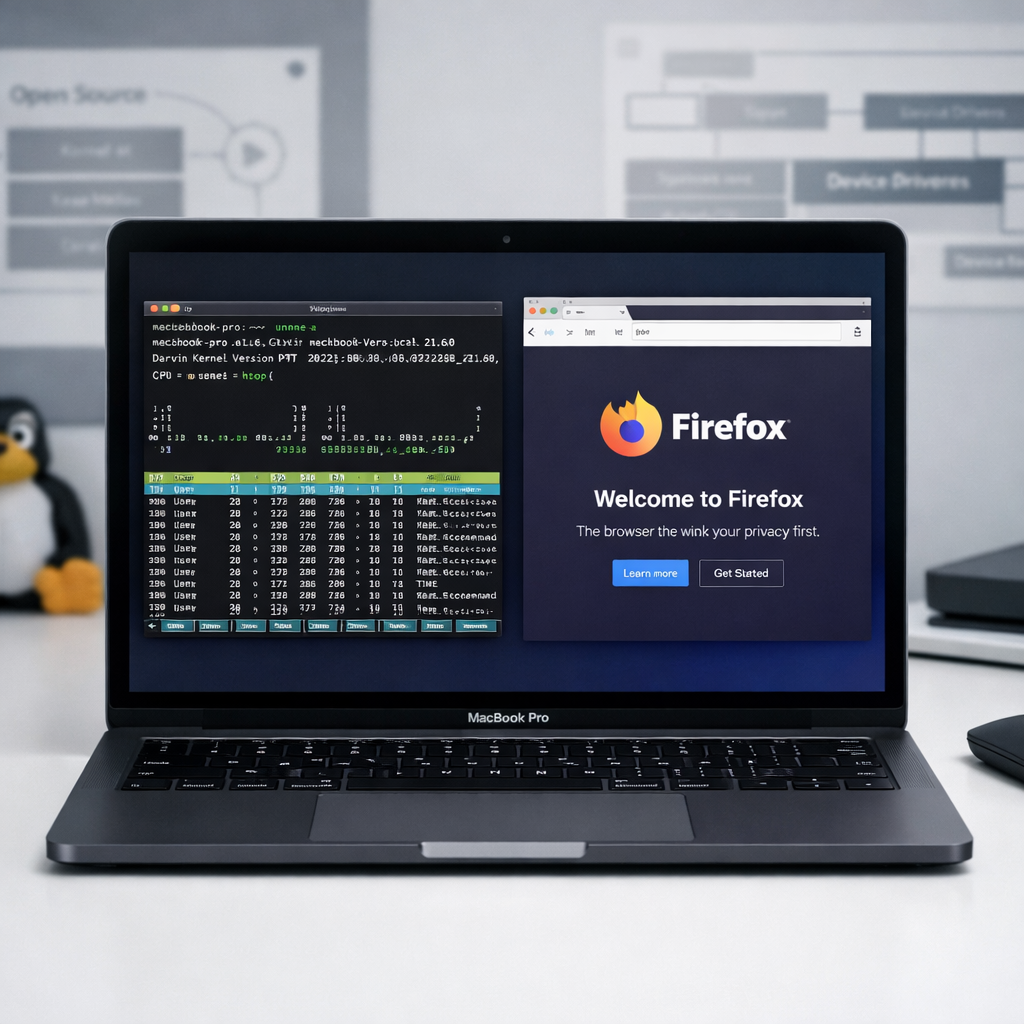
So far, SiliconForest has demonstrated the ability to run unmodified Mac system apps, such as Terminal and Activity Monitor, copied directly from macOS installs. It also successfully launched the standard Firefox build for Mac. A custom Wayland compositor called “Chonkstep” has been ported into the mix, with reportedly very good results.
However, the project is still in early stages. Heavier apps, especially graphics- and audio-intensive ones like Logic Pro and Photoshop, require more work before they will run properly and efficiently. At present, SiliconForest is only confirmed to run on one device—the M1-powered 13-inch MacBook Pro. There is no confirmed support yet for other Macs or Apple’s M2 and M3 chip families.
SiliconForest aims to give users a free, open, and hackable alternative to macOS, with native Mac app compatibility. It builds on Apple’s published open-source code, while re-implementing or replacing bits Apple hasn’t made public. Its developers believe this hybrid approach will allow SiliconForest to replicate much of macOS’s app support.
Big challenges remain: filling in the gaps of unpublished system components, achieving stable drivers for all hardware features (GPU, audio, power management, etc.), and ensuring performance and compatibility with mainstream Mac applications. The scope is ambitious—but if successful, this OS could appeal to enthusiasts, developers, and users wanting more control over their systems.
Ultimately, SiliconForest is a proof of concept right now more than a product. But it points toward a future where Mac apps could be run on more open, community-built platforms without the full stack of macOS. Watch for progress in hardware support expansion, performance tuning, and compatibility with pro-level apps.
What This Means: SiliconForest represents a meaningful experiment in reimagining how Apple’s foundational technologies could be reused outside of macOS. While it won’t displace macOS in the near term, it pushes forward ideas about openness, software freedom, and the curiosity that powers enthusiast communities. If it matures, it could influence how Apple perceives its open-source footprint, particularly around what it intends to publish and support.