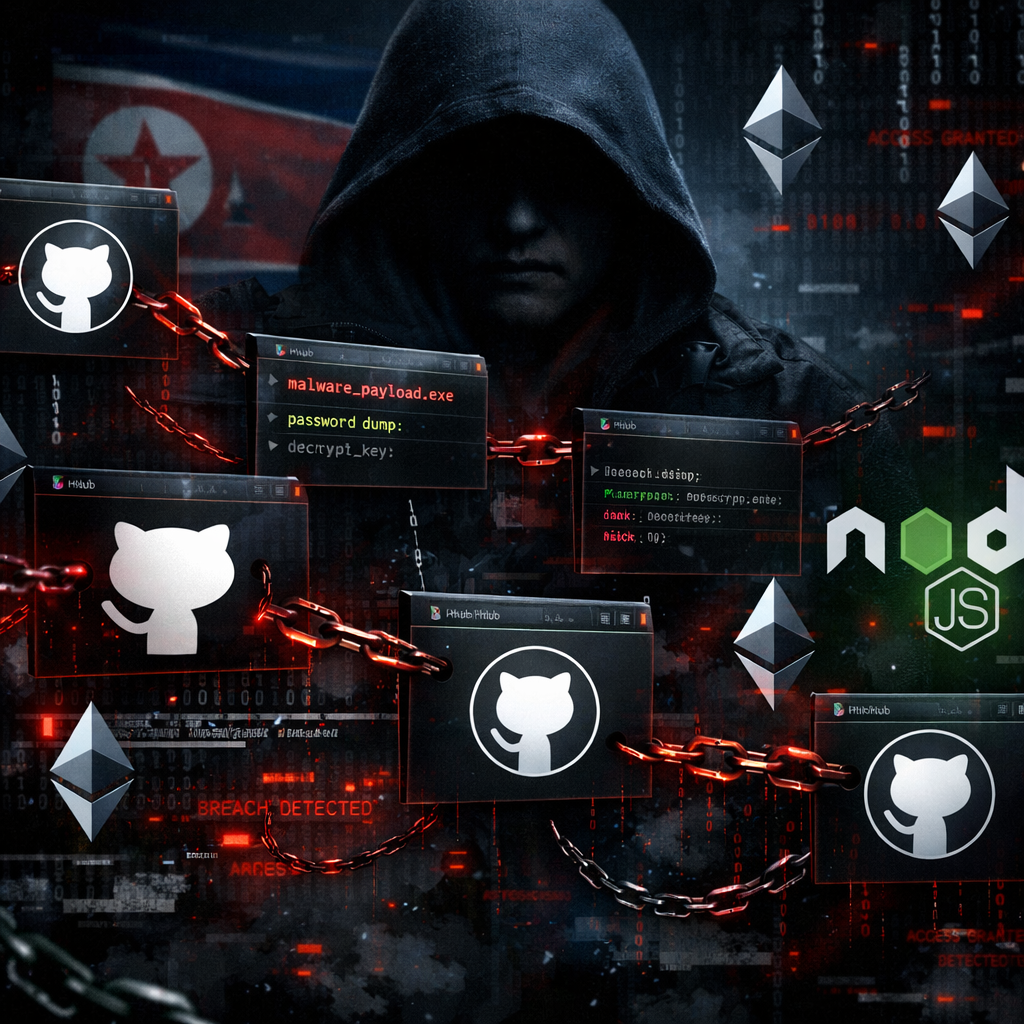
A malware campaign tied to North Korean threat actors has infiltrated over 7,600 GitHub repositories through a Python loader, according to a new report that traces some activity back to February 2025. Named PolinRider, this campaign embeds itself in public open-source projects—hiding in build tools and repository configs—to deliver malicious JavaScript and Node.js payloads. Its arsenal also includes phishing-style fake recruiting, malware-laced assessments, and hijacked maintainer accounts.
How PolinRider Works
The loader is concealed inside innocuous-looking files like conftest.py or utility packages. Whenever imported, it reads the latest Ethereum transaction sent from a wallet to itself, decodes the input data as JavaScript, and executes it using Node.js. That JavaScript then queries a second wallet to determine the command-and-control (C2) server, launches a detached Node.js process (using node -i), and proceeds with the attack. SafeDep’s report notes that this secondary payload gathers reconnaissance, tampers with developer tools like VS Code and GitHub Desktop, and delivers infostealer malware. All the while, the infected tools are hijacked to run attacker-controlled code outside the project’s visibility.
Spread Mechanisms and Scale
PolinRider employs multiple infection vectors including fraudulent recruitment websites, fake hiring portals, forced job assessments, and even fake VS Code extensions. Victims are lured into running malicious scripts under the guise of take-home coding tasks. The campaign also hijacks maintainer accounts to inject malware into legitimate open-source packages. Later, if detected, attackers rewrite git history to remove visible traces. Between October 27 and November 6, 2026, the loader was pushed to over 2,000 repositories, bringing the total to at least 7,609 repos across 2,330 user accounts. Heavy targets include projects such as Neutralinojs, InstaWP Connect, and fxhash.
Advanced Obfuscation Techniques
One standout tactic is the use of a method dubbed NullReceiver, wherein part of a hardcoded wallet address—”helloipbot!!” in its ASCII form—serves as an embedded marker. That, combined with reading a transaction from an Ethereum wallet, yields the C2 server’s address. JavaScript scripts over port 443 fetch and run two distinct payloads—one inline via eval, another in a separate process.
Origins and Connections
While this campaign was only recently quantified, similar activity with the same mechanisms was spotted as early as May 2025. Back then, nine npm packages were poisoned via hijacked accounts. Those early attacks used a simpler precursor to NullReceiver called EtherHiding. The backdoor JADESNOW, associated rat malware Socket.IO RAT, and Python-based backdoor InvisibleFerret were among the payloads dropped. Detailed analysis indicates infection of a maintainer’s machine persisted into 2026, enabling waves of force-pushed commits with the loader hidden deep in legitimate code.
PolicechainRider appears to operate alongside a related campaign dubbed Contagious Interview. While Contagious Interview focuses on social engineering—job scams and credential theft—PolinRider adds an extra threat layer by converting compromised repos into silent malware distribution hubs.
What this means: This is not just another open-source dependency issue. PolinRider demonstrates how state-backed actors exploit supply-chain vulnerabilities in public development projects at scale. Compromised build tooling and hidden loaders threaten entire ecosystems.