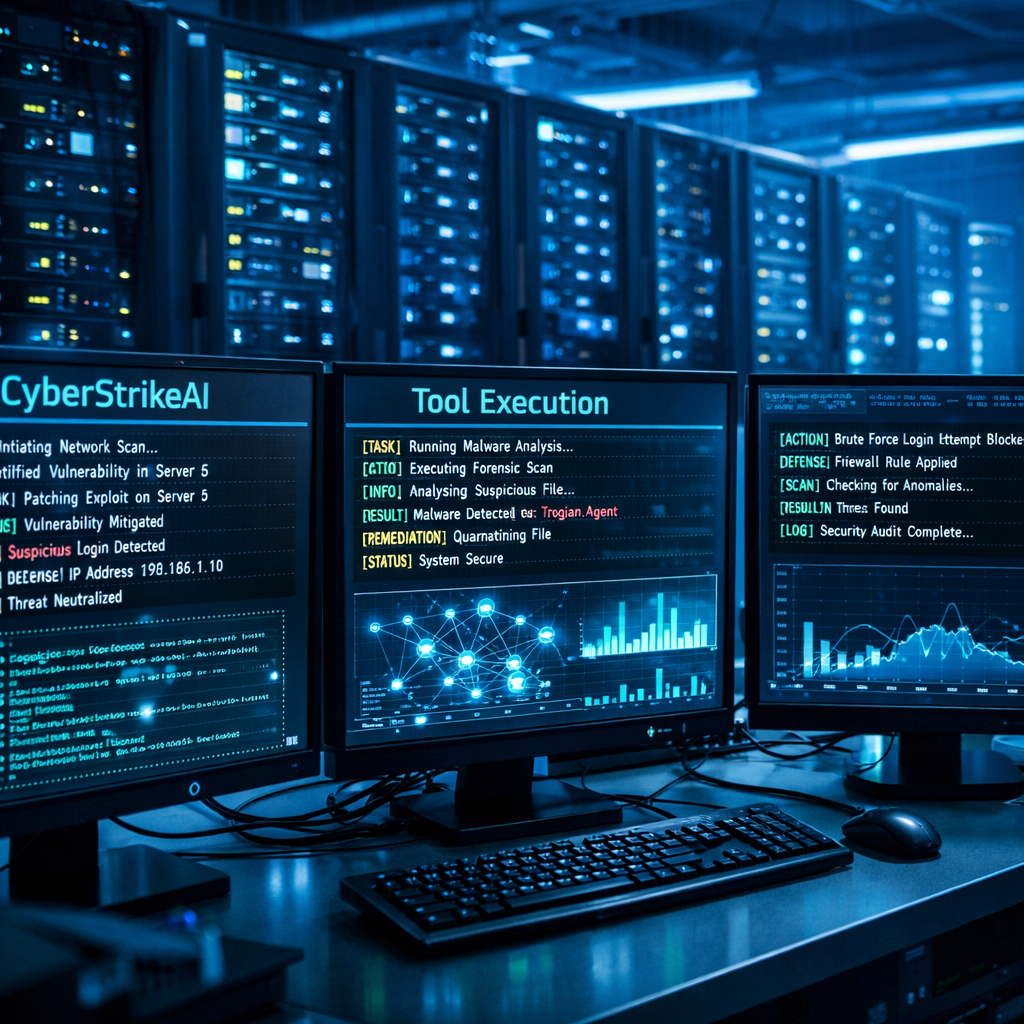
An exposed installation of CyberStrikeAI—a tool that connects language models to security-tool sets for penetration testing—conducted 221 automated tool executions in a single session on November 16, 2026, without human approval at its gate. Diagnostics later revealed that the approval gate, designed to intercept each tool invocation, had been disabled. A human still gave instructions to the AI agent via chat, but that is fundamentally different from approving each individual action before it runs.
What Researchers Discovered
The exposed workspace was investigated by Huntback, which accessed logs, conversation history, and the application’s source code. It showed 240 tool calls in total; 221 executions matched the database of recorded tasks. The rest were internal operations—like updating plans and reading files—that don’t need execution IDs. Of the 221 executed tools, 209 were marked completed and 12 failed. Importantly, four approval rejections were logged—but none from a human reviewer; they were automatically issued after no response came from the model.
At 09:48:15 UTC, researchers saw that approval enforcement was toggled off; it remains unclear who made that change, and there was no indication the AI agent triggered it itself. Later, a person asked the agent to list write and delete actions for chat‐based approval—but that didn’t re-enable the formal gate designed to stop actions before execution. This scenario differs from other recent warnings, like FBI’s ARTEX, in which attackers gained privileged access within a few hours.
What The Session Actually Revealed—and What It Didn’t
The records showed a compute service returned node and job data. But the findings did not prove any destructive or breach activity: no confirmed database tampering, no verified internal network access, no unauthorized shell access. Searches indicating thousands of records, or scripts listing objects, couldn’t establish actual data exfiltration. Even reported new wallets or a list of tools didn’t confirm misuse or criminal intent.
Still, the logs do show nine findings listed as potential vulnerabilities. Huntback emphasized these weren’t independently verified. The investigation stopped short of re‐running any code or breaking into systems, focusing instead on analyzing what the exposed artifacts already showed.
What Security Teams Should Watch For
The incident underscores a few key signals of compromise when AI agents are in play: automatic reviewer failures, disabling of approval gates, and then renewed tool activity. Experts recommend checking for exposed conversation databases, diagnostic logs, or uploaded files—especially when the main application requires authentication but auxiliary services don’t.
Indicators of compromise identified include IP addresses hosting workspace files, exposed diagnostic and conversation logs, server paths like “/CyberStrikeAI/data/conversations.db” and “/CyberStrikeAI/log/diagnostic‐2026-11-16.log,” and the SHA-256 hashes of key files. The model configuration “deepseek-v4-pro” was also noted in the runtime records.
Even with uncertainty around actual damage, this event raises serious questions about how AI-driven security tools can be misconfigured. What happened here wasn’t a zero-day exploit or a malware campaign—it was a framework doing what it was programmed to, but without the checks intended to constrain it.