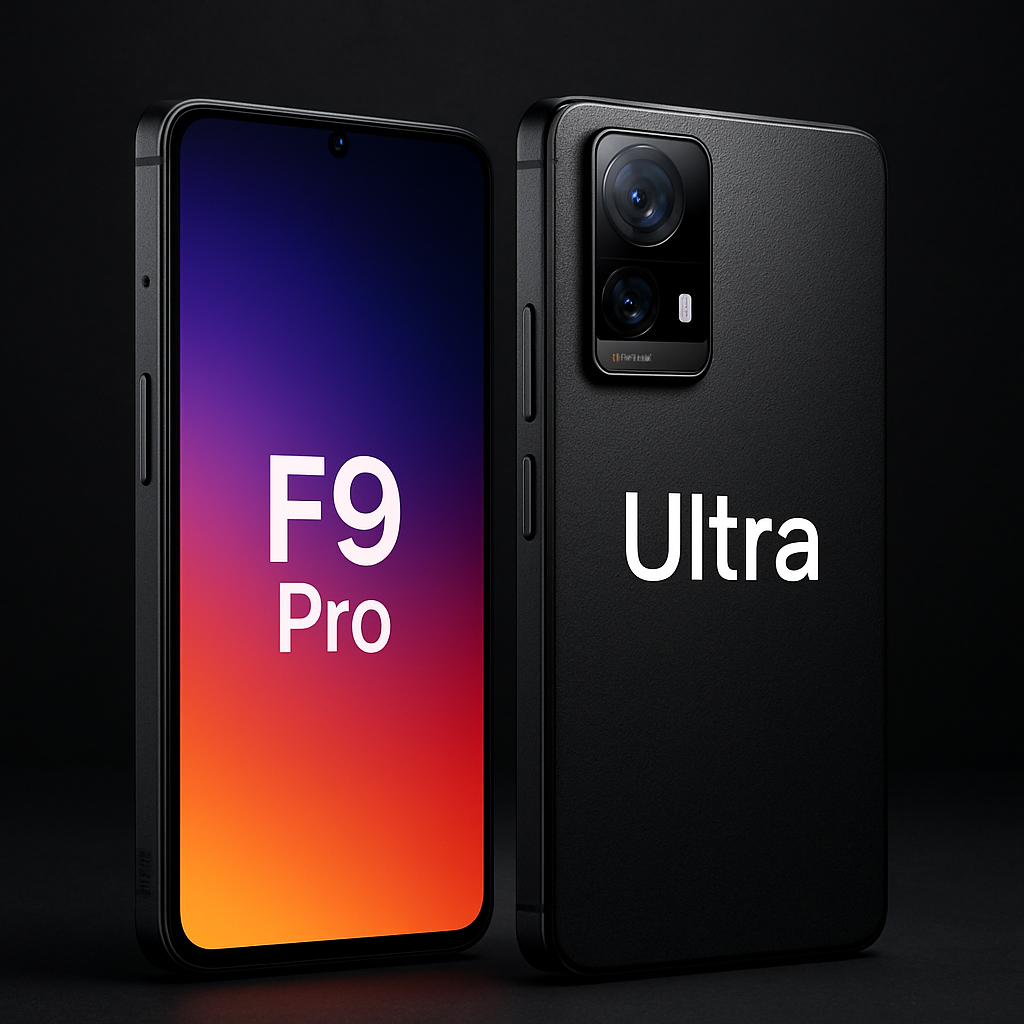
Poco has unveiled its newest pair of flagship smartphones: the Poco F9 Pro and Poco F9 Ultra. Both devices push the envelope with cutting-edge hardware, towering displays, AI-enhanced photography, and batteries built for marathon usage. Here’s a breakdown of what’s new, what separates them, and why this matters.
Performance, display & core design
The F9 Ultra is powered by Qualcomm’s Snapdragon 8 Elite Gen 5, offering up to 16 GB RAM and a huge 1 TB of ultra-fast UFS 4.1 storage. The F9 Pro also runs the same Gen 5 platform (V Series SM8850-1-AB), though capped at 12 GB RAM and 512 GB storage. Both models include Poco’s VisionBoost D8 graphics chip—built on a 12 nm process—for AI frame insertion and super-resolution tasks, delivering smoother animation and sharper visuals.
Display tech is a shared strength. Each phone features a HyperRGB AMOLED screen with an ultra-high 185 Hz refresh rate and peak brightness of 4,500 nits. The F9 Pro carries a 6.59-inch panel at 2510 × 1156 resolution; the Ultra grows to 6.9-inch with 2608 × 1200 resolution. Touch responsiveness is class-leading, with 480 Hz 10-point touch sampling and instant 4800 Hz touch sensing. Protective glass is Gorilla Glass 7i, and both phones use ultrasonic in-display fingerprint sensors.
Cameras, audio & battery life
Camera hardware has been significantly upgraded. Both F9 models feature a 200 MP main sensor, complete with optical image stabilization (OIS) and 4K video capture. The Pro model complements this with a 50 MP floating telephoto lens (2.5× optical zoom) and an 8 MP ultra-wide; the Ultra swaps in a heavier 50 MP periscope telephoto (5× optical) and a 50 MP ultra-wide setup. For selfies, expect 32 MP modules on both.
Audio is also tailored to the model. The F9 Pro features dual symmetrical stereo speakers, while the Ultra adds a 2.1-channel system: stereo speakers plus a 1620 rear subwoofer. Battery capacity is where the Ultra goes all out—6,330 mAh in the Pro versus a massive 8,050 mAh in the Ultra, which also uses a silicon-carbon blend material (with 16 % silicon content) for its build. Charging options are extensive: 100 W wired, 50 W wireless, plus reverse wired (27 W) and wireless (22.5 W) charging on both devices.
Other features & pricing
On the durability side, both phones carry an IP68 rating for dust and water protection. NFC support and the latest release of Xiaomi’s HyperOS 3 are standard. Color choices vary: Pro models come in Black, White, and Aurora Green (the latter featuring glow-in-the-dark rear styling), while Ultra versions are offered in Black or Dark Cherry with glass fibre and interactive lighting effects.
Pricing launches with “early-bird” and standard rates. The F9 Pro begins at $699 (12/256 GB) — early-bird price drops to $649 — and goes to $769 for 12/512 GB ($699 early-bird). The F9 Ultra starts at $799 (12/256 GB; early-bird $729), ramps to $949 for 16/512 GB ($799 early-bird), and tops out at $1,199 for the 16/1 TB version ($1,059 for early-bird). Global orders will be open via Poco’s international site and Xiaomi’s launch portal.
Why this launch matters: Poco’s F9 duo signals a renewed push into true flagship territory. The inclusion of the Snapdragon 8 Elite Gen 5 series, paired with huge displays and super-size batteries, positions these phones as contenders against top models from Samsung, OnePlus, and others. If Poco executes well on software polish and delivery timelines, the Ultra—especially—could make serious headway in markets where battery life and camera power are top priorities.