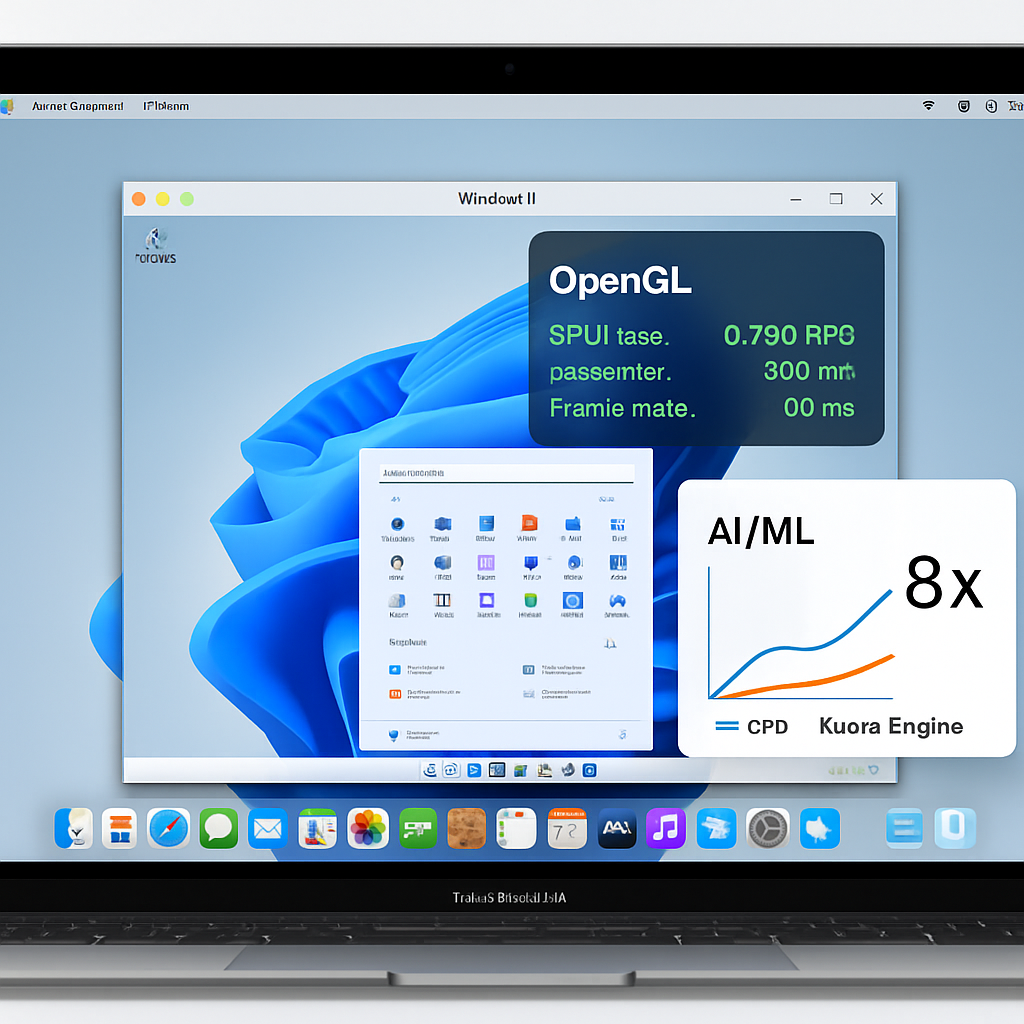
Parallels has unveiled Desktop 27, a major update for Mac users who rely on Windows or Linux virtual machines. With this version, Parallels is leaning heavily into hardware-accelerated graphics, local AI performance, and enterprise features tailored for teams managing many Macs. The catch: it works only on Apple silicon machines.
Graphics Boost Through OpenGL 4.3
A highlight of Parallels Desktop 27 is the introduction of a new Metal-based graphics driver that supports OpenGL 4.3 in Windows VMs on Macs with Apple silicon. This opens compatibility with demanding Windows applications such as ArcGIS Pro, ZWCAD, and Blender 4.3—software which, until now, had been constrained or unusable in a virtual environment on Mac. Parallels claims graphics performance jumps of up to 160% on M3 and newer chips, with ArcGIS Pro seeing up to 35% faster 3D rendering and full workflows cut by as much as 24%.
Speeding Up Local AI & Machine Learning
For developers working with AI and ML workloads, Parallels Desktop 27 adds support for the Scalable Matrix Extension (SME2) instructions in both Linux and Windows VMs—limited to Macs with M4 chips or better. This translates into much faster matrix operations (up to 7×) and significantly quicker neural network inference (up to 1.75×). Tools like Ollama and llama.cpp especially stand to benefit. These improvements reduce dependence on cloud resources for many workflows.
Enterprise & Deployment Features
On the enterprise side, Parallels Desktop 27 rolls out updates to SSO (Single Sign-On), renewed SOC 2 compliance, and better security posture through third-party assessments. Teams also get a refined DevOps management interface that complements the command line tools, helping with tasks like automation, managing hosts and VMs, and releasing resources dynamically (e.g., via Jenkins). Secure Golden Images provisioning now supports enterprise storage services such as Azure Blob Storage and SharePoint, which helps streamline zero-touch, fully provisioned VM setups.
Apple Silicon Only & Version Compatibility
This release marks the end of Parallels Desktop support for Intel Macs. Version 27 requires Apple silicon hardware and is built for macOS 27 Golden Gate, which also drops support for Intel Macs. Those using Intel machines can continue with Desktop 26, which will receive security updates through August 2027. Any future macOS moves are aligned with Apple’s transition away from Intel.
What This Means: If you rely on graphics‐intensive Windows apps, build AI models locally, or work in enterprise environments, Parallels Desktop 27 offers meaningful improvements that leverage the power of newer Apple chips. For everyday users doing basic Office work, the gains might be modest.
Looking ahead, it’ll be interesting to see how developers adapt to the SME2-enabled acceleration, and whether software vendors begin delivering native OpenGL versions that further blur the line between virtual and native performance on Macs. Also to watch: the impact of Apple’s macOS 27 platform updates — especially around virtualization support, security, and AI — as the new features mature in real-world settings.