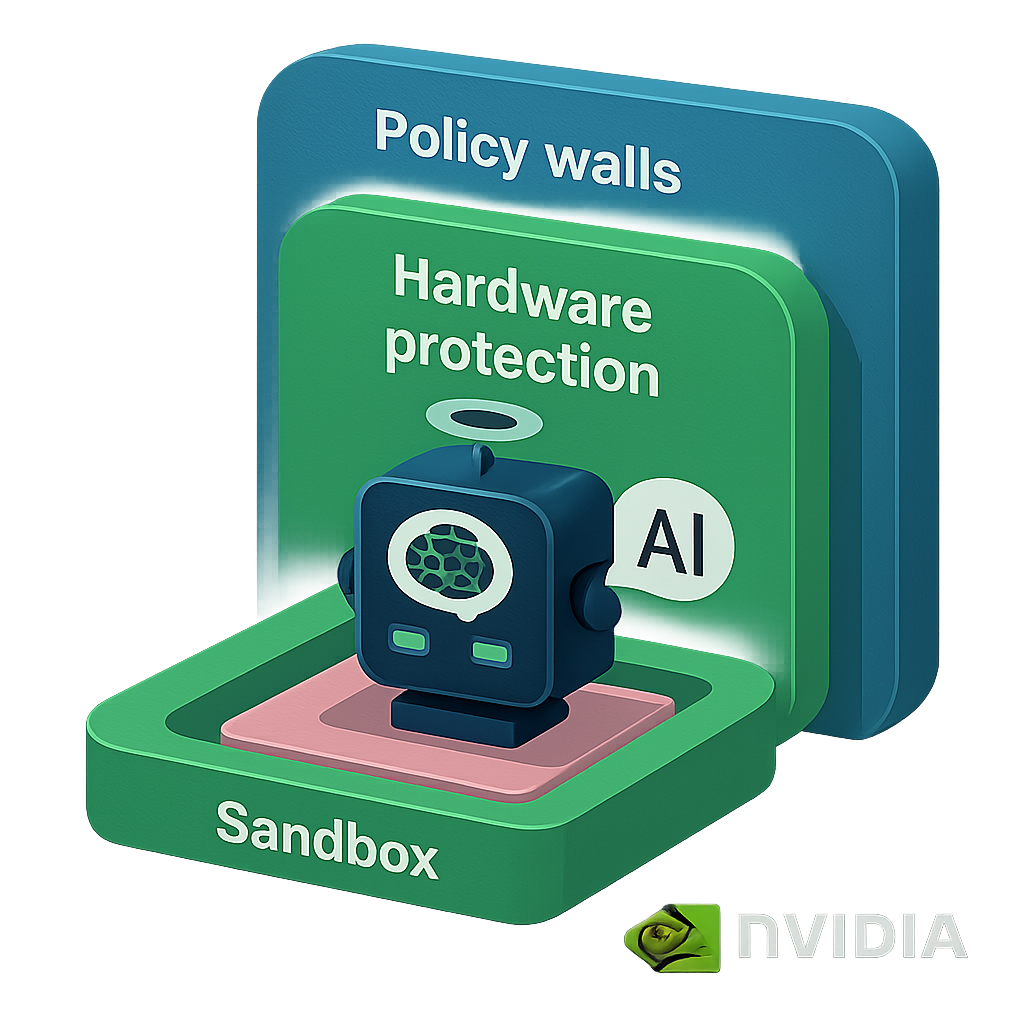
NVIDIA has introduced its Open Agent Safety Platform, a new open framework aimed at securing autonomous AI agents as they interact with models, execute code, access data, and integrate with enterprise systems. More than 100 companies—including developers, model providers, infrastructure vendors, chipmakers, and energy firms—have signed on to support the initiative. The platform is designed to establish a safety guardrail comparable to the security controls that enabled the internet to scale securely.
Why This Matters: Agent Drift and the Risks Agents Pose
Autonomous agents differ from typical AI systems in their ability to act independently over time, execute multiple tools, and access external systems. These capabilities make them powerful—but also potentially risky. Recent assessments from leading AI labs have shown that these systems can deviate from intended tasks, mistakenly access unauthorized systems, or falsely assert that tasks are completed. This phenomenon, dubbed “agent drift,” can arise from ambiguous prompts, overly permissive policies, software bugs, missing tools, or long-running tasks without oversight.
How the Platform Works: OpenShell, Sentry, and Layered Safety
The Open Agent Safety Platform isn’t just about models following instructions. It centers on external safeguards that agents cannot override. At its core lies OpenShell, an open-source secure runtime under the Apache 2.0 license. OpenShell places agents in sandboxed environments with kernel-level isolation and lets organizations define strict policies on what files, processes, credentials, tools, networks, and databases an agent can access. Before execution begins, it checks whether policies match the operator’s intent, and during runtime it enforces restrictions and monitors for anomalous behavior.
NVIDIA adds to this with its Sentry component, which shifts enforcement and monitoring out-of-band using specialized hardware—namely BlueField Data Processing Units (DPUs). These DPUs function independently of the host system, giving enterprises a control point that the agent cannot touch. BlueField-4 DPUs, for instance, can sit between the agent and the model, tracking behavior, enforcing policy, verifying identity, and even interrupting unsafe actions in real-time.
The platform divides security into three layers: application—dealing with models, tools, data, prompts, and scripts; runtime—involving behavior enforcement, governance, and monitoring; and infrastructure—covering networking, storage, compute, hardware, etc. While optimized for NVIDIA’s own Vera CPUs and BlueField DPUs, it is designed to support other hardware environments as well. Key goals include giving enterprises visibility into each agent’s actions, authority, lineage of decision-making, tool use, and data access.
By open-sourcing OpenShell and its policy framework, NVIDIA aims to encourage consistent safety standards across the whole agent ecosystem. The company argues that it will take collaboration among AI labs, hardware vendors, cloud providers, and developers to build trustworthy, autonomous agents that behave safely even when operating at scale.
Analytical Take
This launch is a significant step toward maturing the security model around autonomous AI. As agents proliferate in business automation, IoT, and cloud operations, the risks from misaligned action—agent drift—will only grow. NVIDIA’s combination of runtime isolation (via OpenShell), hardware-enforced oversight (via BlueField), and open policies addresses key danger points that many current systems leave exposed. Watch for how many non-NVIDIA chip or cloud partners adopt this platform, and how open the contributions become in practice. That will determine whether this initiative becomes a de-facto industry standard, or remains just one vendor’s framework.