Northwood Space, a provider of satellite ground-station infrastructure, has raised $375 million in a Series C financing round that values the company at $2 billion. The investment, announced Monday, was co-led by Andreessen Horowitz (a16z) and DFJ Growth, and includes participation from Alpine Space Ventures, Washington Harbour Partners, Stepstone Activate, In-Q-Tel, and others. The company also secured a multi-year credit facility from HSBC Innovation Banking to support its expansion. This brings Northwood’s total equity raised to over $500 million.
What Northwood Does
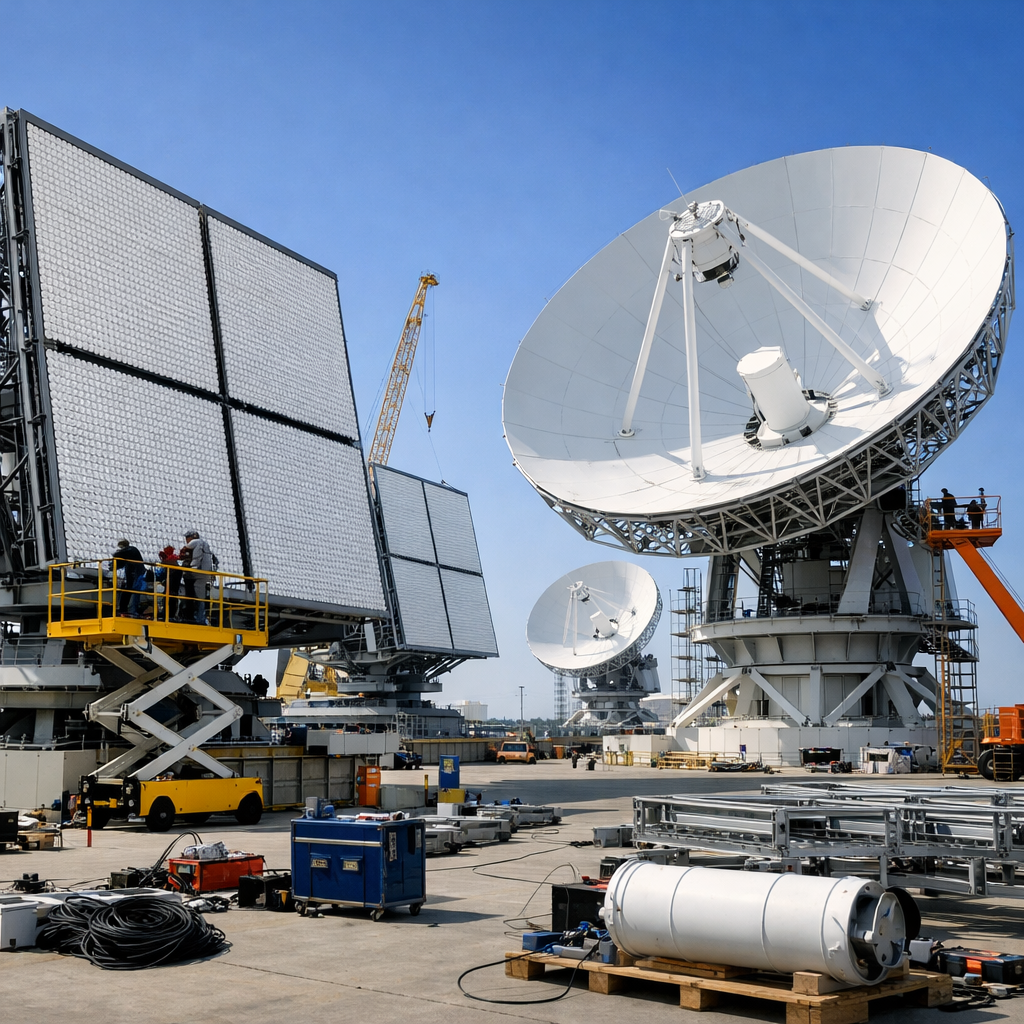
Founded in Torrance, California, Northwood Space designs and operates a shared ground-network layer connecting satellites to Earth. Its portfolio currently includes two major hardware products: Portal, a phased-array antenna system engineered for command, control, and telemetry (C2/TT&C) use cases, and Prism, a high-throughput parabolic antenna designed to handle large data downlinks. Portal supports simultaneous contacts with up to six satellites and operates across multiple orbital regimes—low Earth orbit (LEO), medium Earth orbit (MEO), and geostationary Earth orbit (GEO)—using electronically steerable beams. Prism provides high-volume links and flexible RF capability across commercial and government missions.
What the Capital Will Fuel
Northwood intends to spend the new funds accelerating its hardware production and deploying more ground-station sites worldwide. Over the past year, the company built 29 units combined from both product lines, and aims to scale that to “hundreds” of units. A new production facility in Torrance spans 185,000 square feet and is built to support the manufacturing demands of high-volume deployment. The team currently has around 140 employees, with plans to add roughly 400 more over the next three years across Torrance and Washington, D.C., particularly in RF engineering, manufacturing, software development, and site operations.
The company has already made strides on contracts and deployments. In January, it secured a $49.8 million contract with the U.S. Space Force to support its Satellite Control Network. It has deployed multi-orbit-capable ground-station sites on two continents, with more sites under construction across more regions. Northwood also emphasizes rapid deployment: its modular hardware fits into standard freight containers, enabling international shipping and activation that takes hours, rather than the months or years typical for traditional dishes. For example, the company demonstrated that just 10 Portal units can replicate the performance of a single 20-foot dish.
Why This Matters
The number of operational satellites has surged, placing increased strain on terrestrial infrastructure that supports telemetry, tracking, command, and data delivery. Northwood argues that traditional ground-station models struggle to keep pace with this growth due to long manufacturing cycles, site approvals, and logistical constraints. Its shared, vertically integrated approach aims to address those bottlenecks by combining hardware, software, and global operations in a more scalable, resilient framework.
The current raise arrives less than nine months after Northwood’s $100 million Series B and follows recent technical milestones including live GEO command links, multi-orbit site deployments, and the operational launch of both Portal and Prism antennas. With demand from commercial and government space sectors rising sharply, Northwood is seeking to meet that need with infrastructure that can scale fast, flex reliably, and deploy globally.
Analytical Take: The ground segment of satellite infrastructure is finally getting its due—it’s no longer the invisible backend, but the performance bottleneck and scaling challenge for modern space constellations. Northwood’s large raise and rapid growth signal that investors believe ground networks are as critical to space’s future as launch or spacecraft design. Key to watch: how quickly Northwood turns capital into sustained throughput, uptime, and international footprint. If they can deliver on deployment speed and global reach—as promised—it could reshape how satellite missions are supported, especially for defense, Earth observation, and broadband constellations.