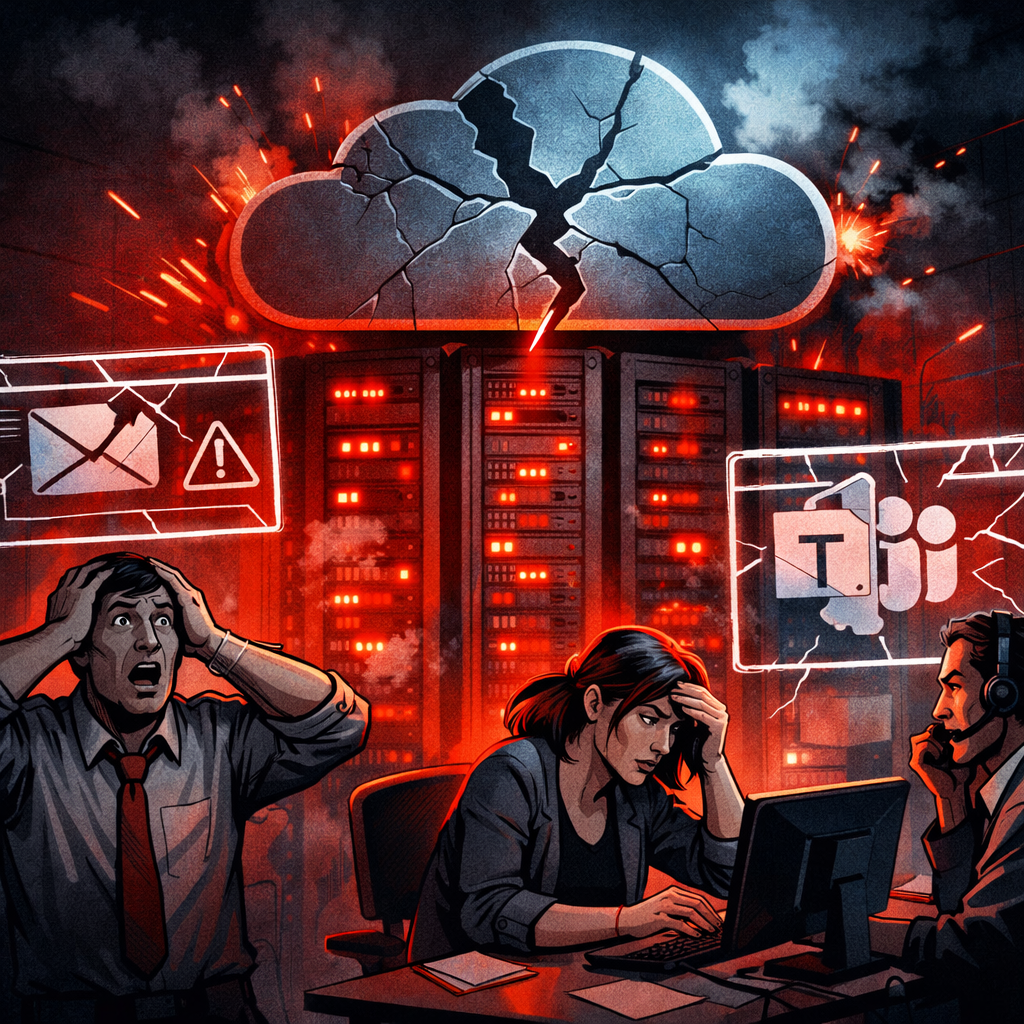
Microsoft has declared an internal “Code Red” following a prolonged outage that crippled major services like Microsoft 365, Outlook, Teams, Copilot, and Exchange Online for nearly 24 hours beginning November 12, 2026. What started as mailbox access issues quickly spread, affecting SharePoint and Microsoft Defender XDR. The disruption slashed productivity for businesses worldwide, including government operations, airlines, and trading firms. CEO Satya Nadella issued a public apology, and Microsoft emphasized that the outage was not due to a cyberattack or AI agents.
Root Cause: A Code Defect in Cloud Gateways
The chaos stemmed from a Windows defect introduced in July on Microsoft’s cloud gateway servers—specialized machines that route incoming traffic for Microsoft 365. This flaw didn’t surface earlier because it impacted newer machines with more CPU cores more severely, and testing had missed this variation. Internal tasks began to compete for shared resources, overtaxing processing and memory capacities.
As the outage unfolded, Teams traffic was shifted onto the primary gateway that also handles Exchange Online, at a time when approximately 14% of that gateway’s capacity was already offline due to another issue. That overloaded servers, which then began to fail en masse. Exchange Online could not reroute traffic effectively, leaving mailboxes offline or inaccessible for many users.
Restoration, Diagnostic Chaos, and New Targets
To bring services back online, Microsoft reinstated an older method of managing incoming connections, restarted server clusters, and gradually rerouted traffic to healthy machines. To prevent emails stuck in queues from being rejected, the company extended delivery timeouts to 48 hours.
During the outage, over 80% of gateway servers went unresponsive, illustrating just how widespread the failure became. Internally, Microsoft’s response revealed organizational strain: engineers relied on more than 11,000 messages across 11 Teams threads, while diagnostic logs were disjointedly stored, making coordination cumbersome.
As part of its postmortem, Microsoft set an internal goal to shrink recovery times from prolonged outages—aiming to restore service globally within one hour. Though this is not a formal guarantee to customers, it reflects a push to improve resilience. Among planned technical fixes: limiting incoming requests under high server load; segregating traffic by geographic region to localize failures; and using AI tools to synthesize diagnostic data for faster incident tracking.
Wide Ripple Effects and Transparency Moves
The outage’s impacts went well beyond individual users. Government communications were disrupted, trading operations delayed, and airline and regulatory workflows affected. In the UK, Parliament debated how such infrastructure failures underscore dependencies that span across multiple applications built on the same backbone.
For administrators, Microsoft offered specific incident codes—MO1550821 for the broader outage and EX1550543 for mailbox access issues—and recommended monitoring its public service status page in case the admin centers are inaccessible.
This event marks the most prolonged Exchange Online outage in Microsoft’s history, with many users losing email access for longer than ever before. Internal statements indicate wake-up calls on both tech and coordination fronts.
What This Means & What to Watch Next
This outage is a stark reminder: as cloud platforms grow in scale and complexity—spanning AI agents, real-time collaboration, and enterprise infrastructure—latent flaws in shared components can cascade into global disasters. Microsoft’s targeting of under-an-hour recovery for wide-scale incidents signals growing urgency around resilience and reliability.
Upcoming benchmarks will be critical. Microsoft must prove its internal target of 1-hour full service recovery under pressure. Administrators will watch for whether planned regional isolation and AI-driven diagnostics make a difference. And for businesses, this is a moment to negotiate stronger SLAs and demand greater transparency around internal thresholds and postmortems. The industry is watching closely.