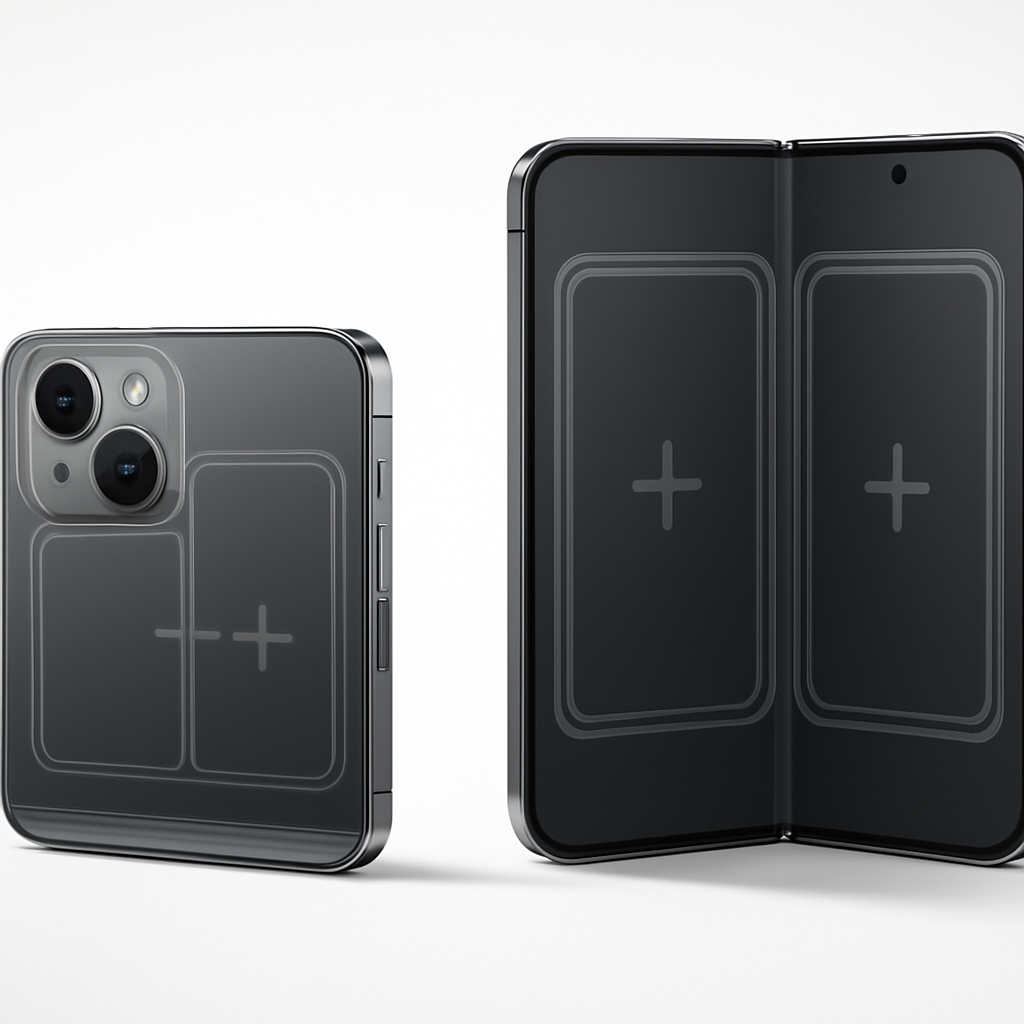
Apple has officially disclosed the battery capacity for its first foldable iPhone, the iPhone Duo. According to documentation published for its EU energy label, the device packs a combined total capacity of 4,883 mAh. This figure represents the sum of two individual battery cells inside the device — one measuring 2,962 mAh and the other at 1,921 mAh.
What the Battery Size Means in Context
The Duo’s dual-cell architecture diverges from more traditional single-cell designs, splitting power across two modules. This approach could be driven by the foldable form factor’s internal constraints — the hinged design likely forces divided space, so dual cells are a practical solution to maintain capacity without compromising structure.
To gauge how 4,883 mAh stacks up, the eSIM-only iPhone 18 Pro has a single battery of about 4,288 mAh. On the other end of Apple’s current lineup, the iPhone 18 Pro Max boasts around 5,567 mAh. Thus, the Duo lands in between these two, leaning more towards Pro Max levels but still trailing the largest battery Apple offers.
Other Notable Details
Because the Duo comes exclusively with eSIM support and no physical SIM tray, this battery spec applies universally, without regional variants or smaller models with reduced capacity. Leaks earlier this week had already suggested the two-cell layout and its breakdown, and now the official documentation confirms both cells and the total. This aligns with earlier teardowns that revealed part of the other iPhone 18 series battery capacities. The 18 Pro and Pro Max, in particular, have been measured at about 4,288 mAh and 5,567 mAh respectively.
The Duo’s foldable design features a 5.4-inch outer display and 7.6-inch interior display, built with a book-style hinge format. It represents Apple’s most radical shift in recent iPhone design — folding inward, minimizing crease visibility, and leaning on familiarity for everyday usability.
Battery capacity doesn’t always translate directly to battery life, though. Users will want to see how Apple balances power efficiency, software optimization, and display demands — especially since foldables tend to draw more power when the inner display is active.
Analysts and enthusiasts alike have been curious whether the Duo could match or exceed some Android foldables on battery life. With a near-5,000 mAh total, it has the numeric potential, but much will depend on heat management, display refresh rates, chipset efficiency, and usage patterns.
This battery reveal comes just days ahead of Duo’s official launch, giving consumers more data just in time for preorder decisions. Apple has already announced preorder availability starting October 23, with walk-in stock expected to be very limited.
What this means: the Duo’s battery places it in a competitive position — large enough to rival many flagship phones, but still with compromises inherent to foldable engineering. What to watch: real-world battery life tests once the device is in hands; how display brightness and hinge mechanics affect longevity; and whether Apple’s software refinements can squeeze efficiency out of this dual-cell design. If successful, the Duo could reset expectations for foldable iPhone stamina.