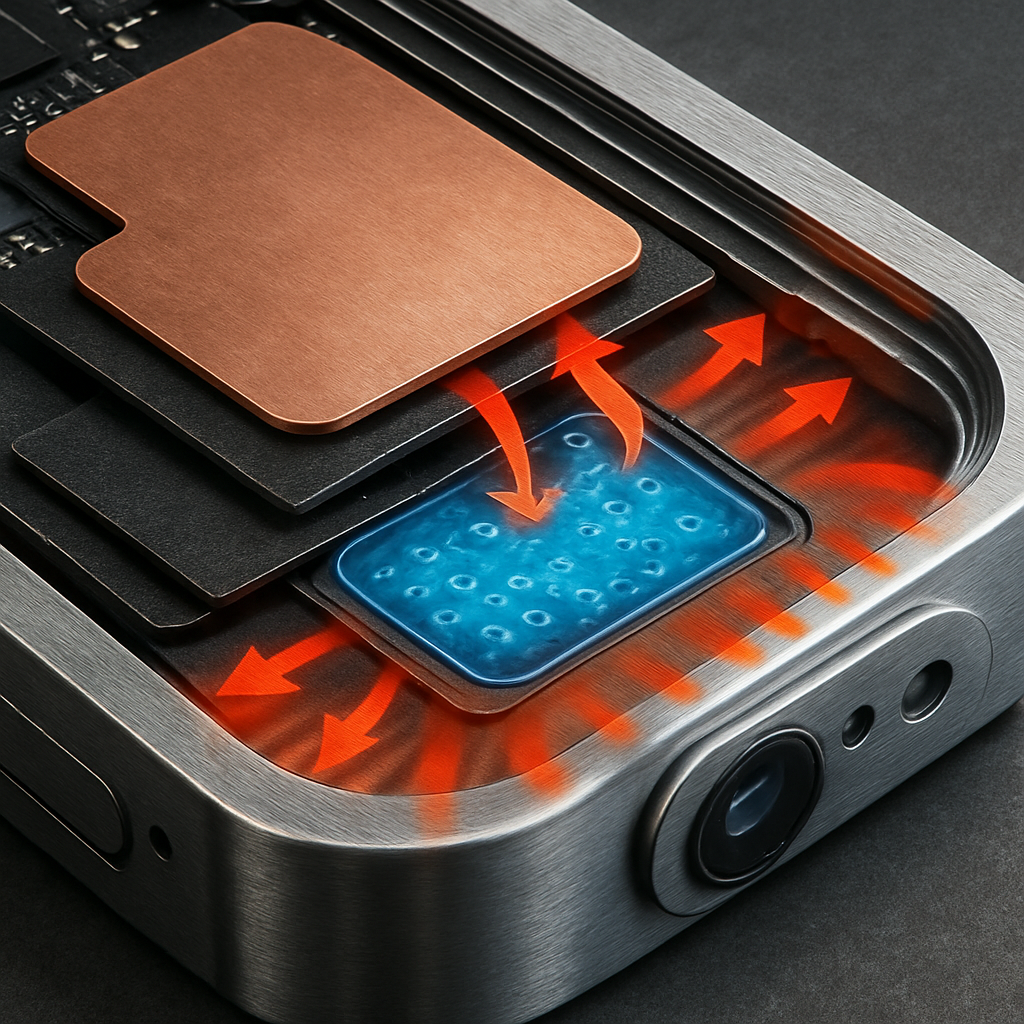
Apple’s newly unveiled iPhone 18 Pro significantly upgrades its thermal design, delivering roughly three times the cooling capacity of the iPhone 17 Pro. This enhancement is part of a broader shift in architecture that allows the device to sustain higher performance under demanding tasks like gaming, on-device AI workloads, and extended video recording. Key to this leap is how the new A20 Pro chip has been engineered and tethered to a more efficient heat dissipation system.
What’s Different Under the Hood
The A20 Pro chip introduces a packaging method inspired by Apple’s M-series silicon designs that places the processor die directly next to memory modules. This alteration removes memory from the thermal path, helping heat flow more efficiently. Connected directly to what Apple calls a next-generation vapor chamber, this setup allows better management of thermal energy, especially when pushing for high sustained performance. Together with upgraded materials and construction, these changes bridge a gap in how quickly and how efficiently heat is moved away from core components.
The Vapor Chamber: Larger, More Efficient Surface Area
The vapor chamber itself has been redesigned with about three times the surface area compared to last year’s model. It employs premium materials—more graphite and copper—alongside stainless steel that Apple reports is largely recycled. These changes enable a much larger contact area for heat to dissipate and tie into the aluminum body, further aiding heat flow.
Performance and Battery Gains That Follow
Thanks to the cooling revamp, Apple claims that iPhone 18 Pro achieves its highest sustained performance ever. In internal comparisons with the iPhone 17 Pro, this translates to up to a 40% improvement under continuous loads. In addition, battery life has also been extended: video playback reaches up to 36 hours on the Pro and up to 45 hours on the Pro Max in eSIM-only models.
Charging speeds also see gains with the standard model reportedly charging to 50% in about 15 minutes via wired, and around 30 minutes via wireless charging. These improvements reflect a broader optimization in Apple Silicon efficiency, battery design, and heat control.
iPhone 18 Pro’s cooling system is not just about raw power—it’s about maintaining that power under thermal stress. The new setup helps prevent the throttling that often follows intensive usage, while also preserving longevity and responsiveness. With the vapor chamber performing a central role, the aluminum frame acting as an efficient sink, and the memory removed from the hottest parts of the chip package, this model is clearly targeting serious users who demand both speed and stability.
Combining all these architectural and material changes, Apple positions iPhone 18 Pro as its best effort yet at sustained high performance—fueling big gains for gaming, AI, video work, and other power-user demands. This applies especially to the Pro Max, which inherits the same cooling tech but couples it with a larger battery for even longer lasting usage.
It’s not just about peak benchmarks anymore; Apple is stressing how its Pro devices now aim to stay at the top of their game longer without overheating. This matters for anyone using their phone for extended loads—live streaming, AR, 4K/8K video capture, or demanding machine learning tasks. The days when your device throttles aggressively after a few minutes of gaming may be on their way out.
Analytically, Apple’s cooling gains in iPhone 18 Pro reflect both a response to increasingly powerful smartphone demands and a visible engineering shift. Moving memory off the thermal path, expanding vapor chamber surface area, and leveraging recycled, high-conductivity materials suggest Apple is taking thermal design seriously in more ways than one. What to watch for next: whether the Pro lineup can maintain performance in real-world conditions—especially at high ambient temperatures—and how the improved cooling influences overall lifespan. The new design sets a higher bar for thermal stability; now the test will be in daily use.