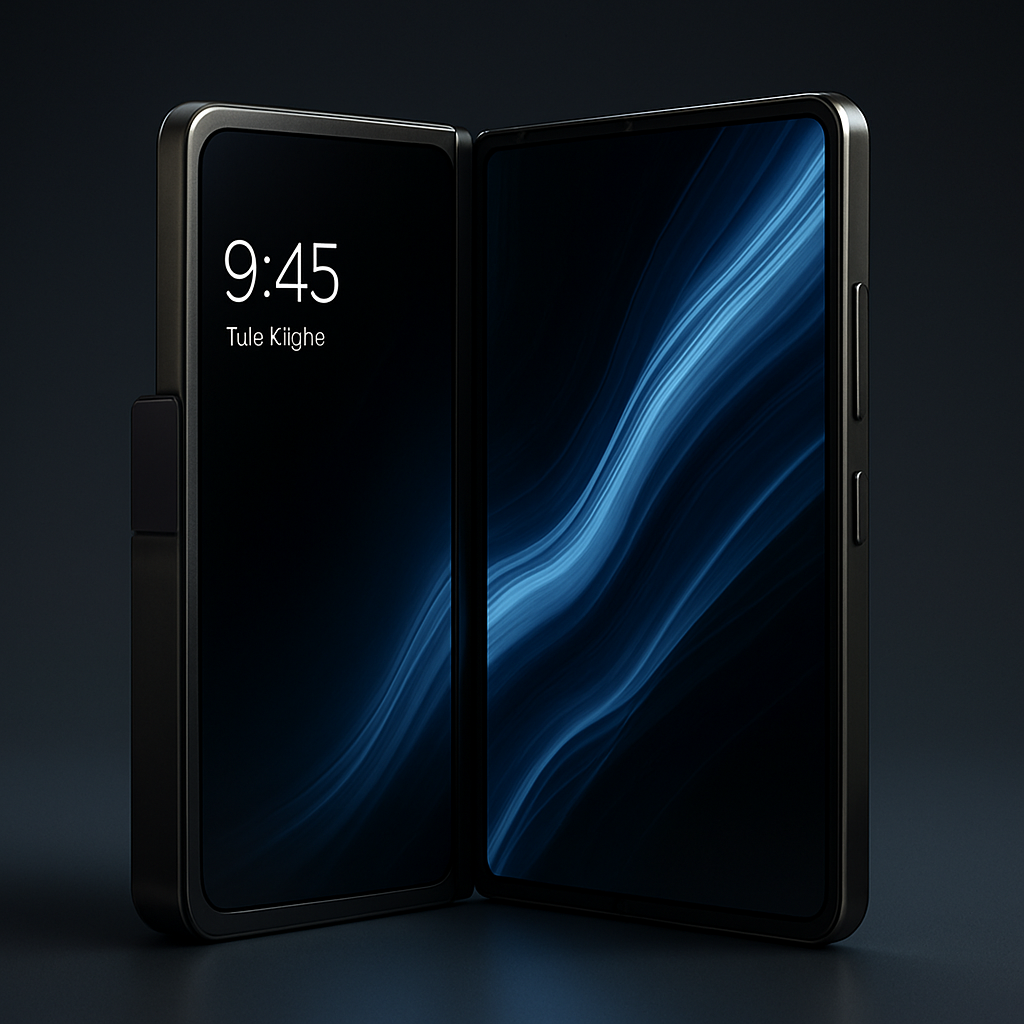
After years of speculation, Apple has officially entered the foldable phone market with its first such device, the iPhone Duo. Revealed during the “Surprise and Shine” event, this unique phone combines a compact outer display with a larger inner screen, wrapped in premium materials and cutting-edge tech—but at a premium price. Here’s what sets it apart, and where it may have to compromise against rivals.
What the iPhone Duo Brings to the Table
The iPhone Duo features a short, wide external display for one-handed use when closed, along with two rear cameras and a hinge that opens to reveal a larger tablet-like display inside. The outer screen measures 5.4 inches, while the internal display spans 7.6 inches. Both use Super Retina XDR tech, supported by ProMotion, Always On, and reach brightness levels up to 3,000 nits. Apple has also included a selfie camera tucked under the screen, though it is slightly visible depending on the content.
Build materials include a titanium chassis, with Ceramic Shield glass on both front and rear surfaces; the front display also uses a second-generation Ceramic Shield. Apple has reworked iOS to take advantage of both screens—sidebars adapt on the inner display, and StandBy mode is optimized so users can see clocks and widgets even when the phone is closed or partially open.
Performance, Battery, and Pricing
Powering the Duo is Apple’s new A20 chip, built on 2nm fabrication. It packs a 6-core CPU (2 performance cores, 4 efficiency cores), a 7-core GPU with claims of up to 40% faster graphics, and dual Neural Engines totaling 32 cores for boosted AI capability. Networked connectivity is handled by Apple’s C2 modem.
The power comes from a dual-battery design delivering up to 31 hours of video playback on the inner display alone. Use of both screens together lowers that duration somewhat, with Apple saying overall use clocks in around 24 hours.
As for the price: the iPhone Duo starts at $1,999 for the 256GB model. Purchases open for preorder on October 16, with official launches slated for October 23. Color options at launch are blue and silver.
Other highlights include a matte nano-texture inner screen to minimize reflection, and USB-C support for Apple Pencil (though magnetic mounting proved problematic in testing). The device will also adapt in different physical states (closed, half-open, etc.), with iOS responding accordingly.
Trade-Offs and Challenges
The price alone puts the Duo in a high tier—well above most nonfolding flagship phones and in the range of niche folding competitors. For many users, size and form factor could be a hurdle; the specs don’t yet reveal weight or thickness, both often compromises in foldables. The visible selfie camera and any potential durability concerns around the hinge and folding display also remain areas to watch.
While Apple has clearly pushed to reduce display crease and visual distortion over time, it’s unclear how this will hold up under daily wear. The late input for Pencil compatibility also suggests some features weren’t fully resolved in initial development.
Release timing could pose its own challenge. With preorders more than a month away, there’s potential for consumers to sit tight for reviews, hands-on impressions and comparisons versus established folding models from competitors.
Why This Move Matters
Apple’s launch of the iPhone Duo signals a decisive entry into a growing foldable market. For years, Apple held back, likely due to technological and material challenges. Now it’s betting on leveraging its software strength—refining iOS to scale across folds, multiple screen states and more complex interactions.
This device also underscores Apple’s increasing emphasis on AI computing at the edge, evident in its dual Neural Engines and the new A20 chip. For users focused on performance and content creation, it may represent what folding phones have promised but often only partially delivered.
The iPhone Duo is a big gamble: a bold design, powerful internals, and Apple’s full confidence in reworked software—but with a price tag and form factor that will not appeal to everyone. It’s a statement more than a mass market product at this stage. What to watch now: real-world durability, battery life under mixed use, software fluidity across folds, and how rivals respond on both price and features in the foldable space.


