Factory automation has long been rigid: robots are finely tuned for a single product or task, and any change means weeks of retooling, reprogramming or swapping equipment. But a San Francisco startup, Industrial Next, is betting a new approach lets factories switch lines in minutes rather than weeks. This would enable automation of delicate, complex tasks that typically still rely on human labor.
AI-Driven Flexibility on the Factory Floor
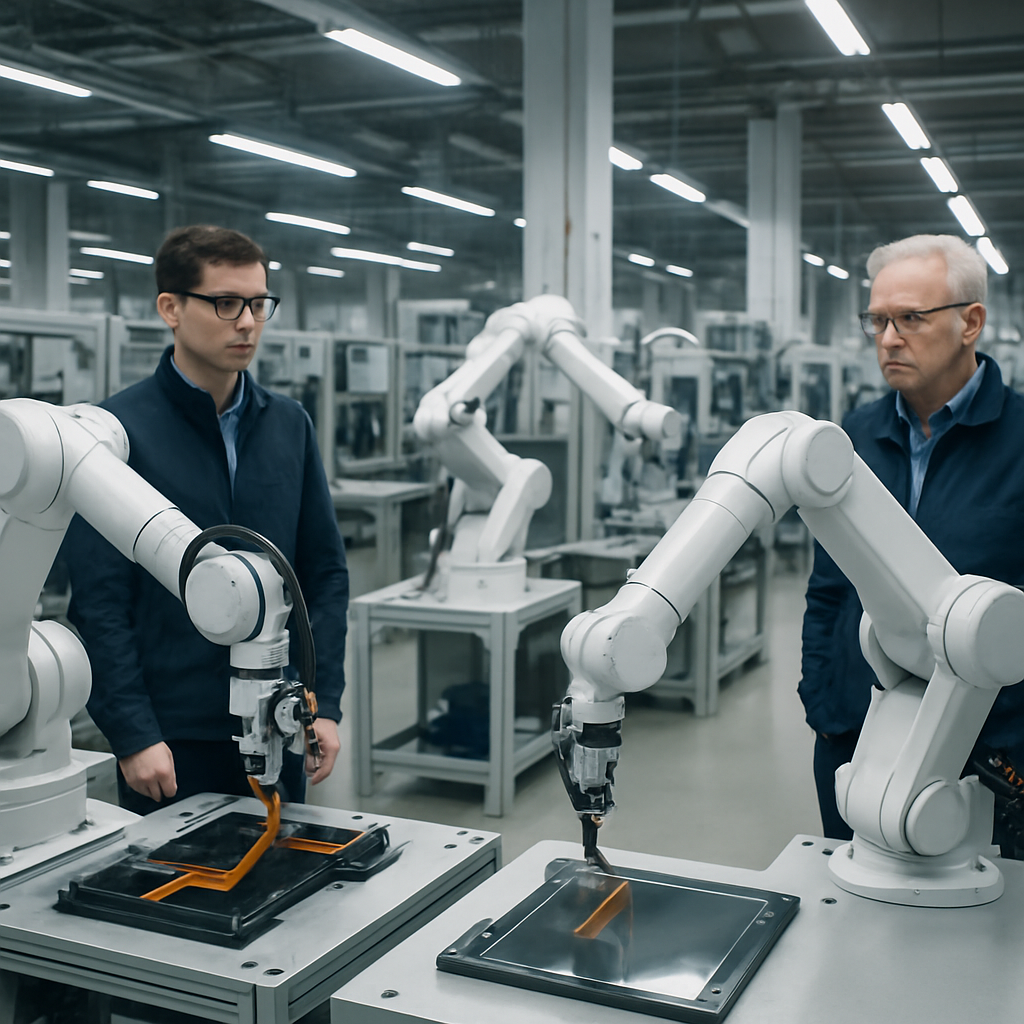
Industrial Next’s claim rests on self-contained robotic stations powered by its own foundation models. These systems tie together vision, task context, and motion planning to allow quick reconfiguration. Instead of writing hard-coded control scripts, manufacturers teach tasks through simulation and demonstration. The robotic stations are designed to be modular—reconfigured, combined, or deployed across different production lines.
A key part of the technology is a high-fidelity simulation engine that creates virtual environments mirroring real-world physics. The robots train in that simulated space to learn precise, dexterous tasks with minimal need for real-world part visibility. According to the company, this training has enabled complex operations long considered too fine for automation—threading flex cables, snapping connector caps, or peeling protective film off phone modules and buttons—with full accuracy, even when encountering entirely new phone models.
Origins, Strategy, and Early Wins
Industrial Next was founded in 2021 by two former Tesla engineers—Lukas Pankau and Allen Pan—who felt existing factory robotics hadn’t kept pace with advances in vehicle and autonomous vehicle design. Frustrated by the gap between cutting-edge machine learning and the outdated industrial equipment they encountered, they sought to reshape how tasks are programmed.
The company has already begun testing its stations in partnership with the BMW Group Technology Office, exploring how its AI-driven approach performs in real-world automotive manufacturing. Some of its robots are also deployed in high-volume smartphone production, executing tasks traditionally avoided by makers due to lack of reliable automation. One such task is film peeling—removing protective film from modules and buttons—with claimed human-level speed and perfect accuracy even on phone models the system had never seen before.
Traditional robotics demands consistency: tiny product changes often break programmed workflows, triggering downtime. Industrial Next’s simulation-based method offers a path toward greater adaptability. By training models ahead of time and using modular stations that can shift between tasks, the startup hopes to minimize disruption when product lines change.
The founders’ long-term vision extends well beyond phones. They aim to scale to end-to-end production, potentially enabling full cars to be built in factory environments without human touch—at least for those parts that can be automated.
This announcement came as Industrial Next presented on stage at Disrupt 2026, where it debuted its capabilities for cameras that understand task context, motion modules, and AI-enabled dexterity.
What this means: If this flexibility works at scale, manufacturers could cut retooling lag, reduce costs of changeovers, and unlock automation in areas still dependent on human precision. The simulation-based approach may be the missing piece that reconciles rapid design innovation with manufacturing speed. Moving forward, it’ll be vital to see how the technology performs across different product types, manufacturing environments, and whether the claimed accuracy and adaptability sustain under heavy industrial load. Watch for demonstrations outside the smartphone sector, regulatory and safety validations, and cost assessments as robots move off the stage and into more complex factories.