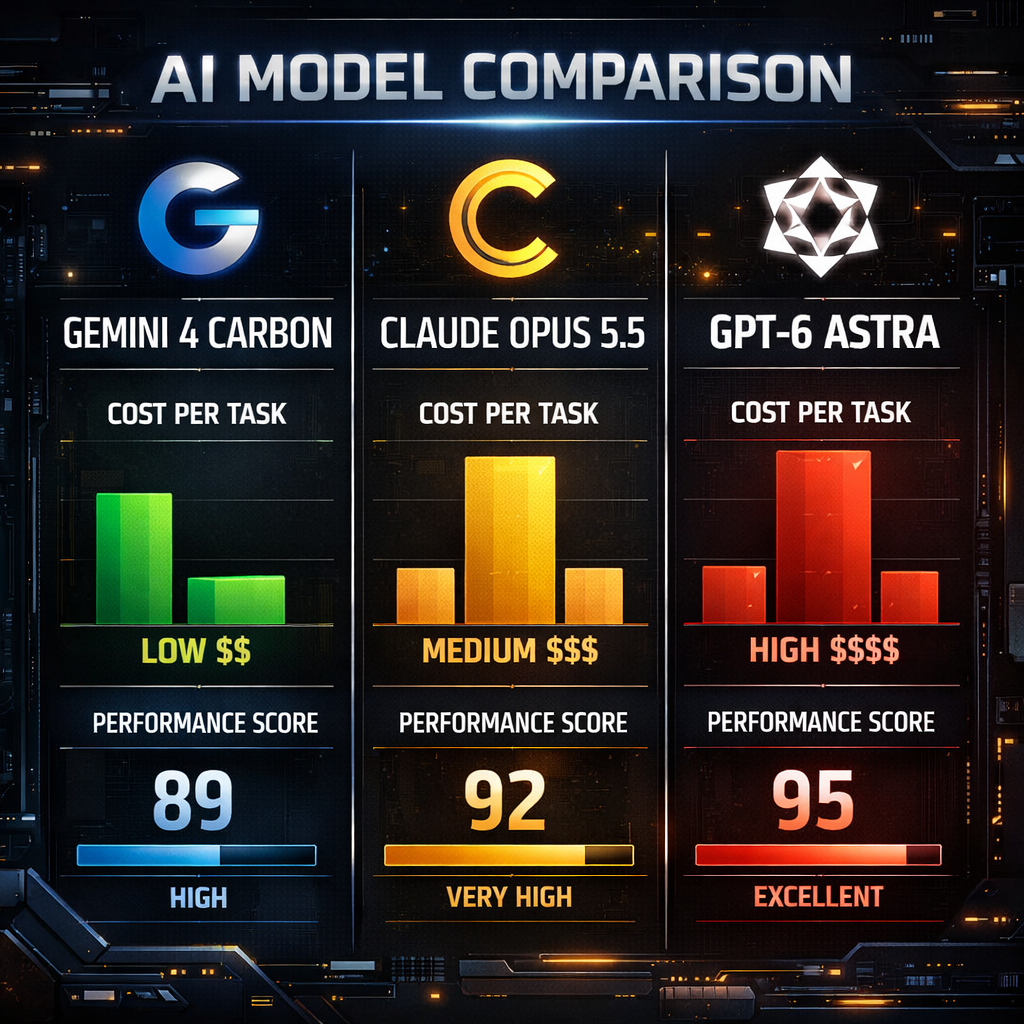
Google’s Gemini 4 Carbon has emerged as a powerhouse in the latest frontier AI evaluation, pushing impressive performance at a fraction of the cost. While it doesn’t claim the top spot, its value proposition is turning heads in the AI field.
Frontier Benchmark Highlights
In its new “GDPx” frontier benchmark, AI research firm SemiAnalysis put Gemini 4 Carbon to the test alongside other leading models from Anthropic, Meta, and OpenAI. The benchmark spans 206 tasks across domains like finance, materials science, cybersecurity, software engineering, law, and biology. These areas are considered rigorous measures of a model’s versatility and real-world utility.
Claude Opus 5.5 from Anthropic still leads the field, yet Gemini 4 Carbon is close behind. What really sets Carbon apart is its cost-to-performance balance: where Claude Opus 5.5 costs about $51 per task, Gemini 4 Carbon comes in at just over $16 per task—nearly three times cheaper. GPT-6 Astra, by comparison, scores lower than both but costs even more—around $54 per task.
Domain Differences & Model Rankings
SemiAnalysis also reported that removing tasks in cybersecurity, biology, and alignment from the mix reshuffles the leaderboard. In that narrower view, models like GPT-6 Astra and Opus 5.5 regain top spots—demonstrating how a model’s strength can vary depending on the domain of tasks evaluated.
Another of Google’s frontier models, Gemini 4 Argon, lands in eighth place in both full and domain-adjusted rankings. While Argon beats Meta’s Muse Wonder, it trails behind Wonder Full in performance. Its cost per task is slightly lower than Carbon but the performance drop is noticeable.
When focusing specifically on cybersecurity tasks, Google’s models outperform many of their peers, though they still fall short of Meta’s Muse models, which dominate these categories by a significant margin.
Google first revealed Gemini 4 Carbon on October 28, promoting “significant gains” over prior models, with a public release listed as “coming soon” for most users. Its internal tests also show it outperforming GPT-6 Astra and Opus 5.5 in many areas, building on SemiAnalysis’s external results.
Analysts, developers, and customers looking for leading-edge model performance now face choices not just about raw capability, but cost effectiveness and handling across different domains. Gemini 4 Carbon clearly makes a strong case in that balancing act.
Why this matters: AI models are no longer being judged solely on top scores—cost per task, efficiency in domain-specific applications, and scalability are now central. Gemini 4 Carbon’s results show Google has prioritized these metrics, which are especially relevant as enterprises consider deploying frontier models at scale. As Carbon becomes more broadly available, watching its adoption—and how future models respond—will be crucial.