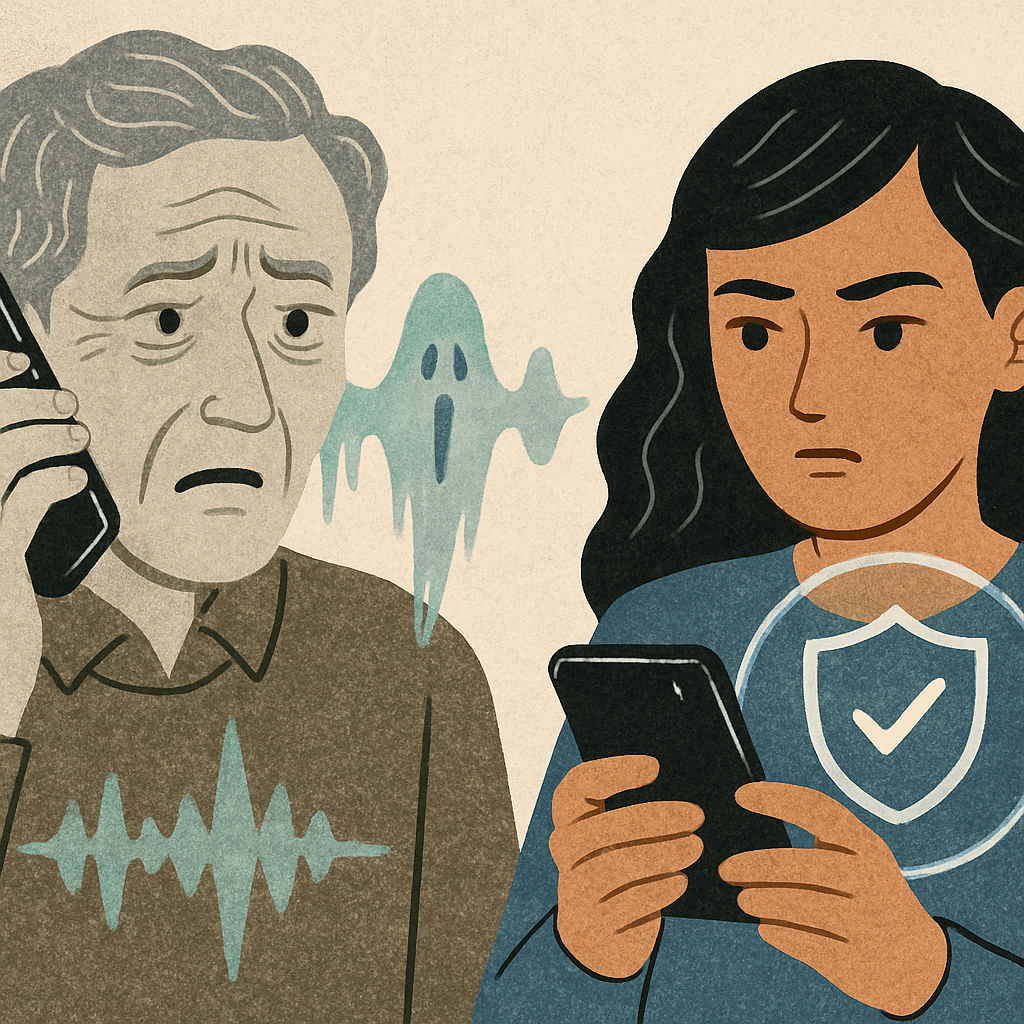
A phone call two years ago convinced Tarini Padmanabhuni’s grandfather he was speaking to his own brother. The caller claimed that the brother had been abducted and only a ransom could save him. Trusting the voice, the grandfather paid—only later discovering the claim was false and the voice was a deepfake imitation. The realization that there was no way for him to tell the difference lingered with Padmanabhuni.
That experience sparked the creation of DetectifAI, a San Francisco startup building tools designed to stop deepfake voice scams before they succeed. Such fraud is rapidly growing: in the U.S. alone, people lost nearly $900 million to AI-enabled scams last year—a 24% increase from 2024—and the most vulnerable are those aged 60 and up, who lost roughly twice as much as the 50–59 age group.
On-Device Deepfake Detection
Padmanabhuni argues that current detection tools fail to protect users at the most critical moment because they depend on cloud-based models. These require data to be sent off the device, introducing delay, privacy risk, and a chance for tampering. DetectifAI takes a different path. Its models are built compact from the start so they can run locally on a smartphone’s operating system. That enables instant detection of fake or AI-modulated voices during calls, voice messages, or other audio, without audio data ever leaving the device.
Product & Market Strategy
DetectifAI offers its solution through a software development kit (SDK) that can be licensed by phone manufacturers, allowing the feature to be embedded directly into future handsets. Padmanabhuni believes this could become a standard spec—much as camera resolution has been. Additional licenses will be sold to businesses and fraud-prevention firms.
So far, the company is already handling real cases: more than 100,000 calls per month for financial institutions in India are monitored for both deepfake voice content and speaker verification. These calls are often made by AI voice agents for debt collection or loan follow-ups. DetectifAI has secured early revenue, though it hasn’t disclosed client names due to confidentiality.
Padmanabhuni’s journey to this point began early. She got into machine learning at age 12, later studying cyber-physical systems at Manipal Institute of Technology in India. She also served as the youngest team lead in the Formula Student racing competition, working on India’s first autonomous racecar division.
A striking early test of DetectifAI’s product involved a WhatsApp beta where users could forward suspicious voice notes and receive an analysis of whether the audio was real. One tester, familiar with family members who had been scammed, expressed willingness to pay for the service—something Padmanabhuni notes her grandfather never had.
The startup has raised seed funding from investors including Josh Constine and Manohar Kamath. It is among the companies selected to compete in the upcoming TechCrunch Disrupt Startup Battlefield from October 13–15 in San Francisco.
Why this matters:Deepfake voice fraud is no longer a hypothetical risk—it’s inflicting real harm, especially on older adults. DetectifAI’s push to embed detection on-device rather than in distant cloud services addresses both speed and privacy concerns. If this becomes standard in phones, it could drastically reduce the window during which scammers manipulate victims. As manufacturers consider whether to adopt such specs, the broader conversation will shift toward regulation and user expectations: detecting deepfakes may soon be as essential as ensuring strong cameras or high-resolution displays. Keep an eye on which smartphone brands integrate this first, and whether policy moves to mandate such protections.