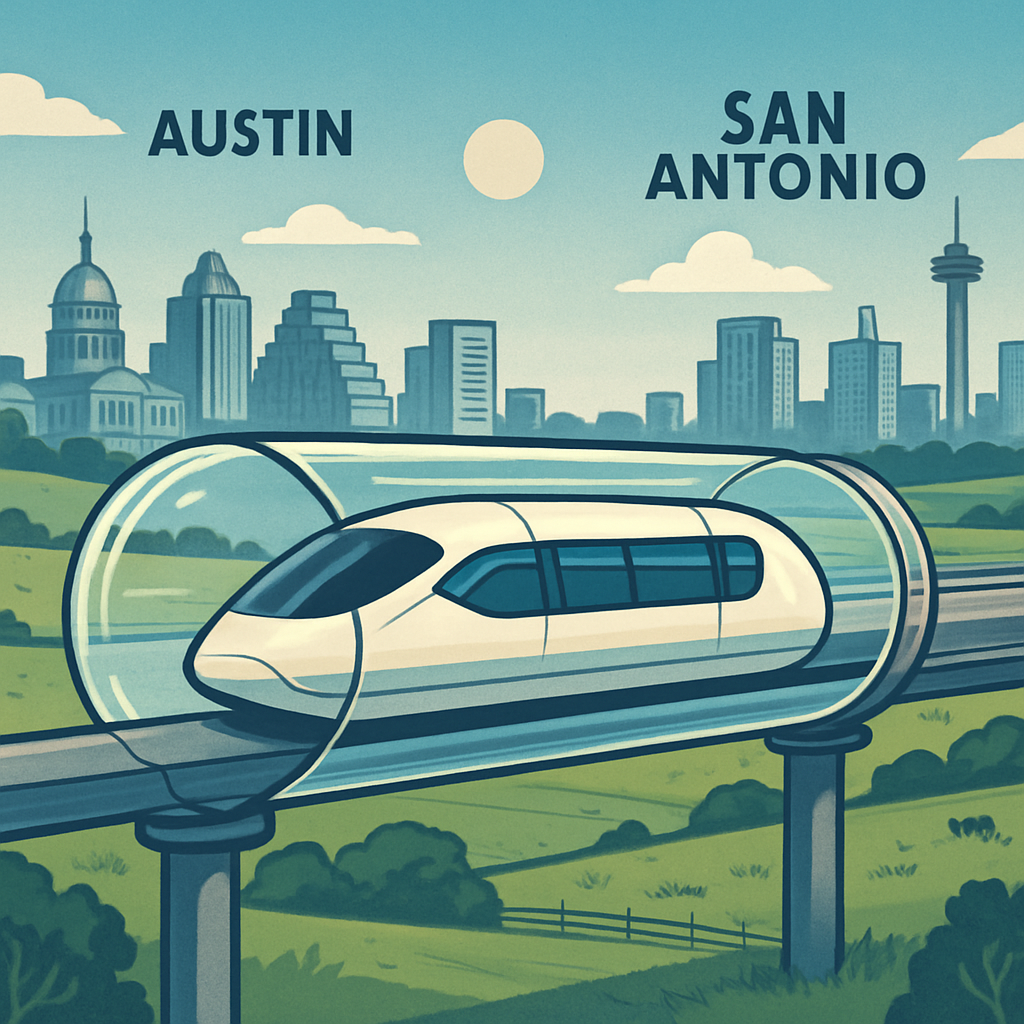
Elon Musk has floated a bold plan through The Boring Company for a “precursor Hyperloop” between Austin and San Antonio, aiming to slash travel time to under 30 minutes. The pitch follows a resurfaced AI-generated video envisioning futuristic human colonies, which Musk reposted with comments framing that as the kind of future he’s determined to build.
From Concept to Skepticism
Though Musk shared the idea publicly with the backing of The Boring Company, the project is squarely in the speculative phase—no engineering plans or formal route designs have been posted. The concept was introduced in response to the science-fiction style visuals of the video, blending Musk’s long-standing fascination with infrastructure projects and sci-fi ambitions.
This would not be the first ambitious undertaking from The Boring Company. Notable past proposals—such as tunnel systems in Chicago, Los Angeles, and a link between New York City and Washington, D.C.—have not moved into construction. Meanwhile, the company does operate a transit system in Las Vegas that mixes tunnels and surface routes, and recently secured $3 billion in funding led by investors from the United Arab Emirates.
Why This Route, and Why Now?
Austin and San Antonio are about 80 miles apart, yet heavy reliance on road travel results in drives near or exceeding two hours depending on traffic. A <30-minute “Hyperloop” could reshape transit in Central Texas—not just as a tech proof of concept, but as a potential game-changer for regional development and mobility.
Hyperloop as a transportation concept isn’t new: it proposes high-speed travel in near-vacuum tubes to minimize air resistance and friction. Musk championed it years ago, and several companies have explored it, but no full-scale public version is yet in operation. The term “precursor Hyperloop” suggests this might be an incremental or scaled version of the full vision, possibly using simplified or modified technology compared to earlier proposals.
The Road Ahead
The key obstacles are the usual heavy hitters: funding, regulatory approval, land acquisition, engineering challenges, and demonstrating safety. The fact that The Boring Company already secured massive recent capital gives it more leverage—but talking about the project doesn’t guarantee it proceeds.
Also essential will be defining exactly what Musk means by “Hyperloop” in this case. Is it full vacuum tube travel? Will existing technologies be adapted? Where will stations be built? Alignment through densely populated or environmentally sensitive areas could make permitting very difficult.
This could be part of broader trends in U.S. infrastructure and high-speed transit, where private companies are increasingly stepping into roles traditionally handled by public agencies. Whether this project moves from pitch to plan will depend largely on the political and financial goodwill in Texas and among federal regulators.
What this means: The proposal adds another high-stakes infrastructure idea from Musk, blending his futuristic aspirations with transportation engineering. If built, a fast Austin-San Antonio connection would be transformative for commuters, commerce, and growth. For now, it’s a vision—it’s urgent to watch for permits, technical feasibility studies, environmental reviews, and official cost breakdowns to see whether this becomes reality rather than just headline chatter.