Critical One-Click RCE Vulnerability in Azure Windows Admin Center Exposes Networks to Attack
A significant security flaw has been identified in Microsoft’s Windows Admin Center (WAC), a browser-based management tool widely used by IT administrators to oversee Windows servers, clients, and clusters. This vulnerability enables attackers to execute arbitrary commands remotely with minimal user interaction, posing a substantial risk to both Azure-integrated and on-premises deployments.
Understanding the Vulnerability
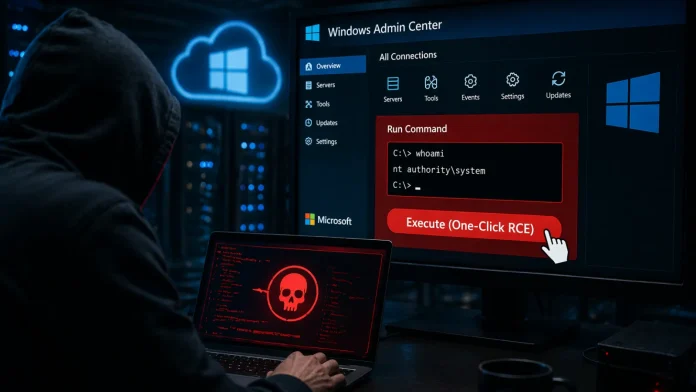
Discovered by Cymulate Research Labs, this critical flaw allows unauthenticated, one-click remote code execution (RCE). By enticing a user to click on a maliciously crafted URL, an attacker can execute arbitrary commands on the target system without the user’s knowledge. The vulnerability was responsibly reported to Microsoft on August 22, 2025. Microsoft promptly applied server-side patches to secure all Azure-managed instances, ensuring that cloud customers are automatically protected without requiring manual intervention. However, organizations utilizing on-premises WAC deployments must proactively update their systems to the latest release to mitigate this risk.
Technical Breakdown of the Exploit
The exploit chain leverages three primary architectural weaknesses:
1. Response-Based Cross-Site Scripting (XSS): Attackers can inject arbitrary JavaScript into both Azure portal flows and on-premises error handling mechanisms. This allows malicious scripts to execute within the context of the user’s session, leading to unauthorized actions.
2. Insecure Redirect Handling: WAC’s acceptance of externally controlled gateway URLs without proper validation enables attackers to hijack legitimate application flows. This can be exploited for spoofing and phishing attacks, redirecting users to malicious sites that appear trustworthy.
3. Insecure Credential Storage: In on-premises setups, sensitive Azure access and refresh tokens are stored directly in the browser’s local storage. This makes them susceptible to immediate theft via the XSS vulnerability, granting attackers unauthorized access to Azure resources.
Deployment-Specific Implications
The impact of this vulnerability varies based on the deployment environment:
– Azure-Managed Environments: Attackers can craft URLs containing malicious payloads that prompt fake authentication dialogs, silently harvesting user credentials from a trusted Microsoft origin.
– On-Premises Deployments: The risk is more severe, as attackers can force the WAC gateway to execute arbitrary PowerShell commands on managed servers. Additionally, stored Azure tokens can be exploited for lateral movement, granting attackers full cloud privileges and control over the tenant.
Exploitation Process
Cymulate researchers demonstrated that the attack chain requires minimal user interaction:
1. Preparation: The attacker registers a valid domain name, secures a trusted web certificate, and forges a WAC gateway URL.
2. Delivery: The malicious link is distributed through phishing emails, masked links, or automated web redirection.
3. Execution: Upon clicking the link, the WAC application redirects traffic to the attacker-controlled server. The rogue server responds with a crafted error message containing hidden scripts. Due to inadequate sanitization of incoming error messages, the malicious script executes within the user’s session, leading to unauthorized command execution.
Mitigation Strategies
To protect against this vulnerability, organizations should:
– Update On-Premises Deployments: Ensure that all on-premises WAC instances are updated to the latest release to incorporate the necessary security patches.
– Educate Users: Train staff to recognize and avoid phishing attempts, emphasizing the importance of not clicking on suspicious links.
– Implement Network Segmentation: Limit the exposure of WAC instances by placing them behind firewalls and restricting access to trusted IP addresses.
– Monitor Logs: Regularly review access logs for unusual activity that may indicate exploitation attempts.
Conclusion
The discovery of this one-click RCE vulnerability in Windows Admin Center underscores the critical importance of maintaining up-to-date systems and implementing robust security practices. While Microsoft has addressed the issue in Azure-managed instances, on-premises deployments remain at risk until they are updated. Organizations must act swiftly to apply the necessary patches and educate their users to prevent potential exploitation.