Since August 2026, a cluster of Com-affiliated cybercrime actors have executed a coordinated campaign leveraging vishing and adversary-in-the-middle (AitM) phishing to hijack cloud accounts and extract sensitive data for extortion. Investigations by a major security firm trace the attacks to threat actors targeting financial services, healthcare, and legal sectors across the U.S., U.K., and Australia. Construction, manufacturing, pharmaceuticals, insurance, real estate, and high technology firms have also been compromised. The stakes are high when exposed data carries serious regulatory, operational, or market damage.
Multiple threat clusters have been linked to these operations, including Bling Libra (ShinyHunters), CL-CRI-1116 (Redact/BlackFile), CL-CRI-1147 (Pink), CL-CRI-1182 (Falcon), CL-CRI-1192 (Helix/UNC6671), CL-CRI-1264 (Vortex), and the newest, CL-CRI-1274 (Cinder). While financial services were hit twice as often as healthcare in August, September saw healthcare overtaking financial firms in attack volume.
Attack Flow: From Voice Phishing to Persistent Takeover
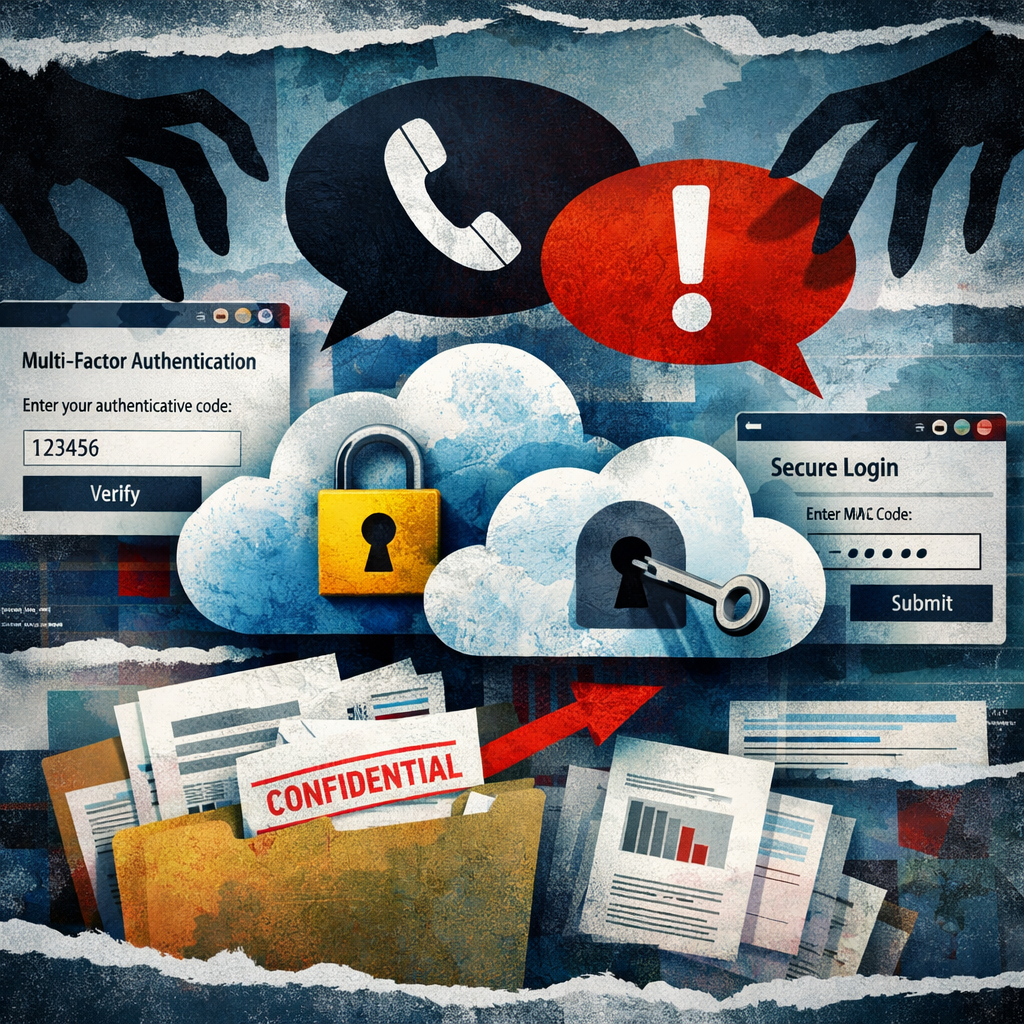
The campaign typically begins with voice phishing: attackers impersonate internal IT personnel, claiming “authentication issues” and directing victims to a phishing page customized for their organization. These AitM proxies intercept credentials and session tokens while victims attempt to authenticate. Attackers often gain enough control to enroll their own multi-factor authentication (MFA) methods to build enduring access.
From there, the tactic is to abuse native cloud tools rather than developing custom malware. Threat actors generate temporary credentials, authorize third-party OAuth apps, sift through SharePoint, OneDrive, and Microsoft 365 mailboxes, and modify internal mailbox rules to avoid detection. Some clusters have sideloaded malicious browser extensions that function as keyloggers, steal tokens, enable remote control via browser protocols, scrape local and session storage, and even scan webcam feeds and clipboard. Certain accounts see earliest activity with a reused MFA device, commonly named “Pixel 10a.”
Extortion Phase and Novel Tools in Play
After extracting the data, attackers proceed with extortion: internal emails or Microsoft Teams messages warn of data theft and direct recipients to TOR-hosted sites for ransom demands. The threat cluster Cinder (CL-CRI-1274) stands out for using the Microsoft Graph SDK for data exfiltration, while others like Helix (CL-CRI-1192) rely on malicious Chrome extensions enabled via developer mode.
A shared phishing tool dubbed “Doko’s Panel” has surfaced as a key component. It enables real-time interception of authenticated sessions, allowing lateral movement into SaaS tools like Salesforce, Slack, DocuSign, and more. The ecosystem supporting these attacks appears professionalized: one persona was observed recruiting “experienced callers” on Telegram, demanding fluent, accent-free English and offering six-to-seven-figure weekly returns. This setup signals that vishing-as-a-service is no longer fringe in the phishing world.
While many threat actors still rely on cloud and identity services from Microsoft, others mimic single sign-on (SSO) portals or passkey configuration pages via fake apex domains. Use of native cloud utilities minimizes traces of custom toolkits and enables faster movement through breach stages. Attackers focus less on encryption and more on speed across the intrusion lifecycle.
Why this matters: this operation touches all the things that keep enterprises awake at night — MFA bypass, SaaS compromise, identity fraud, insider-style access after the fact. As more organizations migrate workloads and data to cloud platforms, the window for damage becomes razor thin once credentials or session tokens are stolen.