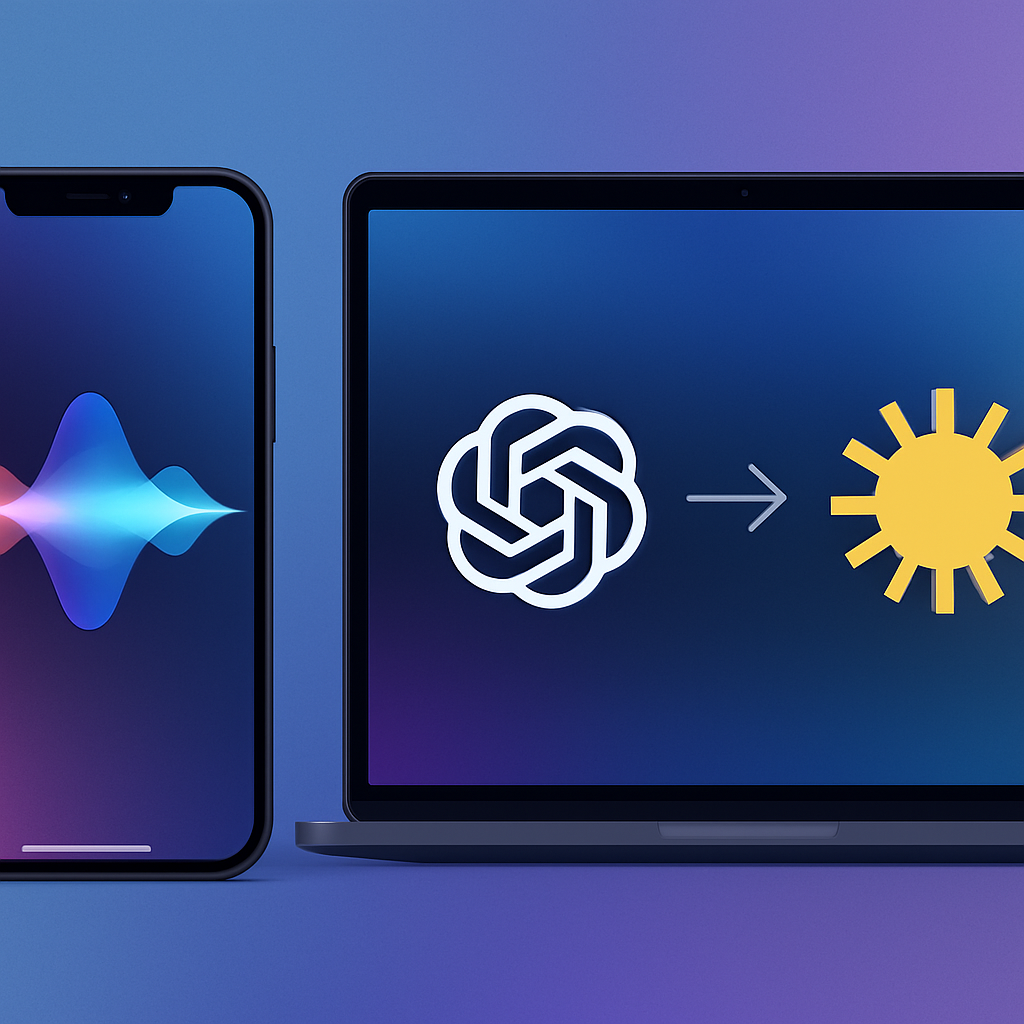
Code discoveries in iOS 27 and macOS Golden Gate reveal a shift in Apple’s Siri system: users may soon be able to use Claude or ChatGPT in place of the native Siri AI. The finding, made by coder pdfu, highlights two internal mechanisms that hint at deeper integration of third-party AI models into Apple’s voice assistant.
What the code reveals
One feature spotted in the frameworks is called “Model Delegation.” It allows an external model like Claude to function as an extension of Siri in much the same way the built-in ChatGPT extension does. In a demo, Claude is set up via an “Ask…” option from a contextual menu. When the user asks Siri to “Ask Claude” to set a reminder, Claude interprets the request and delegates the action back to Siri to create the reminder in Reminders.
Another demonstration shows how Claude can generate a CSV file—something Siri can’t do on its own—and return it via the Siri app conversation window. This suggests that external models may handle tasks beyond Siri’s native capabilities.
Replacing Siri’s core AI: GPT-5.6 and model swapping
More striking is evidence of a protocol within Apple’s “Model Manager Services” that could allow the core server-side component of Siri to be swapped out entirely for another model like GPT-5.6. In this setup, the third-party model receives Apple’s planner prompt and tool definitions, meaning it can use system tools, access personal data, and respond using Siri’s interface and voice.
The code’s demo shows ChatGPT summarizing a user’s emails on a topic, extracting action items, and then sending a message via Messages using the user’s contacts—all while operating within Siri’s native app. The heavy lifting happens behind the scenes.
Status and limitations
For now, the “Ask…” mechanism is only enabled for ChatGPT in the macOS Golden Gate Release Candidate, which is the near-final build ahead of full release. Claude support is not yet available to the public. Apple has not officially opened the model delegation entitlement to third-party developers.
These developments may be influenced by the EU’s Digital Markets Act, which requires that Apple provide third parties with meaningful access to hardware and software features afforded to its own services. The European Commission has explicitly stated this requirement applies to Siri.
Even though this is still under development, Apple’s architecture in iOS 27 and macOS Golden Gate suggests a significant evolution in how Siri might operate. If model delegation and inference providers become publicly available, users could choose which AI model powers Siri’s intelligence—letting external models like Claude or GPT-5.6 take over core tasks while Siri remains the interface.
Analysis:This is a potential turning point for Apple’s AI strategy. Allowing third-party models to replace Siri’s back-end isn’t just about flexibility—it redefines control over AI mediation on Apple devices. If Apple proceeds, the company will need to balance performance, privacy, and consistency, especially when external models access system tools and personal data. For users, developers, and rivals, this opens up possibilities for deeper competition and customization. What remains critical is whether Apple will fully roll this out across platforms and whether developers beyond ChatGPT will be granted access. Watch closely as the initial public builds of iOS 27 and macOS Golden Gate reach users.