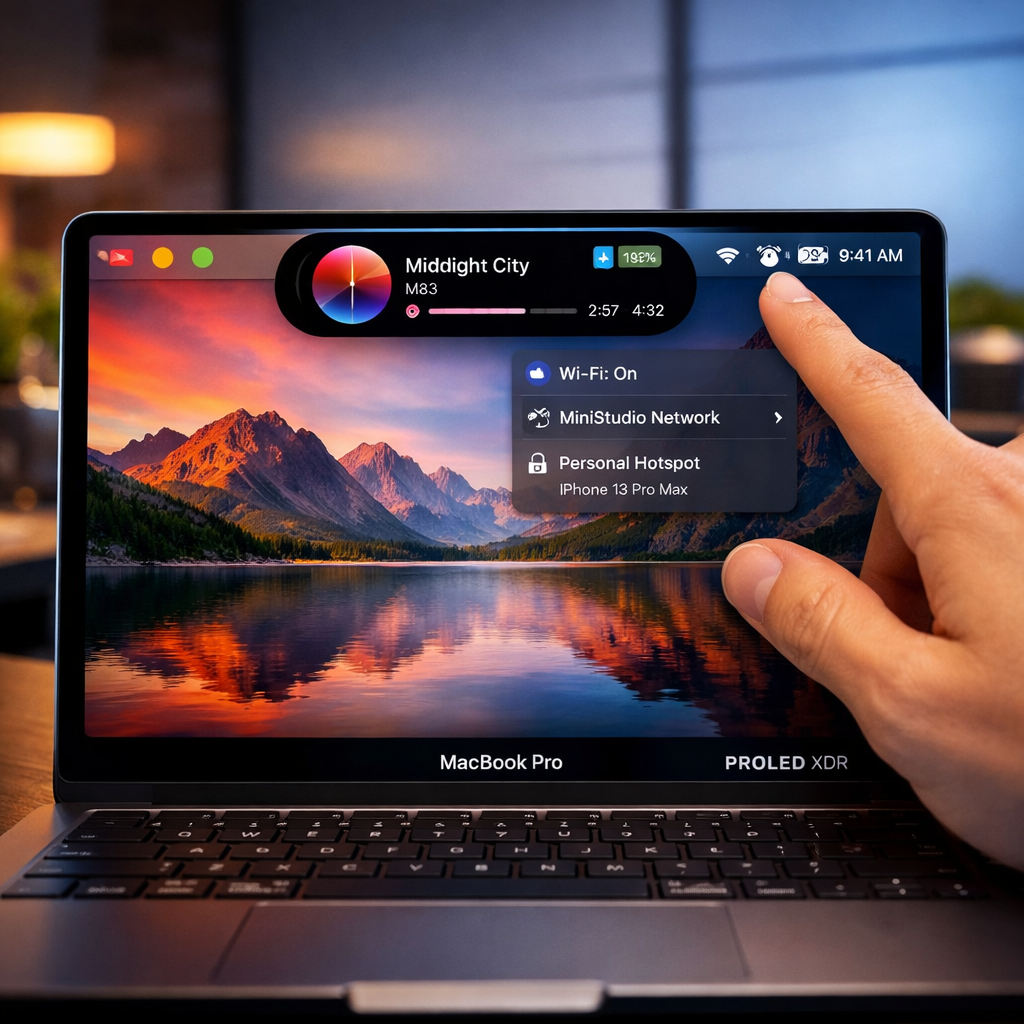
Apple has finally introduced touch to the Mac. The latest MacBook Pro with a PROLED XDR display is its first model to recognize fingers alongside the usual trackpad and mouse, and macOS has been retooled to support this change.
Smooth Adaptation: Bigger Targets, Fluid Feedback
While the menu bar looks near-identical to older Macs at rest, touch activation dynamically enlarges items beneath your fingertip to help ensure accurate selection. The classic red, yellow, and green window buttons also grow when touched, and the hidden Dock shows itself with a swipe-up gesture from the screen’s bottom.
The oculus around the Dynamic Island has been reimagined too. Instead of a static notch, the MacBook Pro now features a Dynamic Island, which expands into a floating widget once pulled down—allowing direct access to Spotlight, Live Activities, or Siri AI by finger.
Pro-Grade Apps Get Touch Overhaul, macOS 27 Enhancements
Touch isn’t limited to casual navigation: professional tools like DaVinci Resolve and Logic Pro have been updated for finger input—allowing direct color grading, audio editing, and other precise tasks without a stylus or trackpad. Meanwhile, macOS translation of touch into click events means many current apps will function without developer intervention.
This isn’t coming out of nowhere. macOS Golden Gate has been laying the groundwork. Gesture support—such as pull-to-refresh in Sanar, Mail, Calendar, and other apps—has already been added, while Golden Gate 27.2 brought in touch-specific gesture recognition. These changes smooth the transition toward full touch capabilities.
Launch Details & Pricing
The new MacBook Pro is now open for preorder as of October 28, 2026, with first deliveries and retail availability beginning November 6. Two sizes are offered—14-inch and 16-inch—with chips ranging from M5 Pro to M5 Max. Starting prices in the U.S. begin at $2,899 for the 14-inch M5 Pro model, and rise based on chip and display size.
Design adjustments include thinner profiles, lighter bodies, and a display built with a precision-mounted touch sensor, not an overlay—reducing latency and improving the responsiveness of finger interactions. The 14-inch model drops about half a pound, while the 16-inch shrinks by roughly 0.7 pounds compared to predecessor models.
Other enhancements include upgraded sound with deeper bass, new audio tweeters, dynamic thermal architecture to redirect heat away from the display, continued support for apps developers rely on, and inclusion of new features like Apple Intelligence, Visual Intelligence, and Siri AI.
The computers are already available to preorder in 30 countries, including the U.S., where the first models ship November 6.
What this means:Apple has crossed a clear threshold—touchscreens are no longer incompatible with Mac workflows. This means macOS needs to balance its long history of precision with the imprecise nature of fingers. The expansions, gesture recognition, and adaptive visuals are Apple’s first big step in resolving that tension.