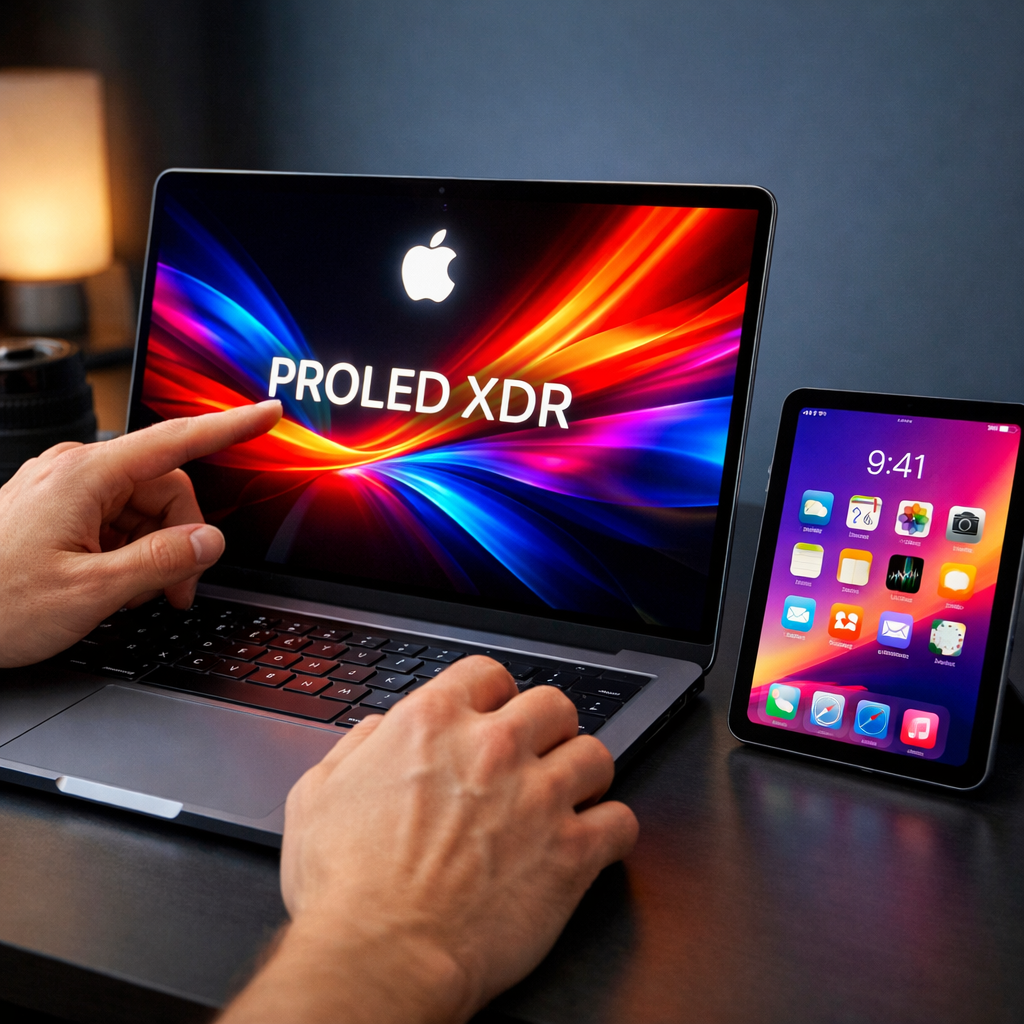
Apple’s first-ever MacBook Pro with touch-enabled OLED display is officially arriving to customers starting November 6, with preorders already placed in Australia, New Zealand, Asia, the Middle East, Europe, and North America. This flagship PROLED XDR MacBook Pro, as well as a newly updated OLED iPad mini and M6 chip upgrades to entry-level MacBook Pro and iMac, marks a major hardware milestone for the company.
What’s New: Display, Touch, and Design Overhaul
The tentpole change is the MacBook Pro’s introduction of Apple’s “PROLED XDR” display—a tandem OLED panel enabling built-in touch for the first time on any Mac. The screen replaces the notch with a Dynamic Island, and the laptop is thinner and lighter than previous mini-LED models. Apple has also reinstated the illuminated Apple logo.
Performance comes from the existing M5 Pro and M5 Max chips rather than newer silicon. Customers can configure up to 128GB of unified memory and up to 16TB of storage. Battery life is claimed to be up to 24 hours, despite the lighter build. Prices begin at US$2,899 for the 14-inch model, and US$3,399 for the 16-inch, both using the PROLED XDR display.
Alongside OLED iPad Mini, M6 iMac & Base MacBook Pro
Also arriving November 6 is the new OLED iPad mini. It now sports an 8.5-inch OLED screen, A20 Pro chip, and gains IP67 water and dust resistance with a slimmed profile. Starting price for that model is US$699.
The more affordable tiers of Mac desktops and laptops receive M6 chip upgrades. The entry-level 14-inch MacBook Pro and the iMac carry over their prior designs, but with updated internals to improve speed and power efficiency. The 14-inch MacBook Pro with M6 starts at US$1,999, and the iMac at US$1,499.
Australia is the first country where in-store customers can buy one of the PROLED MacBook Pros, though online shipments for those same models don’t begin until late November or early December, meaning supplies may be tight. The OLED iPad mini, as well as the M6 iMac and base MacBook Pro, are expected to be more immediately available.
Apple’s rollout will follow familiar geography: Australia and New Zealand first, followed by Asia, the Middle East, Europe, and finally North America.
Why it matters:For years, Apple resisted adding touch input to the Mac, maintaining a separation between macOS and its touch-centric devices. The arrival of this PROLED XDR MacBook Pro changes that. The company is now offering a hybrid interaction model—trackpad and keyboard remain primary tools, but touch now supplements them. For creative pros—designers, musicians, developers—the ability to directly touch and manipulate content on screen could reshape workflows. Keep an eye on app updates for touch-optimized UI, potential durability and fingerprint concerns, and whether macOS evolves more aggressively in future generations to account for direct touch. This shift is likely to trail through Apple’s laptop line, potentially including MacBook Air or future MacBooks, and sets a new standard for premium pro-level laptops.