Today Apple unveiled a quartet of products centered on the smart home: a new HomeView smart hub, the HomePod mini 2, an updated Apple TV 4K, and a special-edition Beats Pill speaker with Pokémon themes. These launches show Apple doubling down on home intelligence, voice interaction, and immersive media. Each product is designed to interconnect under the Apple Intelligence umbrella — promising deeper personalization, new voice AI features, and more seamless hardware integration.
HomeView: Apple’s Smart Hub with a Screen and Voice AI
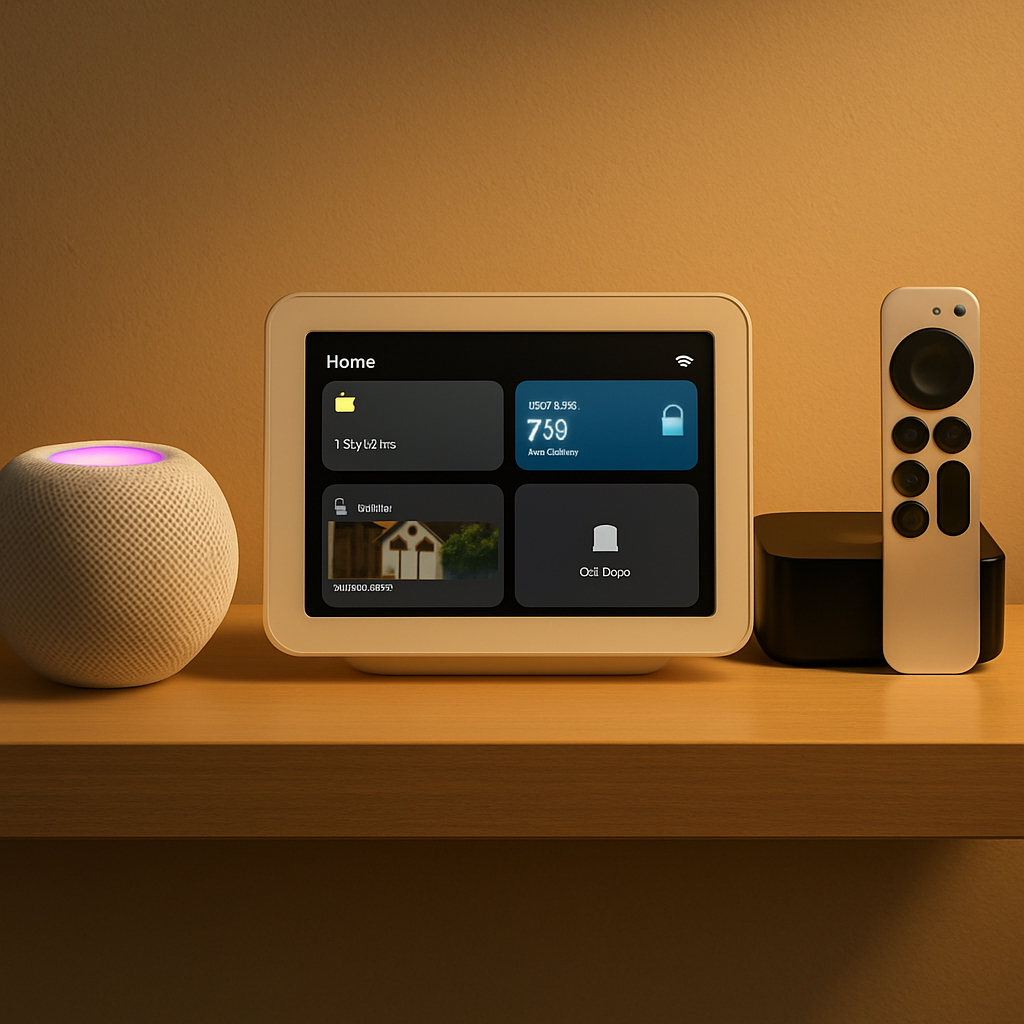
Apple introduced HomeView, a versatile smart home hub with a 7-inch square Liquid Retina touch display, running on an A18 chip with Siri AI baked in. It comes in two versions: a tabletop model with four color options (silver, starlight, rose pink, space gray) and a wall-mounted version limited to two finishes (silver and space gray) with compatible mounts supplied. The screen adjusts its detail when you approach and dims exceptionally low (down to 0.3 nits) at night, rising to 500 nits in daylight. It also recognizes up to six people by face, offering each user personalized widgets, apps, and home-control shortcuts.
Connectivity is rich — HomeView includes a 12-megapixel Center Stage camera for video calling, USB-C for power, and a hinge in the base that allows tilt adjustment. It functions as a full smart home hub — streaming content, displaying recipes, syncing calendars, acting as a speaker, and more. HomeView is priced at $299 in the U.S., with preorders beginning today and availability set for November 13.
HomePod mini 2: Light, Sound, and AI
Smaller, smarter, and more vibrant, the HomePod mini 2 arrives priced at $149 and retains the spherical form of its predecessor. Its top surface now offers a “Sound Glow” feature: reactive lighting that pulses color visuals based on the music’s bass and treble, drawing from the song’s album art. Internally, the speaker runs on the S10 chip — the same core seen in Apple Watch Series 10 — for live optimizations of loudness, dynamic range, and overall acoustic performance.
HomePod mini 2 supports 360-degree audio and blends effortlessly into multiroom setups. Four units can combine to deliver a four-speaker surround system when paired with the new Apple TV 4K, with spatial recognition to balance sound according to the room. It also doubles as a speaker for Mac. Siri AI support will arrive with a software update; in the meantime, the device can already detect smoke and carbon monoxide alarms and send alerts. Five color options are offered, and it launches on October 30.
Apple TV 4K (4th Gen): A19 Chip, Universe of Voice
The new Apple TV 4K keeps the black box silhouette but packs big upgrades: an A19 chip delivering up to 50 % faster CPU performance and twice the graphics power over the A15-based previous generation. For streaming efficiency, it adds an AV1 decoder. It also integrates Siri AI for full-screen conversational interactions — with follow-ups and broad world knowledge — and includes support for hands-free voice via three built-in far-field microphones, in addition to the Siri button on the remote.
The updated Siri Remote retains its look but adds long-needed polish: Find My precision finding, a built-in speaker so you can sound it out, and still uses USB-C for charging. New home theater capabilities are unlocked when it’s paired with four HomePods or HomePod mini 2 units in matching front and rear pairs, with automatic room recognition and sound calibration. Apple TV 4K (4th gen) carries 128 GB storage, Wi-Fi 7, Gigabit Ethernet, and HDMI 2.1 — priced at $299 with preorders live and an official launch set for November 13.
Also revealed today was a Pokémon-themed Beats Pill speaker special edition, featuring Pikachu and Mimikyu — set to be released in select markets, including the U.S., starting October 15.
Apple’s four new devices reinforce its strategic push into smart homes, voice AI, and hardware ecosystems working together. Over the past few years, Apple has added Siri AI, machine learning, and Apple Intelligence to its devices, but today’s announcements show those efforts coming together in physical form. The synchronized lighting, spatial audio, facial identification, and surround sound setups all signal that Apple’s home products are becoming more immersive and interactive. Consumers should watch for how well updates roll out (especially Siri AI), how tightly the devices integrate, and whether these innovations truly enhance everyday living — not just add specs. If Apple pulls this off, it may have just crossed into its most ambitious home portfolio yet.