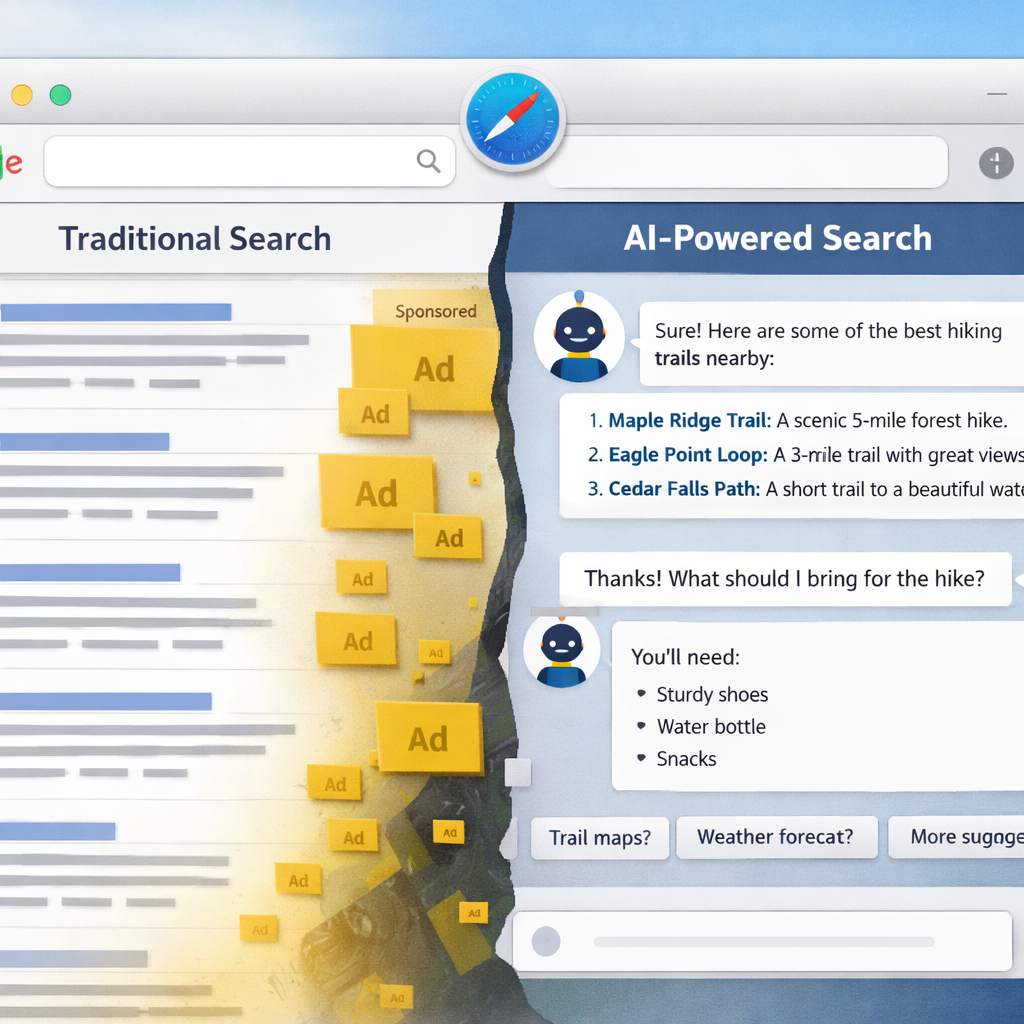
Apple’s longstanding search arrangement with Google—where Google pays Apple 36% of ad revenue generated via Safari—no longer delivers the same returns. Shifts in how people find information, particularly the growing adoption of AI-powered search, are making those ad dollars harder to come by. What was once one of Apple’s strongest Services revenue streams is now showing signs of strain.
What’s Driving the Revenue Drop?
Until recently, Google’s default status in Safari ensured that Apple earned a sizeable cut whenever users clicked on ads in its search results. But now, many users are bypassing traditional search entirely. Instead, they turn to AI features and tools that generate answers, summaries, or conversational responses—formats that tend to display fewer visible advertisements. Google analysts believe these AI-generated overviews are significantly less monetizable than conventional search result pages.
That trend is showing up in financial reports. Apple’s Services revenue growth dropped from 12% year-over-year in past quarters down to about 10%, with public guidance from Apple suggesting further declines might be on the horizon. Google, meanwhile, reported its search advertising revenue growth decelerating from around 17% to just 12%. The reason? AI search interactions appear to generate weaker ad engagement and lower ad yield per query.
How This Affects Apple’s Bottom Line
Google’s diminished ad revenue directly hits Apple when Safari-driven searches don’t convert to ad clicks. Since Apple takes a predefined share of whatever ad revenue Google earns, any drop at Google means a drop for Apple. Navigational shifts in user behavior thus translate into a tangible financial drag for Apple’s Services division.
Adding to the challenge: AI-style search queries tend to be longer, more conversational, and broader in scope. These kinds of queries are harder to match with relevant ads in ways that users will click. Google is still experimenting with formats for AI search results to restore revenue momentum—balancing the need for monetization with the user experience. Push too many ads into AI responses, and Google risks alienating users.
Advertisers are watching closely. They expect Google will find ways to weave in ad formats that work better within the AI search experience—and that those tweaks might help revive growth for both companies. Higher ad engagement in AI responses could mean more revenue shared back to Apple.
Apple’s hefty search deal with Google—with Google having paid Apple roughly $20 billion in recent times—has long been a reliably large source of income. But its value hinges on Google’s ability to monetize user queries. As AI tools reshape search behavior, that income stream is becoming less predictable.
What this situation underscores is a larger tension: big tech’s race to lead in AI-powered search clashes with existing revenue models built around keyword-driven ads. Consumers seem ready to adopt AI as a front door to information—but advertisers and platforms are still trying to catch up.
Looking ahead, It matters for both companies how quickly Google adapts its ad formats—and whether Apple can diversify its Services revenue so it’s less tethered to search ad performance. For industry watchers, the key variables will be changes in ad yield per AI query, how deeply Google integrates ads into AI-overview responses, and whether Apple seeks alternative partners or search models. That will decide if the Safari-Google deal remains a cash cow or becomes a cautionary tale.