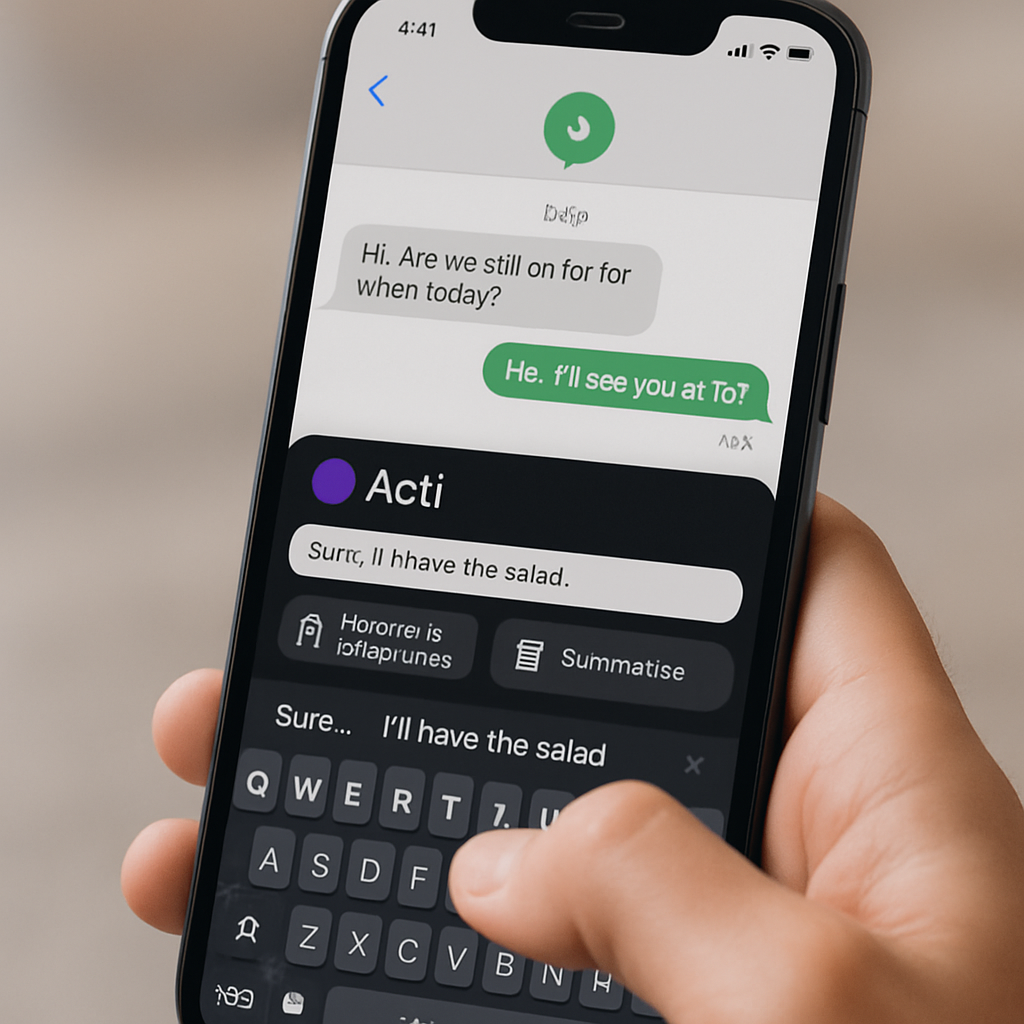
Singapore-based startup Acti has introduced an innovative keyboard application for iOS and Android devices, embedding AI agents directly into the smartphone typing experience. Unlike traditional keyboards that merely suggest words, Acti’s keyboard can perform actions within various apps, including email, messaging, and social media platforms.
Acti’s founder and CEO, Young Wang, highlights the challenge users face when toggling between multiple applications to utilize AI assistance. Acti addresses this by integrating AI capabilities directly into the keyboard, allowing users to access AI tools without leaving their current app. This integration enables tasks such as providing local recommendations or sharing live stock prices within a conversation, eliminating the need to switch to a separate search engine or AI application.
The keyboard is powered by Google’s Gemini models, selected for their balance of intelligence, speed, reliability, multilingual support, and cost efficiency. A notable feature of Acti is ‘Skills,’ which allows users to program single-key shortcuts to execute multi-step tasks automatically, such as translating messages or sharing meeting links.
Privacy is a core consideration for Acti. The application operates on a local-first model, ensuring that personal data remains on the user’s device by default. Acti does not access or store private messages or personal context unless the user explicitly activates a feature that requires external processing.
Wang’s experience at Baidu, where he expanded the Facemoji Keyboard to over 300 million daily active users, inspired him to develop a keyboard suited for the AI era. He recognized that text has evolved beyond mere input to become a carrier of intent, which can now be directly translated into action through AI integration.
Acti’s approach reflects a broader trend of embedding AI functionalities into everyday applications, enhancing user experience by reducing the need to switch between apps. This development signifies a shift towards more seamless and context-aware AI interactions within commonly used interfaces.