A humanoid robotics company called Agility is making history with a SPAC transaction that will take it public and inject about $465 million in fresh capital through a mix of private and retail investors. It becomes the first firm whose sole product line consists of humanoid robots to enter the public markets. The funds are seen as necessary to support its commercial rollout of robots to real industrial customers.
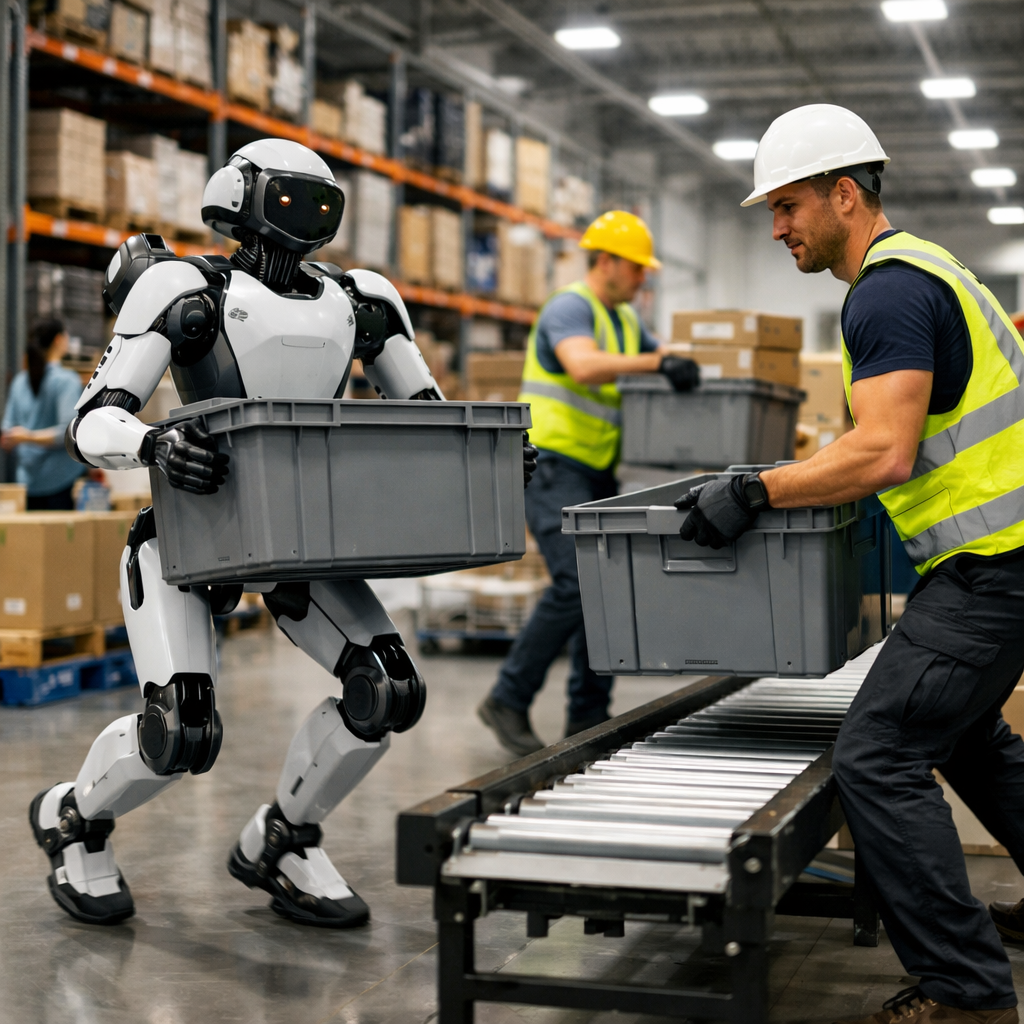
Founded in 2015 by researchers at Oregon State University, Agility’s challenge has been walking on two legs safely. Since inception, its focus shifted toward practical work in industrial settings. Its Digit robot is deployed today at nine customer sites—including Schaeffler, GXO, Toyota Motor Manufacturing Canada, and Mercado Libre—handling sizable volumes of tasks like moving heavy totes. One GXO facility alone is using Digit to move over 100,000 totes.
Financials and Revenue Realities
Although Agility is generating revenue—in the first six months of 2026 it pulled in $174,000, mostly from what insiders would classify as related parties—it continues to burn cash, seeing losses of $362 million over the same period. These numbers underscore how far it has to go before turning a profit, even with the new money coming in.
On the capability front, Agility is ramping up its next-gen robot line, Digit 5. This version is designed to operate safely in human-shared environments rather than only in isolated work cells, and there are $300 million in contracts lined up from about 30 customers for that model. Yet Agility has not shown working prototypes of Digit 5 yet. It says it will at CES 2027, with general availability expected later in the year. Targets for factors like throughput, uptime, and placement accuracy must be met before those contracts can be fulfilled.
Challenges and What’s Next
Agility faces two central hurdles. First: finding customers who will commit enough to offset high pre-deployment costs. As of May 2026, four customers had signed up for proof-of-concept deployments, each costing around $500,000. Second: refining the robot’s task execution. Digit currently can pick up heavy loads and place them with around 98% accuracy, but more nuanced manipulation and dexterity are still outside its reach.
The company leans heavily on operational experience—65,000 hours of real-world robot use—plus simulated and video-based data to improve its systems. While many in the robotics field experiment with generative AI and transformer-based models to improve adaptability and autonomy, Agility says its strength is grounded partly in what its robots already do today, at scale and with purpose.
The SPAC infusion should be sufficient to meet near-term needs, though Agility isn’t claiming it brings self-sufficiency just yet. Its planned production facility has a capacity to make up to 10,000 units per year—assuming demand and performance milestones are met.
The significance of Agility’s public debut goes beyond its own balance sheet. Many humanoid robot companies remain in the lab or in demo phases. By putting Digit in the field today and betting on a robot that works alongside humans in standard industrial environments, Agility positions itself ahead of firms focused more on spectacle than on solving repetitive labor gaps.
What this means: if Digit 5 can deliver on promised metrics and reliability, it could validate robot-as-a-service economics at industrial scale. Investors will want to see whether Agility can both scale deployment and improve robotics performance fast enough, especially around manipulation and dexterity. Its success or struggle may set a benchmark for which humanoid robotics ventures follow.