Today’s roundup delivers a trio of major developments from Apple: an upgrade path for HomePod sound systems, the startup acquired to expand biomagnetic sensing, and fresh pricing and history details around Apple’s upcoming foldable device along with rumors of sweeping App Store policy shifts.
HomePod to Get Accurate Surround + “Party Mode” Audio Features
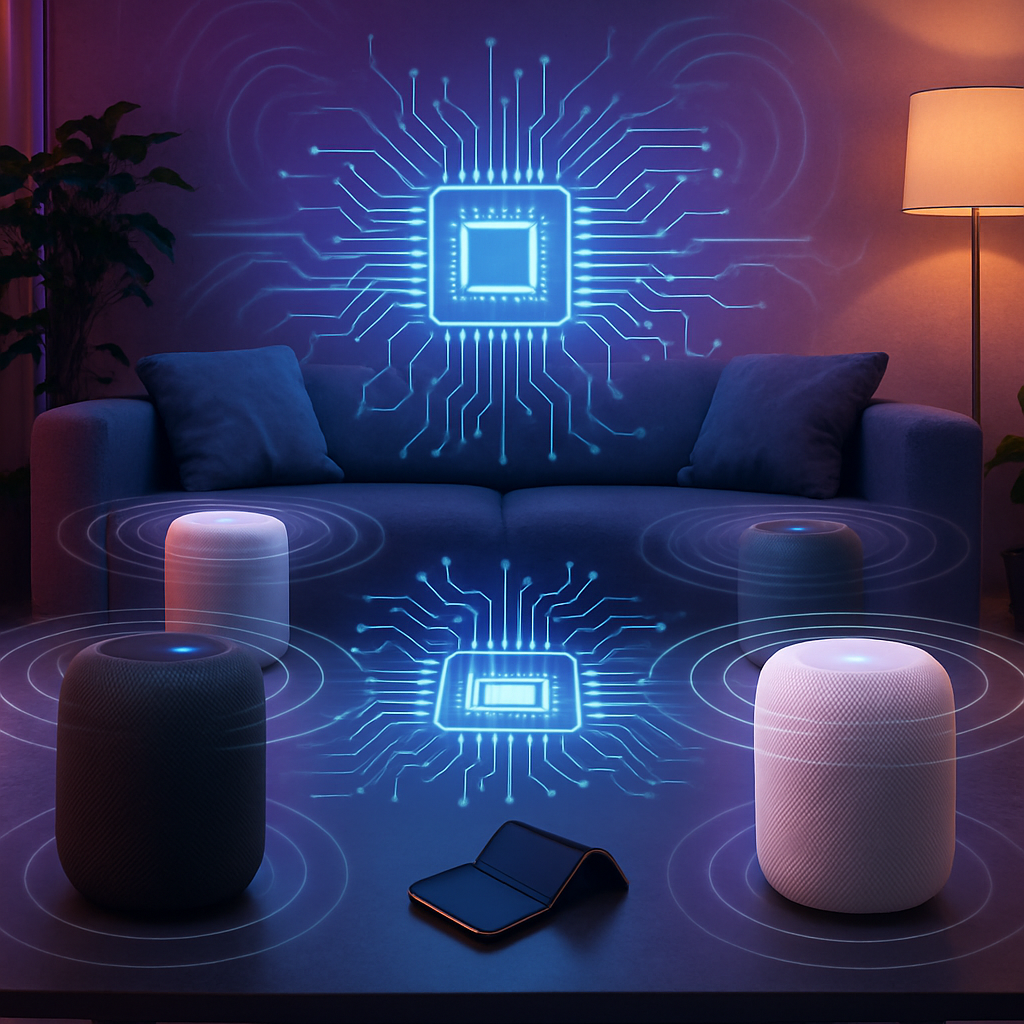
Strings found in audioOS 27’s beta 8 reveal that Apple is experimenting with a true four‐speaker surround setup using full-sized second-generation HomePods. This configuration would position two units in front (left and right) and two in the rear, aiming to deliver cinematic surround sound with dedicated roles for each speaker—covering dialogue clarity, bass management, spatial positioning, and dynamic equalization. These features go beyond the existing stereo pair model.
Meanwhile, a new listening mode internally dubbed “Party Mode” is in the works. Unlike traditional stereo tuning that optimizes audio for a central listening position, this mode appears to spread sound more uniformly through the room—ideal for social settings.
Code also references an unidentified hardware family “AID12007,” likely indicating new speaker models—potentially a refreshed HomePod mini or a successor to the full-sized version.
Sonera Acquisition Expands Apple’s Sensing & Wearables Horizon
Apple has quietly acquired a California startup named Sonera. The company developed sensing technology capable of measuring magnetic fields generated by the brain and body without skin contact—something that could be a game-changer for health tech.
Potential applications flagged in public filings include non-invasive monitoring of neuromuscular conditions, advanced prosthetics control, and sport performance tracking. This acquisition suggests future Apple Watch updates could harness biomagnetic signals for more precise health and accessibility features.
Foldable iPhone History, Price Insights & Vision Shift Under Tim Cook
New reporting sheds light on the long path toward Apple’s foldable iPhone (dubbed internally “iPhone Ultra”). Early material development dates back to 2016, but it was Tim Cook—after a trip to Asia around 2020—who pushed to shift the design toward a mainstream foldable phone rather than a tablet-pivot concept.
Design priorities reportedly included a crease-minimized display, reliable hinge mechanics, flexible inner cover glass, and under-display camera work. Rumored specs include a 7.8-inch inner display, a 5.5-inch outer one, and proportions likened to a passport when folded.
Pricing has evolved too: while Apple initially aimed for a base price of $1,999, rising component costs have pushed that estimate up to $2,199. Higher storage variants may approach $3,000—reaffirming the device’s premium positioning.
App Store Poised for Revenue & Margin Changes
Apple appears to be rethinking how its App Store drives profits and margins, based on reporting from the company’s own internal news sources. The company is said to be considering revisions that could shift revenue mix via adjustments to commissions, fee structures, or other rules affecting both developers and users.
While specifics are still undeveloped and it’s unclear whether these ideas are baked into a formal plan, the fact this conversation is taking place signals a potential shift in how Apple views one of its core services businesses.
What to Watch For: If the HomePod surround setup or Party Mode make it into a public update, they could change consumer expectations for speaker tech in Apple’s ecosystem. The Sonera acquisition hints at increasingly sophisticated health and wearable features ahead. Foldable iPhone pricing now seems locked in as a high-end investment, likely lowering mass-market appeal but reinforcing Apple’s premium branding. Finally, App Store changes may trigger tension with developers, but could play a key role in how Apple balances revenue streams under the new CEO era.