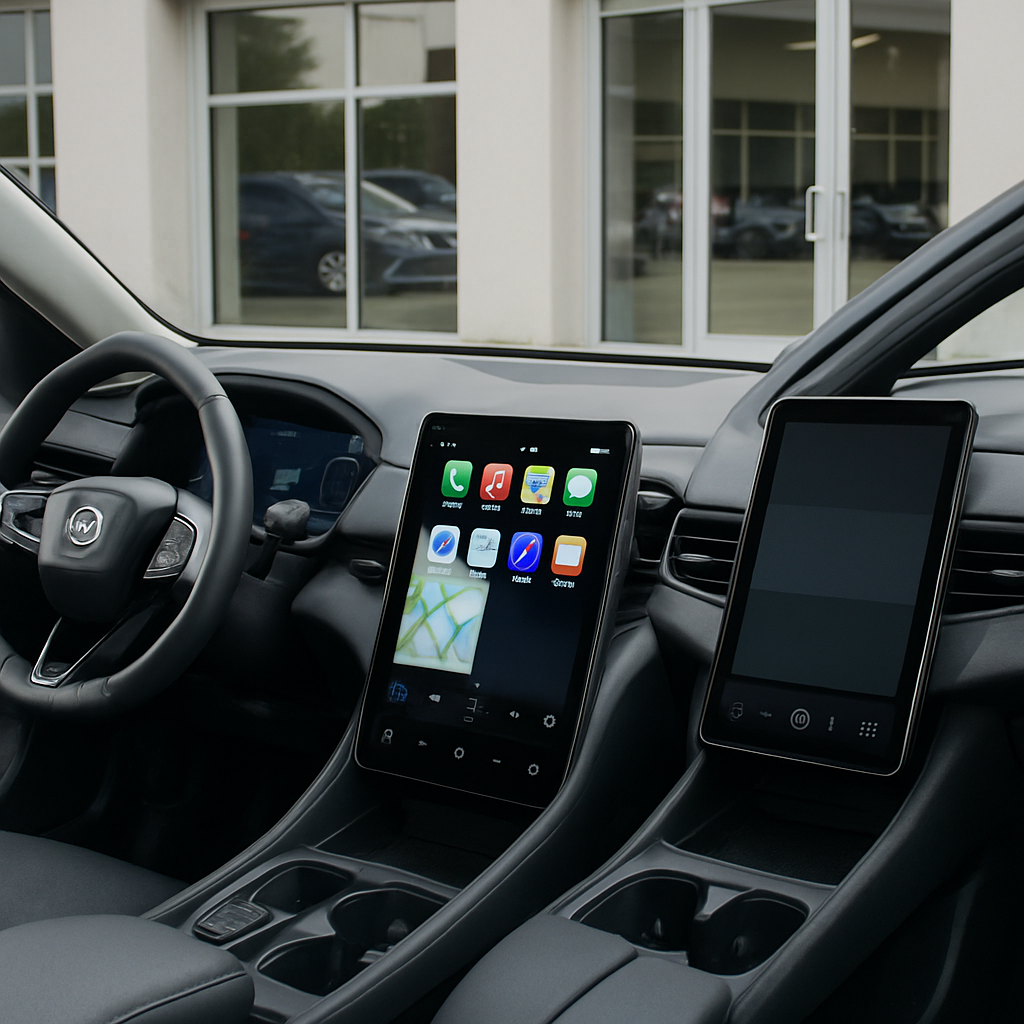
General Motors’ bold move in 2025 to phase out Apple CarPlay and Android Auto in favor of its own infotainment system under Android Automotive OS has entered the marketplace test—and the results are starting to tell a clear story. GM removed CarPlay from its electric vehicles in 2023, claimed it was a decision rooted in privacy, and positioned it as a way to deepen control over its digital ecosystem. ([appleinsider.com](https://appleinsider.com/articles/26/08/20/carplay-the-driving-force-deciding-the-choice-between-two-nearly-identical-cars/))
Enter the real-world comparison that consumers didn’t explicitly ask for: GM’s Chevy Blazer EV, which lacks CarPlay, versus Honda’s Prologue EV—essentially the same vehicle engineered by GM but branded by Honda.
This contrast acts as an unintended A/B test: aside from branding, pricing, and CarPlay presence, the two models are nearly identical under the hood. ([appleinsider.com](https://appleinsider.com/articles/26/08/20/carplay-the-driving-force-deciding-the-choice-between-two-nearly-identical-cars/))
Between 2024 and mid-2026, the Prologue EV has consistently outsold the Blazer EV—and by increasingly wider margins. In 2024 Prologue sales exceeded Blazer’s by 43%. A year later, that gap expanded to 73%. By the first six months of 2026, Prologue’s lead leapt past 165%. ([appleinsider.com](https://appleinsider.com/articles/26/08/20/carplay-the-driving-force-deciding-the-choice-between-two-nearly-identical-cars/))
Pricing vs. Feature Premiums
Price plays a role—but it might not be the tipping point. Honda’s Prologue EX starts at $39,900, while the base Chevy Blazer LT comes in at $44,700—an 11% premium from Chevrolet. While that’s meaningful, street prices often narrow that display MSRP difference down to just a few hundred dollars for buyers. ([appleinsider.com](https://appleinsider.com/articles/26/08/20/carplay-the-driving-force-deciding-the-choice-between-two-nearly-identical-cars/))
The CarPlay Factor: Simplicity & Satisfaction
What’s pushing buyers toward the Prologue may be less about badges and more about what’s inside: the infotainment experience. CarPlay users report higher overall satisfaction compared to owners relying on built-in systems, with many saying the user interface and voice-assisted controls make for safer, simpler interactions while driving. In contrast, standalone systems—like GM’s new native infotainment—are often seen as gimmicky, harder to navigate, and less familiar. ([appleinsider.com](https://appleinsider.com/articles/26/08/20/carplay-the-driving-force-deciding-the-choice-between-two-nearly-identical-cars/))
The takeaway: buyers may forgive smaller drawbacks for value, but asking them to abandon a feature they’ve come to expect—especially one tied to safety and convenience—is steep price to pay. For many, CarPlay isn’t just optional ballast—it’s a core part of the car-software promise. ([appleinsider.com](https://appleinsider.com/articles/26/08/20/carplay-the-driving-force-deciding-the-choice-between-two-nearly-identical-cars/))
GM’s experiment is more than just about one feature—it illuminates a broader shift in what automotive consumers care about. In an age of rising interest rates and increasing EV options, the smallest missing piece in user experience can tilt purchase decisions. While owning the entire software stack has appeal for manufacturers, the marketplace seems to be sending GM a signal: features that avoid friction—the ones people already trust—still hold serious power.