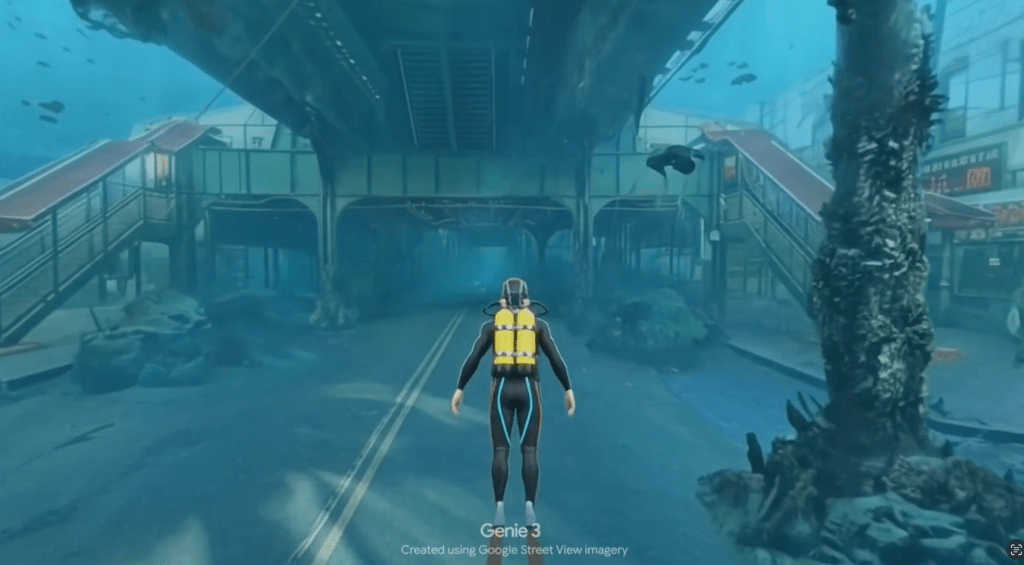
Google’s Genie Integrates with Street View to Revolutionize Virtual Exploration
Google has unveiled a groundbreaking integration between its advanced AI model, Genie, and the extensive Street View imagery, marking a significant leap in virtual environment simulation. This development, announced at the Google I/O 2026 developer conference, enables users to interactively explore real-world locations with unprecedented realism and flexibility.
Traditionally, Google Maps’ Street View has allowed users to view static images of streets and neighborhoods. With the integration of Genie, these images transform into dynamic, interactive environments. Users can now virtually navigate through streets, adjust environmental conditions such as weather, and even simulate hypothetical scenarios like natural disasters. For instance, one could experience a sunny day in typically overcast London or visualize a New York City block blanketed in snow during summer.
Jack Parker-Holder, a research scientist on DeepMind’s open-endedness team, highlighted the versatility of this integration. He explained that Genie could simulate rare events, such as sunlight reflecting off Victorian architecture in London, preparing robots for unexpected conditions. Similarly, travelers can preview destinations under different weather conditions, aiding in trip planning.
Over the past two decades, Google has amassed a vast repository of over 280 billion images across 110 countries and all seven continents through Street View. This extensive dataset, combined with Genie’s capabilities, offers a powerful tool for creating realistic simulations of real-world environments.
Genie 3, the latest iteration of Google’s world model, was released for research preview in August 2025. By January 2026, it became accessible to Google AI Ultra subscribers in the U.S., enabling users to generate interactive game worlds from text prompts or images. The primary applications envisioned for Genie include educational experiences, gaming, and robotics training.
One notable application of Genie 3 is its role in enhancing Waymo’s simulators. By training self-driving cars to handle exceedingly rare events like tornadoes or unexpected animal crossings, Genie contributes to the robustness of autonomous vehicle systems. Integrating Street View data further equips Waymo to prepare for deployments in diverse urban settings worldwide.
Unlike traditional simulators that operate from a vehicle’s perspective, Genie’s integration with Street View allows for simulations from various viewpoints, including those of pedestrians or robots. This flexibility broadens the scope of applications, from urban planning to disaster response training.
Starting today, Google is rolling out this feature to select Ultra users in the United States, with plans to expand access globally in the coming weeks. Diego Rivas, a product manager at DeepMind, emphasized the experimental nature of this integration, acknowledging ongoing efforts to enhance accuracy and realism.
Early demonstrations have showcased impressive, recognizable simulations, though they currently exhibit a video game-like quality rather than photorealism. Additionally, the models are not yet physics-aware, meaning they do not fully understand cause-and-effect relationships. For example, in a simulation of a woman running through a snowy Joshua Tree, she ran right through cacti and bushes.
Despite these limitations, the integration of Genie with Street View represents a significant step toward more immersive and interactive virtual experiences. As the technology evolves, it holds the promise of transforming how we explore and interact with the world from the comfort of our homes.