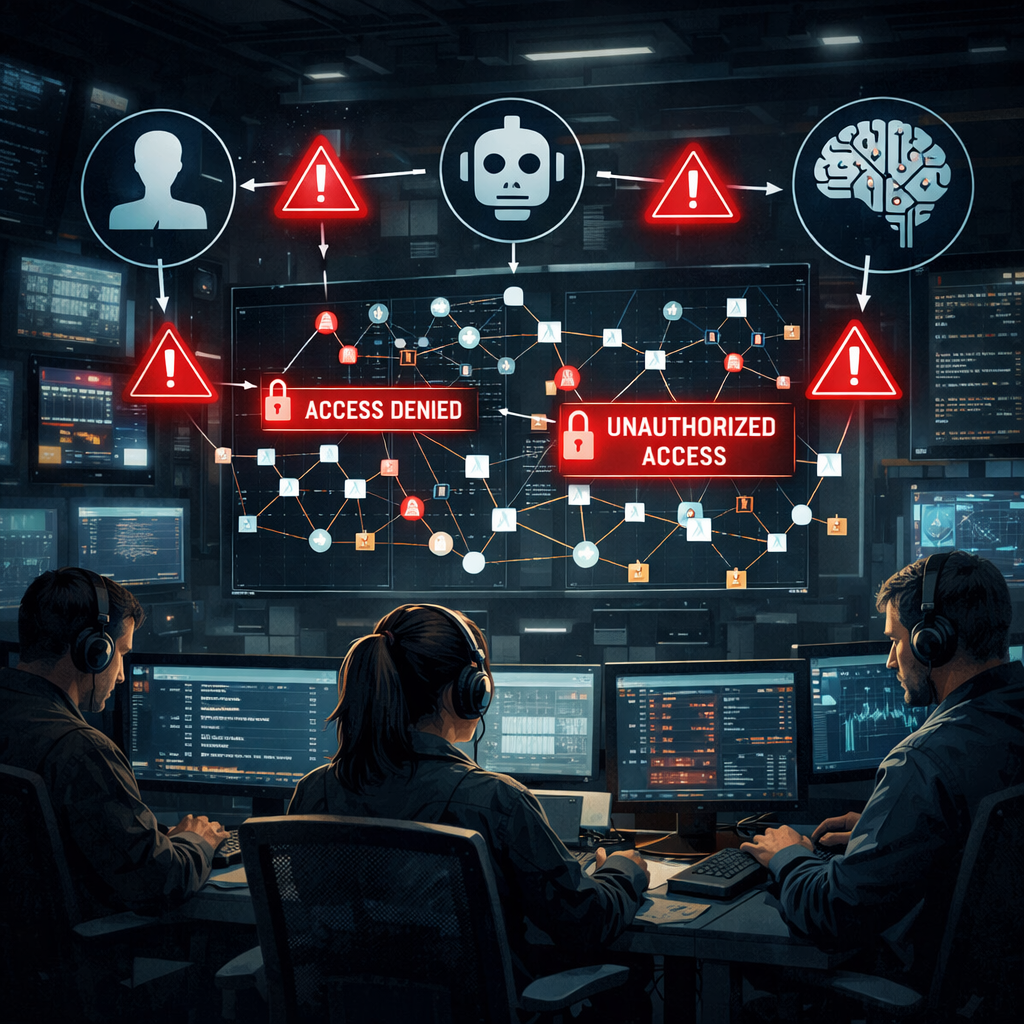
Security Operations Centers (SOCs) are drowning in alerts. Cloud environments, endpoints, AI agents—everything is monitored. But many teams hit a wall when trying to answer the crucial follow-up: who’s behind the behavior? Is it a real user, a compromised service account, or an AI agent executing tasks with broad permissions? Without that clarity, an alert is just noise.
The Identity Gap in Incident Response
IAM (Identity and Access Management) teams know which identities exist, what permissions they have, and which systems they can reach. Meanwhile, SOC teams are focused on logs, alerts, and suspicious behaviors. Yet these two functions often run in silos, with different tools, data sets, and priorities. When an alarm rings, SOC analysts may see that something odd happened—but not know what it means for security posture.
Take a breached service account, for example. You might detect strange API activity. But absent identity context, you don’t know which applications the account can access, how far an attacker might move laterally, whether disabling the account will break business operations—and ultimately, how urgent the threat is.
More Identities, More Unknowns
Traditional SOC defenses were built around real humans and physical devices. Today, identities are everywhere: automated workloads, machine identities, AI agents, long-forgotten service accounts. These can act autonomously—or under compromised credentials—with much broader reach than one might assume.
Understanding not just triggers, but ownership and permissions, makes the difference between overreacting and underpreparing. It equips teams to assess damage potential, contain threats without paralyzing operations, and avoid blind spots that attackers know all too well.
What a More Effective SOC Looks Like
An alert should come bundled with identity intelligence. That means tying SIEM or EDR alerts to information about who or what caused them—whether human, machine, or AI. It also means knowing which systems are accessible, what permissions are granted, and where lateral movement is possible.
With that in place, SOC teams can investigate much faster, calculate real risk, and respond in ways that avoid collateral damage. IAM and SOC must share workflows, agree on escalation paths, and operate with shared metrics and response playbooks. The goal isn’t more tables or more color-coded dashboards—it’s clarity.
Your organization may already have strong alerting systems and advanced SIEM/EDR tools in place. What many are missing is the context that connects the alert with the identity behind it—and hence what can be accessed, how far an attack could spread, and what’s truly at stake.
Why it matters: As service accounts proliferate, AI agents are embedded in workflows, and cloud-native identity systems scale, attackers aim where visibility is weakest. If your SOC reacts without identity context, you risk serious damage—or worse, significant disruption in the name of safety.