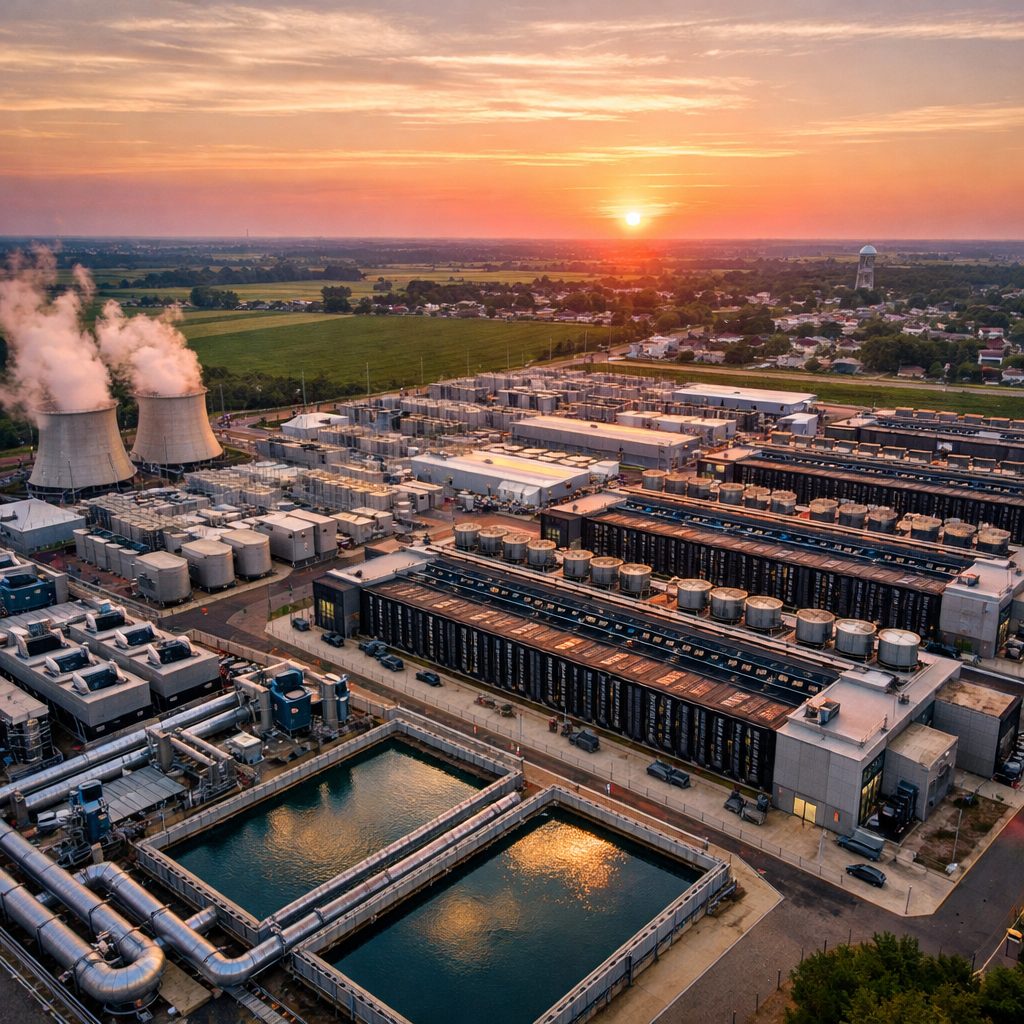
Recent years have seen hyperscale data centers — massive facilities that power everything from social media feeds to generative AI — shift from unseen infrastructure to highly visible lightning rods in tech backlash. In his book Hyperscale, journalist Paris Marx argues that these centers have become central to public anger at Big Tech because of their very real, tangible impact on communities and the environment. What was once abstract computing power now manifests in strained water supplies, booming energy demands and vocal opposition at local levels.
What’s fueling the backlash?
Several communities across the globe have already sounded alarms about what data centers demand – and demand they do. In Ireland, these facilities now consume over 20% of the country’s electricity, prompting grid operators to halt new data center connections around Dublin back in 2022. In Chile’s capital region, data centers developed by giants like Microsoft and Google have sparked protests over water shortages. And in The Dalles, Oregon, Google found itself in hot water when it used almost a third of the city’s available water supply, leading to lawsuits and public uproar.
These local impacts are further magnified by how hyperscale tech has grown post-generative AI’s rise. Enormous compute demand has transformed what were once sparse clusters into sprawling, grid-straining facilities. Marx sees that growth as unsustainable — not just environmentally, but socially. Data centers aren’t some distant back-end—they affect noise, power bills, water access, and visual landscape. Politicians from across the spectrum are responding, making this a rare point of bipartisan anger.
How tech responds — and where critics say solutions fall short
One response has been transparency. Major firms like Amazon, Microsoft, and OpenAI have pledged to stop using nondisclosure agreements when negotiating with local governments. The goal is to give communities more say and information over what’s being built in their midst. Companies are also pledging to pay for infrastructure like power substations, shift to closed-loop water cooling systems, and embrace alternatives to evaporative cooling to reduce water consumption.
Still, critics say many solutions dodge bigger issues. Closed-loop systems, while better for water use, often rely on more electricity — yet firms don’t often address the tradeoff. Local communities express concern that coolant chemicals used in such systems could leak. And claims of renewable energy offsetting emissions or that water usage is marginal — especially compared to agriculture or golf courses — are seen by some as attempts to grandstand rather than truly shift practices.
Marx draws distinction between scale and intent. While data centers themselves aren’t inherently bad, their rapid proliferation — the kind required by hyperscale infrastructures driving AI — brings pressures on resources, on climate, and on equity. And yet many of the promised public benefits of generative AI have yet to materialize. Profit and ambition often seem ahead of societal or ecological payoff.
You don’t have to be a tech critic to feel the effects. When a center lands in your district, you’ll hear the fans, see the cooling towers, get a higher utility bill, maybe even lose access to water. That is what is hard to ignore. It bridges political divides. It’s material.
Though Big Tech has shifted rhetoric and made some policy adjustments, the trajectory of hyperscale build-out continues. The environmental strains and social grievances now form a pattern across continents.
Why this matters, what to watch: The building surge of hyperscale data centers reveals a tension between digital ambition and physical consequence. What communities demand now — accountability, sustainability, and democratic control over infrastructure — could reshape how we build AI’s backbone. As elections and regulatory power lean more toward oversight, the success or failure of Big Tech’s response may determine whether hyperscale becomes a legacy of ruin or a model reimagined.