This week’s cybersecurity landscape underscores the persistent threats targeting both legacy systems and modern technologies. Notably, attackers are leveraging longstanding vulnerabilities alongside advanced AI-driven techniques to compromise systems.
Certighost: Active Directory Certificate Services Vulnerability
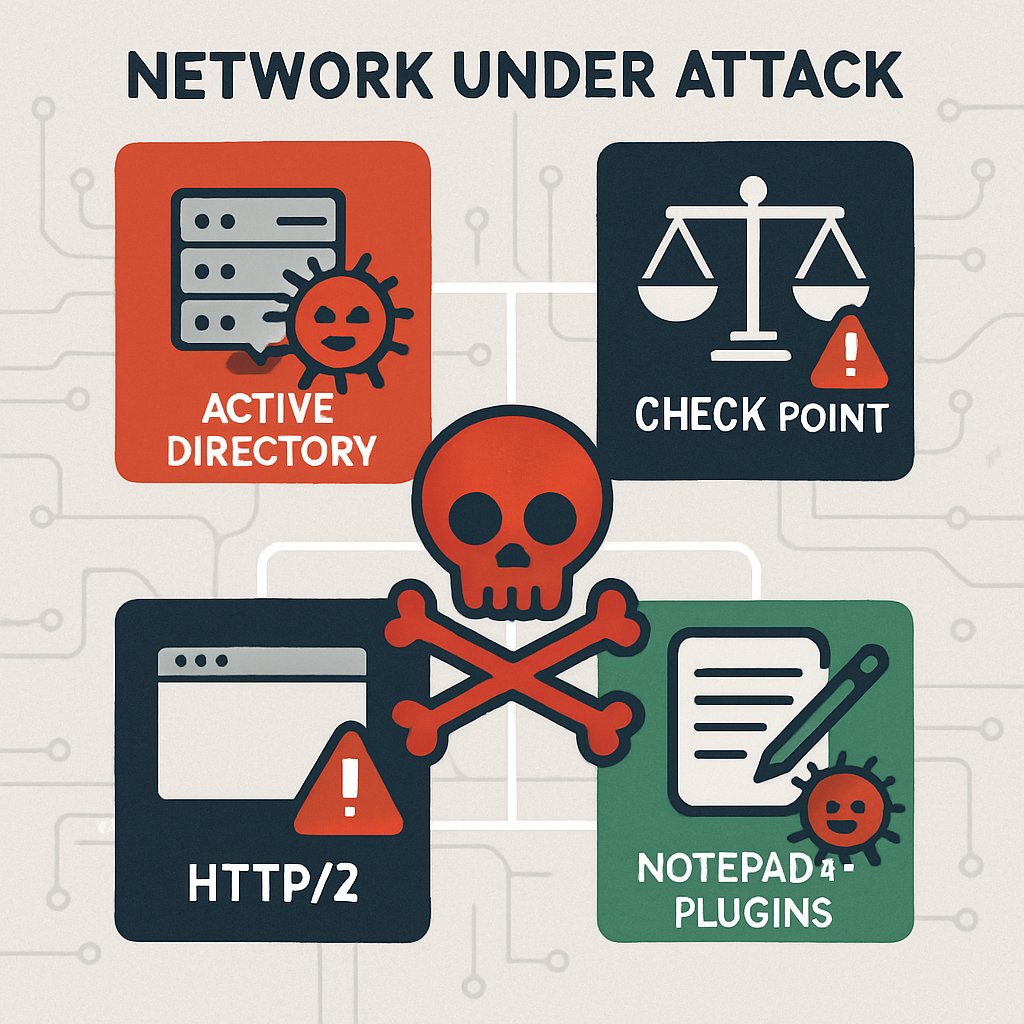
A critical flaw, identified as CVE-2026-54121 and dubbed ‘Certighost,’ has been discovered in Active Directory Certificate Services. This vulnerability allows low-privilege domain users to impersonate Domain Controllers, potentially leading to full domain control. The issue arises from the certificate enrollment process, where the Certificate Authority (CA) trusts an attacker-supplied host without proper verification. Microsoft has addressed this flaw in its July 2026 updates by introducing a validation function. Organizations unable to apply the patch immediately can mitigate the risk by disabling the vulnerable chase fallback via the ‘EDITF_ENABLECHASECLIENTDC’ setting.
Check Point Authentication Flaw Under Active Exploitation
The Cybersecurity and Infrastructure Security Agency (CISA) has issued an urgent alert regarding CVE-2026-16232, a critical authentication vulnerability in Check Point’s SmartConsole, Security Management, and Multi-Domain Management platforms. This flaw enables unauthenticated remote attackers to obtain application login tokens, granting full administrative access and bypassing standard authentication mechanisms. Exploitation is particularly concerning for systems with management interfaces exposed to the internet without IP restrictions. Check Point has released a Jumbo Hotfix on July 22, 2026, to address this issue. Organizations are advised to restrict SmartConsole access to trusted IPs and apply the hotfix promptly.
HTTP/2 Vulnerability Facilitates Server Crashes
Researchers have identified a series of denial-of-service vulnerabilities in the HTTP/2 protocol, tracked as CVE-2026-44909, CVE-2026-59173, and CVE-2026-59762. These flaws allow unauthenticated attackers to crash servers by manipulating flow-control parameters, such as setting ‘SETTINGS_INITIAL_WINDOW_SIZE’ to zero or withholding ‘WINDOW_UPDATE’ frames, leading to memory exhaustion. Affected vendors include Apache Traffic Server, Citrix, F5 Networks, Meta, Red Hat, SUSE, and Yahoo. To mitigate these risks, organizations should enforce strict memory limits for buffered responses, cap concurrent streams per connection, and terminate connections exhibiting stalled flow-control behavior.
Notepad++ Plugins Exploited for System Compromise
Ukraine’s CERT-UA has uncovered a campaign by the UAC-0099 threat cluster, which hijacks legitimate Notepad++ plugins through phishing emails containing double-extension VBS scripts disguised as PDFs. These scripts deploy a trojanized ‘NppExport.dll’ that loads silently upon launching Notepad++, leading to system compromise. The malicious DLL initiates a loader chain that establishes persistence and downloads additional payloads. Administrators are urged to update to Notepad++ 8.9.7, WinRAR 7.23, and 7-Zip 26.02, and to monitor for unauthorized DLLs in plugin directories.
These incidents highlight the evolving nature of cyber threats, where attackers exploit both longstanding vulnerabilities and modern technologies. Organizations must remain vigilant, regularly update systems, and implement robust security measures to defend against such multifaceted attacks.