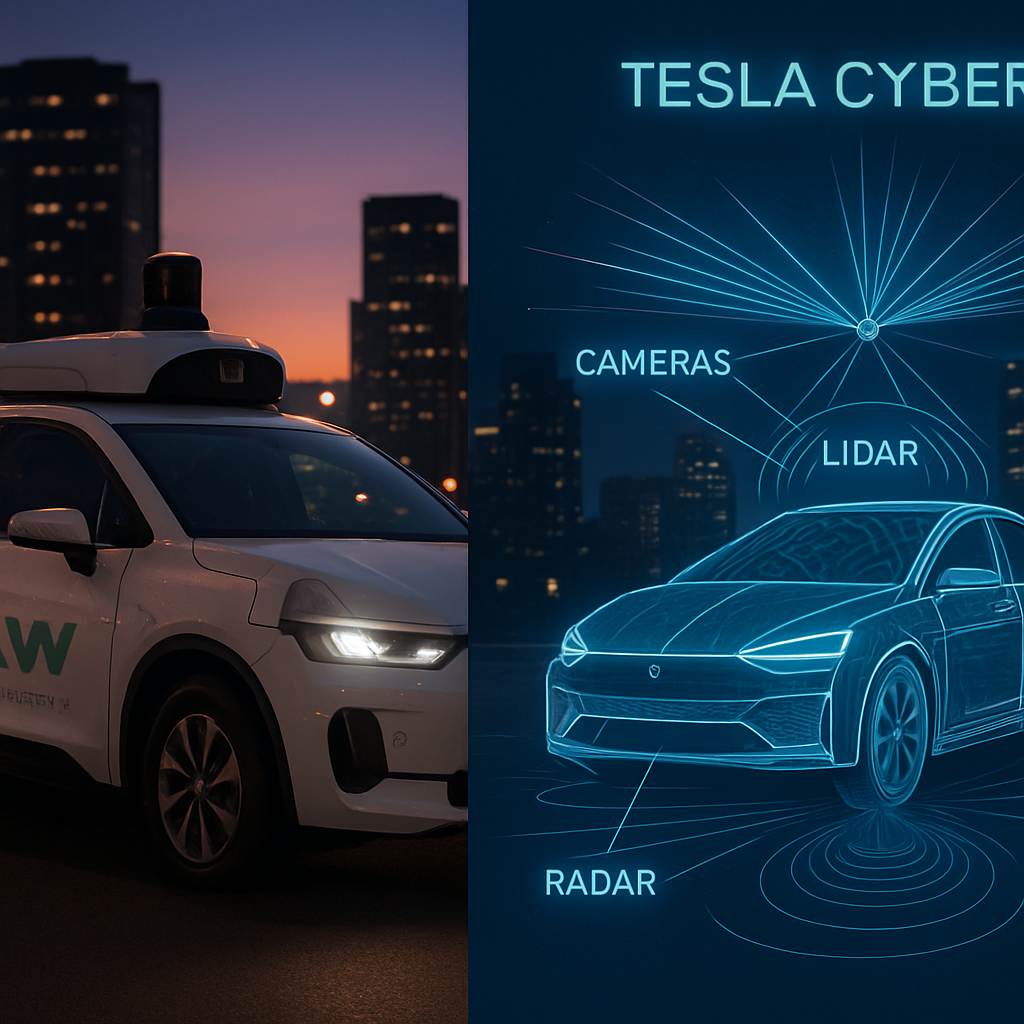
Waymo is making pointed critiques in the lead-up to Tesla’s expected unveiling of its Cybercab robotaxi on September 3. In recent announcements and interviews, the Alphabet-owned company challenged Tesla’s reliance on a “pure end-to-end” AI model using only cameras, arguing that safe and scalable fully autonomous driving requires a multi-sensor approach.
In a blog post, Waymo’s VP for driving software emphasized that after more than 200 million miles of real-world driving, it’s clear that cameras alone cannot deliver the redundancy and reliability needed for wide-scale autonomy. The company maintains that a combination of cameras, radar, and lidar yields a richer, more robust understanding of driving environments. The so-called end-to-end neural network model — where raw camera pixels feed directly into steering commands — remains Tesla’s chosen path and, according to Waymo, carries risks tied to unpredictable failures.
What Tesla’s Cybercab Brings to the Table
Tesla has been developing the Cybercab, a purpose-built two-seat gold sedan designed for driver-free operation. Distinctively, it omits steering wheel and pedals, embodying Tesla’s commitment to an AI-only vision of autonomy. According to recent regulatory filings, Tesla is aiming to build over 125,000 Cybercabs annually. Though it has trialed robotaxi operations using modified Model Y SUVs in several cities, full autonomy with Cybercab still awaits regulatory and technical validation.
Waymo’s Current Position & Market Strategy
Waymo, by contrast, has built out a sizeable robotaxi fleet—around 4,000 active vehicles across 14 U.S. cities—providing approximately 500,000 rides each week. Through its model, Waymo equips vehicles built by other manufacturers with a full sensor suite (cameras, lidar, radar), a strategy that results in higher upfront costs. For example, some of its robotaxis — like the Zeekr-made Ojai — involve import tariffs before autonomous systems are even installed.
Besides sensor tech, Waymo faces pressure from Tesla on cost and production. Where Waymo’s approach tends to be more hardware-intensive and capital heavy, Tesla develops its vehicles in-house and hopes that a camera-centric system will yield economical scalability. If Tesla succeeds, it could challenge Waymo’s dominance on price as well as shift expectations for what robotaxi systems require.
Finally, in addition to its critiques, Waymo announced three new U.S. markets this week, expanding the reach of its robotaxi network. It’s a clear signal that Waymo intends not just to debate the best technical path, but to hold ground and widen its competitive lead as Tesla prepares to launch Cybercab.
What this means: This clash between Waymo and Tesla isn’t just about different engineering philosophies—it’s defining the future of robotaxi norms. If Tesla’s Cybercab can prove reliable and safe using cameras alone, it could force rivals to reconsider high-sensor stack strategies, accelerating innovation around AI interpretability and cost efficiency. But until results emerge, Waymo’s data-driven caution may keep it ahead in both public trust and operational safety. Observers should watch closely how Cybercab performs in its trials, how regulators respond, and whether safety edge cases like harsh weather or complex road scenes expose the vulnerability of end-to-end systems.