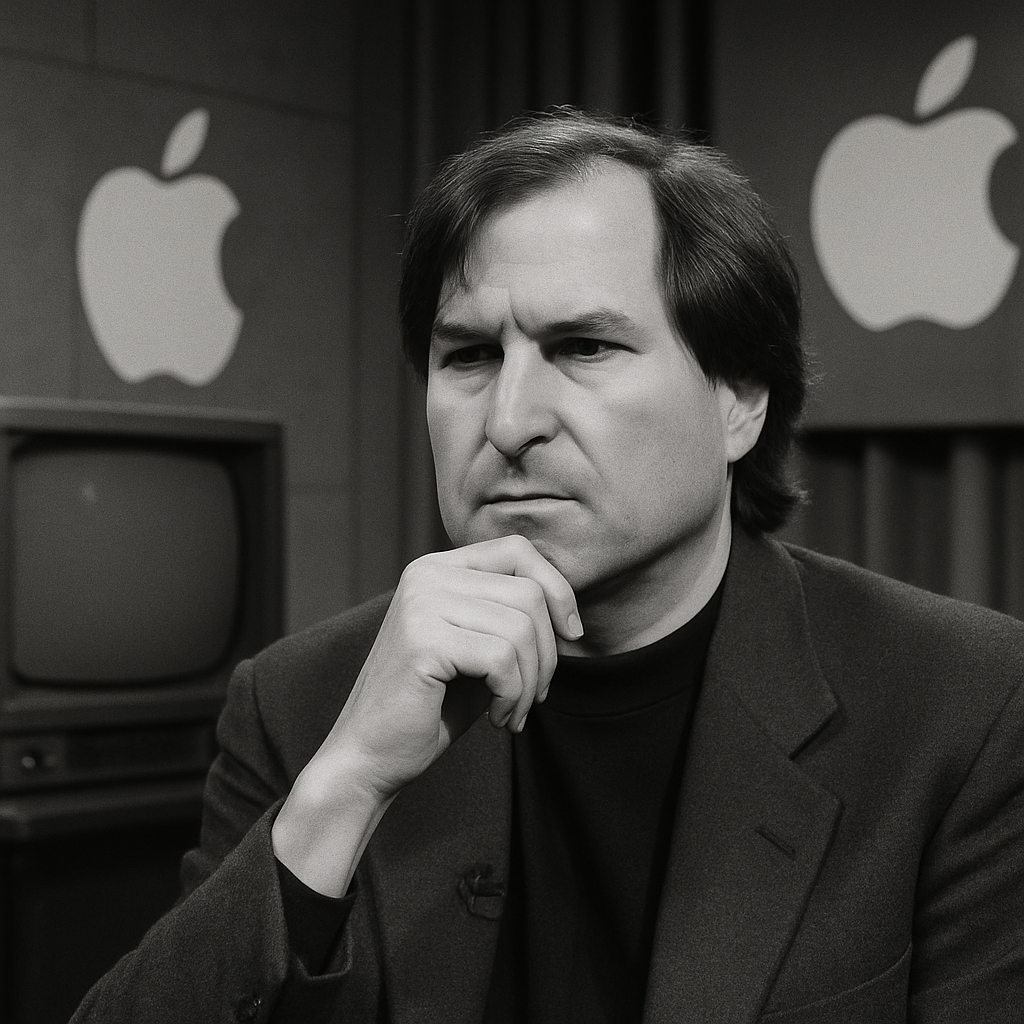
In a vintage TV interview from 1996 — nearly two years before Steve Jobs officially rejoined Apple — he expressed a rare blend of realism and optimism about the company’s future. This appearance on Maryland Public Television’s “Wall Street Week with Louis Rukeyser” shows Jobs acknowledging Apple was in trouble, but adamant that innovation, not cost-cutting, was the path forward. He rejected the notion of tearing everything down to save the company, arguing instead that the spirit of creativity that once drove Apple could lead it back from the brink.
At the time, Apple was facing deep instability: dwindling sales, product misfires, escalating costs, and a murky path ahead. Jobs reaffirmed his belief that Apple still had potential, insisting the company should rely on innovation — the kind that defined its early successes — rather than taking drastic measures like layoffs or slashing budgets. His message was simple: regain greatness by creating something compelling.
From Near Collapse to Renaissance
This moment came during a period when Apple was widely mocked in the tech press as being on life support. It wasn’t just about software bugs or dips in market share. The entire identity of Apple — its design culture, product pipeline, and visionary messaging — seemed fragmented. Jobs’ return in 1997 and his subsequent decisions, including the cancellation of many projects, partnership with Microsoft, and the launch of products like the iMac, pulled the company back into relevance and, ultimately, dominance.
Looking ahead from 1996, Jobs saw a different metric for recovery: bold ideas over recursive cuts. His conviction that innovation could restore Apple’s status foreshadowed the shift in its direction under his renewed leadership. Rather than reorganizing purely to save costs, he believed that products people loved, groundbreaking user experience, and daring design were the engine for real recovery.
Why This Matters Now
With today’s Apple also at a crossroads — new CEO, evolving strategy, market pressures — Jobs’ 1996 mindset offers more than nostalgia. It’s a reminder that even the most iconic companies can drift, but also that the core of what made them great cannot be sidelined. Apple’s recent years have seen both innovation and incrementalism: Vision Pro, generative AI, hardware refresh cycles — all mixed with debates over focus and identity.
If Apple is going to make its next leap — whether in AI, augmented reality, or elsewhere — the lesson from Jobs is clear: investment in bold ideas might be messy, risky, and expensive, but it can also define the company’s legacy. The question now is whether today’s leadership can channel that spirit — prioritize breakthrough creativity over safe operations — because in the long run, that kind of courage may be the difference between holding on to greatness and merely coasting on it.