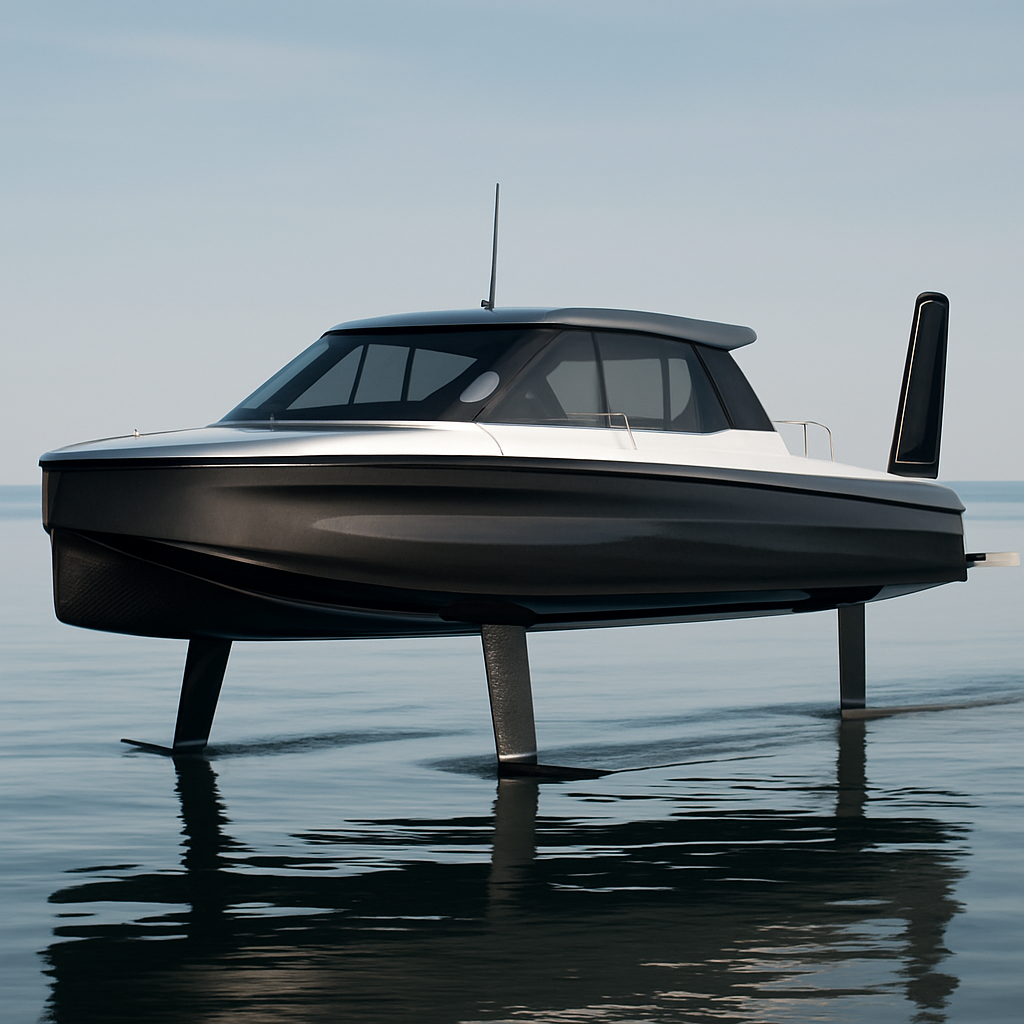
Vessev has launched a breakthrough electric hydrofoil ferry, dubbed the VS-9, that lifts its hull above the waves to significantly cut drag and improve efficiency. During a recent test ride from Brooklyn Marina toward Governors Island, the 30-foot catamaran hovered above the surface with minimal wake, offering a ride that was less “flying” and more eerily smooth—akin to a high-end sports car gliding over water.
What is the VS-9 and how does it work?
The VS-9 resembles a typical catamaran at first glance, but underneath its hull lies a pair of hydrofoil wings that do the lifting. Computer-controlled flaps adjust in real time to stabilize pitch, roll and ride height. The front foil takes most of the load, while a rear foil—housing Vessev’s own electric motor—handles about 20% of lift and allows for shallow-pier dock access when retracted.
The hull and foils are made from carbon fibre composite, helping keep weight light and strength high. Lifted on its foils, the ferry becomes much more efficient—a crucial advantage for electric propulsion where every kilowatt-hour counts. Ride transition, from when hull meets foil, is subtle yet transformative: the vessel quietly rises, hull clears the water, and drag drops.
Performance, capabilities, and trade-offs
When fully laden, the VS-9 can cruise 40 nautical miles; in lighter conditions, range extends to 50 NM. Cruise speed is 25 knots, with top speed around 30 knots. The vessel is rated to foil comfortably in wave heights up to 0.75 meters (about 2.5 feet) before performance begins to degrade. Its battery setup is roughly 105 kWh, and charging supports both AC and DC shore power; DC charging can enable about 0.8 NM of foiling range per minute.
It seats up to ten passengers with a skipper, and payload capacity reaches around 1,000 kilograms. Fully retractable foils help it dock in shallow waters or beached where necessary. Certification has already been obtained from Maritime New Zealand, and the design follows commercial standards including DNV guidelines.
Business move: scaling, markets, and deployment
Vessev raised US$19 million in a Series A round to expand production, software controls, and global reach—including plans for manufacturing operations in the U.S. The company has already logged over 11,000 nautical miles of testing and has its first American customer: FlyTahoe. That operator plans to use the VS-9 for a sustainable transit network on Lake Tahoe, slashing travel times across the region.
Other early markets include urban water transit in places like New York City, where routes between boroughs could leverage existing piers and infrastructure rather than building new terminals. Tourism, charters, and hospitality are also early adopters; some vessels are being marketed to high-net-worth individuals interested in premium watercraft, in addition to operators focused on zero-emission transit.
Vessev has multiple configurations of the VS-9 (Hardtop, Skye, Cabin, Premier) to serve different climates and use-cases. As for future models, the startup has aspirations for a larger, 100-passenger hydrofoil (the VS-18) to step into commuter ferry territory.
Challenges and where it fits in
Hydrofoils shine in calmer, protected water—rivers, bays, lakes—but wave heights above 0.75 meters reduce efficiency and comfort when the hull makes contact. Battery weight and energy density still impose limits on how far and how long electric vessels can go before needing recharge. Charging infrastructure, pier access, and regulations also remain hurdles for scaling operations globally.
With urban transit systems under pressure to cut emissions, electric boats like the VS-9 present a promising alternative. Their low wake design helps environmental goals around shoreline erosion and noise; their efficiency helps lower operational costs. For any city with waterways and waterways adjacent communities, hydrofoil electric vessels could reshape commuting and leisure transport.
What to watch: whether the VS-9 can transition from standout prototype to dependable service in more challenging waters; whether exterior infrastructure can keep up (docks, charging); how cost-competitive it becomes against diesel ferries and other electric vessels; and whether Vessev meets its goal of delivering a unit every five weeks in 2027. Ultimately, the real test is scaling up without losing the ride-quality or environmental benefits that make the VS-9 stand out.