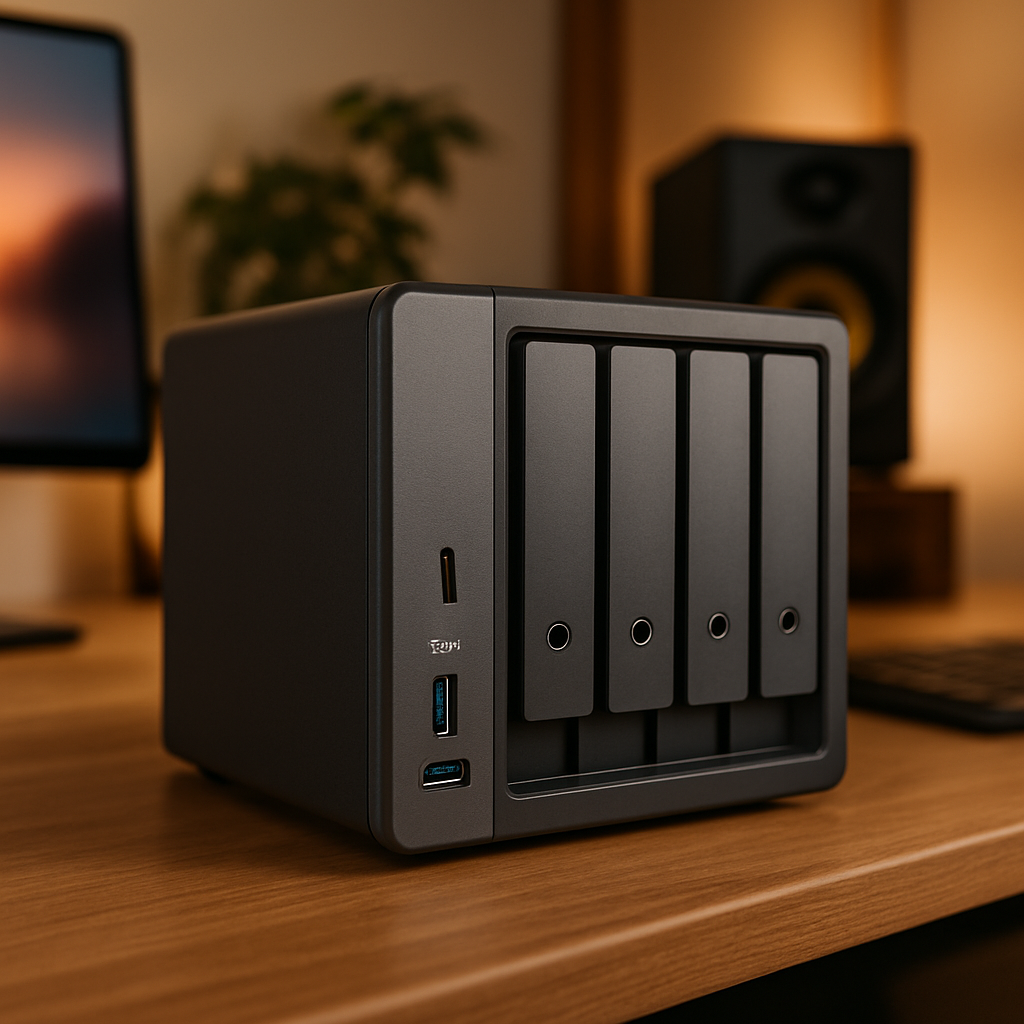
uGreen’s NASync DXP4800 Pro emerges as a compelling mid-range NAS solution for creators and small teams plugged into the Apple ecosystem. Priced around $680, it blends strong hardware specs, flexible software, and dual 10Gb Ethernet ports to offer performance that punches well above its tier — especially when you’re looking to cut back on cloud costs and bring storage home.
What you get under the hood
The DXP4800 Pro is a four-bay NAS that includes a six-core Intel Core i3-1315U CPU with two performance and four efficiency cores, paired with 8GB DDR5 memory by default. There are two SODIMM slots available to take that up to 96GB. Storage options are generous: four SATA drives (up to 32TB each), plus two M.2 NVMe slots (8TB each) that can also serve as cache. All told, the system can hold up to 144TB of storage. RAID options cover everything from JBOD to RAID-10, depending on your PRIORITY in speed vs reliability.
Ports, connectivity & design notes
On the connectivity front, the standout is one 10GbE port along with a 2.5GbE port out back. That 10GbE jack alone puts it ahead of many NAS in this price class. You’ll find a useful array of front-facing ports — USB-C and USB-A (both 10Gbps), and an SD card slot — for quick file imports. On the back there’s more USB-A, a 4K60 HDMI port, and surprisingly no Thunderbolt or a PCIe expansion slot — something you’ll need to move up to uGreen’s bigger units to get. Drive trays are tool-less and hot-swappable; design is functional though loud fans under load are a tradeoff.
Performance, power draw & usability
This NAS handles resource-heavy tasks like Docker, virtual machines, and media processing reasonably well thanks to the Core i3 and compatibility with Intel Quick Sync for hardware acceleration (Plex, Jellyfin, etc.). Testing saw CPU scores in Geekbench 7 reach ~1,932 (single-core) and ~6,383 (multi-core) — solid for its class, though lower than Apple’s own Mac mini models. When taxed fully, power consumption jumped to about 140 watts, and fan noise hit ~49 dBA — tolerable in a closet or server rack, less so on your desk or in quiet environments.
Software & Apple-friendly features
The device ships with UGOS Pro, a mature NAS operating system with image/scene recognition, semantic search, and media/photo apps built-in. For those heavily invested in the Apple ecosystem, Time Machine backups are supported (after following uGreen’s setup guides). Another win: you’re not locked into UGOS Pro — you can swap in TrueNAS or Unraid if you want. There are also the usual suspects: media hosting, Docker support, BitTorrent tools, and photo libraries. No subscription required.
Pros:
- Ceiling of 96GB RAM and Intel Core i3 makes it capable under load.
- Dual 10Gb+ Ethernet ports at this price are rare.
- NVMe slots for caching or fast storage increase performance significantly.
Cons:
- Power draw and fan noise under full load are substantial.
- No PCIe slot or Thunderbolt 4 means less expandability for some users.
- Performance won’t rival modern Apple Silicon machines.
Overall, the DXP4800 Pro lands squarely in the upper-mid range of uGreen’s four-bay lineup. If you can stock it with fast drives, throw in a 10Gb-capable network, and don’t mind a bit of fan roar, it’s a powerful way to run your media server, VMs, or Docker workloads under one roof, while keeping control over your storage rather than submitting to monthly cloud fees.
For Apple households especially, Time Machine compatibility and fast network ports are the deciding features. Just know what you’re getting into with the noise and power under sustained usage. For many creators, though, this could well be the sweet spot: high capability without bleeding budget.
Why this matters: In a market where cloud costs keep climbing and data privacy concerns grow, a NAS like this offers creators and small teams a chance to own storage and performance. Watch closely for whether future models tame the power-consumption and noise issues — and whether 2027 sees the RAM ceiling and hardware pricing evolve as promised.