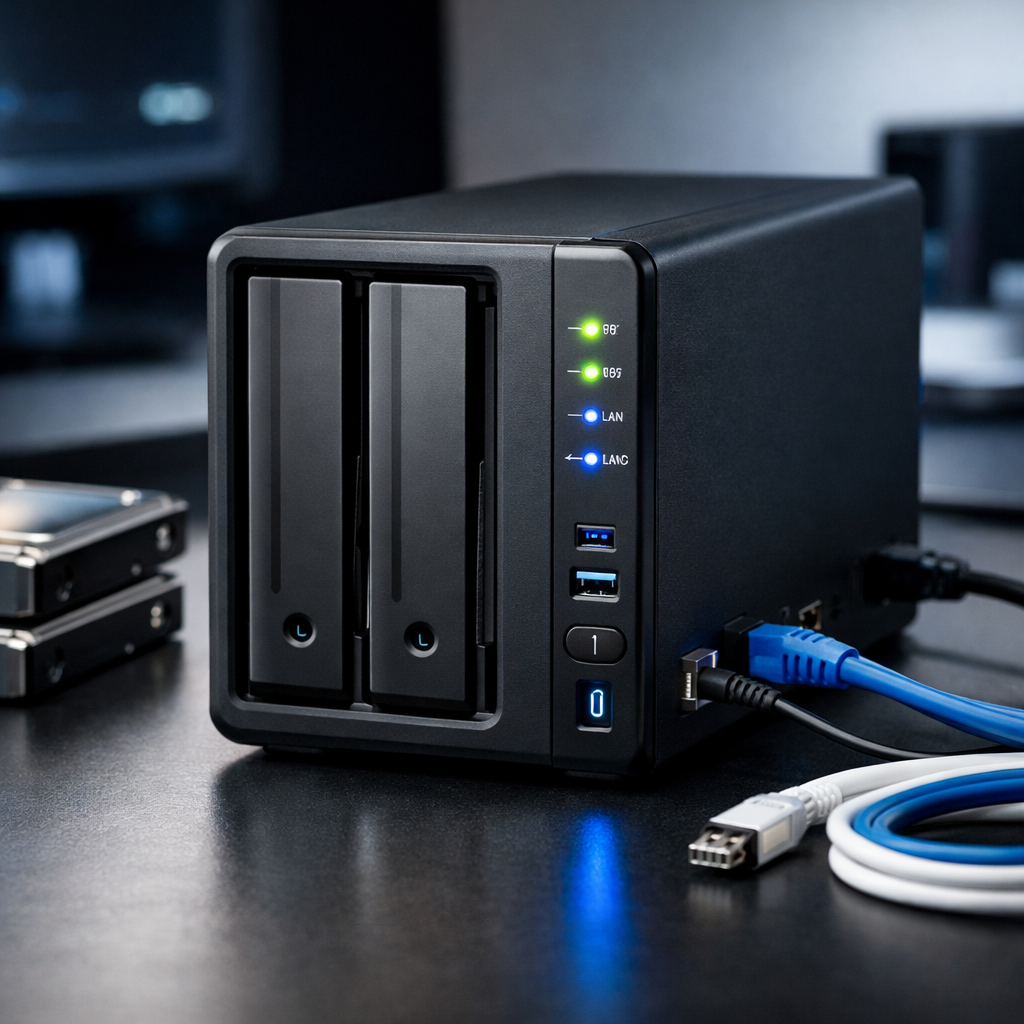
Ugreen’s NASync DXP2800 GT brings 10-gigabit Ethernet to a compact two-bay NAS for around $500, delivering higher speed where many similar devices stick with 2.5-Gbps networking. It’s a focused solution ideal for backup, shared file storage, or media tasks—not for heavy virtualization or large-scale expansion.
Hardware That Punches Above Its Size
At its core, Ugreen equips the DXP2800 GT with an AMD Ryzen Embedded R2514 CPU: four cores, eight threads, clocking up to 3.7GHz. That lets it handle multiple users or tasks without choking under load. It starts with 8GB DDR4 RAM—expandable to 64GB—with optional ECC support, a rarity at this price point. Cooling is handled by a single hydraulic fan behind a magnetic dust filter; rated at 29-34dB, it stays relatively quiet even under load.
Storage-wise, the unit packs two SATA bays (compatible with U.2 NVMe drives in place of SATA), plus two M.2 NVMe slots. Fully populated, that adds up to a theoretical 80TB of raw storage (with two 32TB HDDs and two 8TB SSDs). RAID flexibility is limited to JBOD, Basic, RAID 0, and RAID 1—so redundancy is slim once you factor in usable space in mirrored setups.
Other hardware highlights include a 4K60 HDMI output, a front-mounted USB-C and USB-A at 10Gbps each, additional USB-A ports in the rear (10Gbps and 5Gbps), and all running on UGOS via a dedicated internal 64GB drive—freeing the bays for data. The price tag without disks sits at $509.99.
Where It Excels—and Where It Comes Up Short
The standout feature is the 10GbE RJ-45 port. It’s rare to find that speed in a small two-bay NAS at this price. In environments with compatible networking—like modern Wi-Fi 7 routers with 10-gigabit ports—the performance boost for large file transfers or streaming video is noticeable. The two spindle-based drives won’t fully saturate the 10Gb link, which is where those M.2 slots really show their value.
Processing power is modest. Benchmarks show strong single and multithread performance compared to basic backup boxes, but nowhere near what even Apple’s Mac mini line offers. The device handles tasks like surveillance, pet recognition, video playback, and Docker containers—though its processor limits what Docker-heavy workflows can do.
The trade-offs largely come down to expansion and redundancy. With only two bays, growth is constrained. If you mirror for safety, one bay’s storage is always taken. RAID options are basic; there’s no sophisticated tiering or multi-bay flexibility. Power consumption peaks around 42W, or drops to 18W in hibernation—reasonable, but external drives will be needed to expand storage later.
Good Choice for Certain Use Cases
This NAS shines for small offices needing fast shared storage, or individuals who want a backup box or offsite mirror with reliable performance. It’s overkill for simple single-user backup over USB, but an underpowered workhorse compared to high-end servers.
One of its best values happens right now: Ugreen and Amazon list the DXP2800 GT at about $350 during a Black Friday sale—a sharp drop from the standard $509.99. A good deal for buyers who already have fast drives or intend to invest in them.
Bottom Line
With its Ryzen CPU, ECC memory support, dual NVMe slots, and especially the 10GbE port, the DXP2800 GT is more than most basic NAS boxes. It’s a lean, focused solution rather than a full-feature server. For around $500, and especially near $350 during sales, it offers great return for those with the right networking.
What this means is that for users looking to modernize their backup or storage setup without paying premium prices, the DXP2800 GT is a sweet spot. Watch for deals now, ensure your network can use 10-gigabit speeds, and accept its modest expansion and redundancy limits. If you want major scalability, this isn’t your long-term platform—but as a fast, dependable middle tier, it hits the target well.